

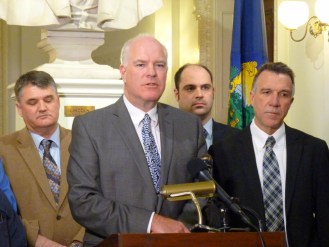
But the Senate minority leader told the House Republican caucus Tuesday that he voted for the measure in order to secure “concessions” that make it more palatable to him.
“I looked at the committee votes. It was four to one, me being the one, and I started to think ‘perhaps there’s a way to get some concessions if I fall on my sword,’” Benning said.
He ran that idea by House Minority Leader Don Turner, R-Milton, and the leaders of two gun rights groups Evan Hughes, with the Vermont Federation of Sportsmen’s Clubs, and Ed Cutler, with Gun Owners of Vermont, who were generally supportive of his plan, Benning said.

The Senate Judiciary Committee had already decided not to take up S.31, the gun legislation introduced by a trio of top Democrats at the start of the session, because it contained a provision requiring universal background checks for all gun sales — something committee chair Sen. Dick Sears, D-Bennington, strongly opposes.
The bill Judiciary began to draft, now S.141, had two primary components. One allows state-level prosecutors to enforce federal laws that make it a felony for a person convicted of certain crimes to own a gun.
Benning prevailed on the committee to make the penalty under Vermont law a misdemeanor. He also told House Republicans that he pushed to narrow the listed crimes, citing marijuana possession, lewd and lascivious conduct as well as driving under the influence as examples of crimes he was able to have removed from the bill.
Sen. Tim Ashe, D/P, Chittenden, stated his preference for keeping all the federally listed crimes during debate last week, but Sen. Alice Nitka, D-Windsor, pushed for motor vehicle crimes to be removed, and the other committee members were generally receptive to Benning’s changes.
Both Nitka and Sears rejected Benning’s characterization of the changes as “concessions.”
Sears called them “adjustments” that the committee was willing to make in order to reach consensus. It was important to Sears to have a “yes” vote from the only Republican on his committee, but there was never any “quid pro quo” agreement to garner Benning’s vote, he said.
The bill’s other main component requires Vermont to report people with mental illness found to be dangerous by a court be reported to the FBI background check database of people prohibited from owning guns.
Here again, Benning told Republicans he was able to win concessions for his vote in favor of the bill. The legislation includes a legal process for people to petition the court in order to have their right to own guns reinstated. That provision originally required an affidavit from a psychiatrist saying the person is no longer a threat.
“I don’t know if any of you have been to court and tried to get a psychiatrist to say something like that, but it’s never going to happen,” Benning told his Republican colleagues Tuesday.
Sears said the committee as a whole was concerned about the reinstatement process, and included Benning’s proposed change because they respect his input and legal experience as a longtime defense attorney.
The committee also agreed to reduce the waiting period before someone can file for reinstatement from five years to three years. Benning says the provision is arbitrary, and doesn’t address the merits of any particular case.
Sears and the committee agreed to take further testimony on the waiting period, which is scheduled for Wednesday morning. If the committee is swayed, it could offer a floor amendment when the bill reaches the Senate floor.
But the most “important” concession Benning said he negotiated was from a senator who is not on the Judiciary Committee. Benning told the House Republicans that before voting “yes” he approached Sen. Philip Baruth, D-Chittenden, a sponsor of S.31, the gun bill that included universal background checks.
Benning said Baruth agreed not to introduce an amendment on the Senate floor to bring back the background check provision from his original bill in exchange for Benning’s “yes” vote in committee. Further, Benning said Baruth, the majority leader, agreed to try and dissuade members of his caucus from doing the same.
Baruth disagreed with Benning’s assessment of their conversation. In an interview on Tuesday night, Baruth said he told Benning there was no committee support for the background check provision, and for that reason he would not bring an amendment to the floor of the Senate. In addition, Baruth said, he didn’t know of anyone else in the Senate who would do so since S.31 was killed by judiciary committee several weeks ago.
Several House Republicans said they respected Benning’s strategy, but they couldn’t support S.141 as crafted by Senate Judiciary. Benning said he understood and is reserving his right to vote “no” if the Senate tinkers with the bill when its on the floor.
That’s something Sears said he’d rather not see happen, because he’d like to be able to include Benning, a strong opponent of universal background checks, on a potential conference committee between the two chambers. That’s because Sears sees the possibility of the heavily Democratic House adding universal background checks back into the bill, he said.
But if Benning votes “no” on the Senate floor, that precludes him from being appointed to the conference committee, Sears said.
S.141 is likely to see a floor vote Thursday or Friday.
Editor’s note: This story was updated at 10:06 p.m. March 17 with information from Baruth.

