

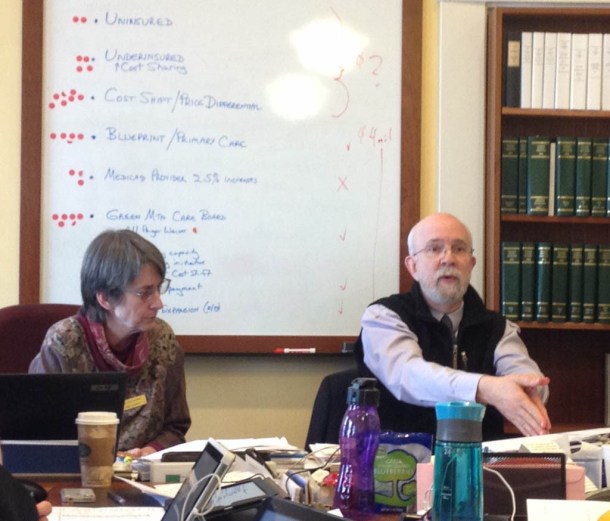
[T]he House Health Care Committee plans to pass a health care reform package by the end of the week, according to its chair, Rep. Bill Lippert, D-Hinesburg.
A major question for the committee early in the session was how much money would be available to fund their initiatives, and while that’s still murky, Lippert said that House Speaker Rep. Shap Smith, D-Morristown, advised him to build a package that uses $20 million in state money.
The committee has identified its top priorities, and Lippert has melded them into a proposal that roughly aligns with what was laid out by Gov. Peter Shumlin in his budget address, though there are differences.
For instance, Lippert more than doubles the amount of money Shumlin proposed for increased cost-sharing subsidies in exchange health plans, because his committee feels strongly that affordability is a barrier to accessing medical care and getting coverage in the first place. At the same time, he reduces the amount of money invested in easing the Medicaid cost shift. That investment is crucial to the governor’s plan to reduce premium growth by 5 percent, but it also relies on money from a 0.7 percent payroll tax that hasn’t been well received by lawmakers.
Robin Lunge, Shumlin’s director of Health Care Reform, said she is encouraged by the overlap between Lippert’s proposal and the governor’s, but it’s too early in the process to weigh in on whether reducing the money invested in shrinking the Medicaid cost shift would scuttle the premium reduction goal.
The highlights of Lippert’s proposal include:
• $4.2 million for cost sharing subsidies. Shumlin’s budget included $2 million. Cost sharing subsidies reduce the out-of-pocket costs, such as co-pays, coinsurance and deductibles for people with exchange plans who are income eligible.
• $7.2 million to address the Medicaid cost shift by increasing the rates it pays doctors and hospitals. Lippert’s proposal restores a bump in primary care payments that sunset as part of the Affordable Care Act, because the increasing access to primary care was a consensus priority for the committee. That’s far less than the $11.6 million in Shumlin’s budget These figures are just for fiscal year 2016, and would roughly double on an annualized basis, because they take effect in January, halfway through the budget year. They’re also just the state’s portion and don’t include the federal match.
• $2 million for increasing payments for providers who participate in the state’s Blueprint for Health managed care program. The Blueprint is credited with reducing costs by limiting ER visits and hospitalizations, but its payments haven’t increased in the past five years, and medical practices are saying participation is becoming a financial burden. Shumlin’s budget calls for the same investment.
• Restores $40,000 in funding for the Office of the Health Care Advocate. While it’s a small sum, Lippert said, it was important to the committee, which values the Legal Aid project’s consumer watchdog role.
• $2.5 million to increase grant funding through Vermont’s Medicaid global commitment waiver for designated agencies, which provide mental health, disability and substance abuse services — also in Shumlin’s budget.
• $560,000 to increase payments to home health agencies; this, too, is in Shumlin’s budget.
• Either $1.07 million or $925,000 to increase the Green Mountain Care Board’s budget. The larger figure is in Shumlin’s budget and assumes the board will need added resources to shepard premium savings through its hospital and insurance plan rate-setting process. The lesser figure assumes that the governor’s plan doesn’t come to fruition, and is only to support the board’s efforts to help Vermont apply for a federal waiver allowing it to set Medicare rates.
• $300,000 to restore the state’s share of the Health Department’s educational loan repayment program for health care workers. That would receive $400,000 in federal match. Lippert said attracting doctors and nurses to Vermont is crucial to ensuring that people have access to medical care.
That package could change as the committee deliberates during the next 48 hours, but it’s likely to contain many of those basic elements. It does not include $15.9 million in the governor’s budget to cover Medicaid’s expanded caseload.
There are a variety of policy initiatives that don’t require spending that the committee would like to move this session as well, but Lippert said they will wait until after the Town Meeting Day break to craft those into legislation.
He anticipates those will come together as two package bills, one containing policies that have unanimous support from the committee, and one that has majority support. That way lawmakers in the minority, there are three Republicans and one Progressive on the committee, won’t be forced to vote against provisions they would otherwise support.
A health policy bill with a greater focus on substance abuse services is working its way through the Senate Health and Welfare Committee as well. If passed by the full Senate, that bill would likely go to the House Health Care and House Human Services committees.
Portions of the House and Senate health policy bills are likely to be reconciled into one package in a conference committee this spring.

