


Editor’s note: Jon Margolis is VTDigger’s political columnist.
[O]ne late afternoon in the spring of 1968, during the student uprising at Columbia University, a few dozen expressed themselves by walking down the middle of Broadway for a few blocks starting at 120th St., blocking traffic while shouting “the streets belong to the people.”
So they do. For years, the people, through their duly elected representatives, had decided that the central paved portion of this particular street was for people in motor vehicles.
Not surprisingly, then, while the students marched, several hundred drivers and passengers – each of whom was much a part of “the people” as the marchers – fumed as their trip home got delayed.
It’s always a good idea to be wary whenever a select few declare themselves “the people.”
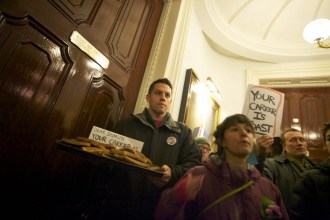
Last week, after Gov. Peter Shumlin abandoned, for now, his plan to bring single payer health care to Vermont, a select few expressed their disapproval at the Statehouse. Some went to the door of his ceremonial office and left a plate of toast along with a note reading, “Dear Shumlin, your career is toast,” and signed “the people.”
Well, there are “the people,” and then there are the people. In Vermont, the people (without the quotation marks) are … everybody. Thanks to that imperfect but useful tool the public opinion poll, the views of everybody about Shumlin’s single payer proposal are known.
The people were and are closely divided, with most surveys showing a plurality or a small majority in favor, but many opposed or unsure. Then there was last month’s election, in which Shumlin barely beat an underfunded, maladroit opponent.
A rejection of single payer?
That would be reading too much into it. But it sure wasn’t a ringing endorsement, especially considering that Rep. Michael Fisher, the chair of the Health Care Committee, was one of the Democratic incumbents who lost to a Republican.
The people, in other words, were and are much less devoted to creating a single payer health insurance system in Vermont than are the self-styled tribunes of “the people.”
This does not prove that the people are right and “the people” are wrong. One could make the case (one can make any case) that the governor made the wrong decision, that he should have pressed on with his plan or altered it.
After all, the anti-Shumlin protesters are right when they say that the present health care system is a mess, degrading the quality of life of thousands of Vermonters, especially those who are both low-income and ill.
But that does not excuse intellectual sloppiness or mindless sloganeering, both of which were on display from the protests and the comments of the single payer enthusiasts.
Who seem confused. They leave little doubt that they are guided by two convictions – two assumptions, really – that are false.
One was that Shumlin never really meant it, that he pledged support for single payer only to win the Democratic primary and keep a Progressive Party candidate off the ballot when he was first elected in 2010.
The other was that he could have prevailed had he only been willing to raise taxes on the rich.
“All people, all care,” chanted the Statehouse demonstrators, “make the rich pay their share.”
As indeed they should. All 3,808 of them.
That’s how many households reported income of more than $300,000 in 2012, the latest figures available, according to the Department of Taxes. Perhaps some of them ought to pay more. Of the 502 households which reported more than $1 million in income, 16 paid state income taxes of … zero.
But according to Robin Lunge, the state’s Director of Health Care Reform, when all the analysts and statisticians cooking up the single payer plan had run their numbers, they figured out that the state would have to come up with roughly an additional $700 million to pay for it.
That would have required an average tax hike of $183,823 for each wealthy household.
Yes, it’s possible that there are also some businesses who could pay more taxes than they do. That might have reduced the potential tax increase for those 3,808 rich folks to … well, maybe $150,000, maybe even as little as $135,000.
You can count the number of times a tax increase of anything remotely akin to that magnitude has ever been passed by any legislative body in the history of the world on the fingers of no hands.
As for Shumlin’s sincerity, let’s for the moment assume the worst of him, that he is what his harshest detractors say he is: a sneaky, nakedly ambitious bounder.
But if so, he is a sneaky, nakedly ambitious bounder who has for years tenaciously clung to a few public policy positions: shutting down Vermont Yankee, enhancing gay rights, de-criminalizing marijuana, producing more renewable energy, legalizing some mechanism by which the hopelessly ill could end their lives.
Oh, and creating a single payer health care system in Vermont.
“He’s been a supporter since the early nineties, since the beginning of his political career,” said Dr. Deb Richter, the physician who has been perhaps Vermont’s leading single payer advocate for decades, and who called Shumlin’s effort “one of the most courageous things I’ve ever seen a politician do.”
Even Martha Abbott, the former Progressive Party Chair, who thinks the Governor “destroyed his credibility” by giving up on single payer, said one reason Progressives believed his commitment in 2010 was that he had been advocating such a system for years.
“It was the main issue he’s been about,” she said.
The evidence, then, suggests that when Shumlin called his decision, “the biggest disappointment of my public service,” he was not just talking politics. This was a personal commitment – certainly intellectual, perhaps emotional.
A more plausible – if politically naïve – objection came from the single payer advocates at the Vermont Workers Center, which issued a statement arguing that “moving to a different financing mechanism has nothing to do with raising new money.” A greater commitment to finding “alternative public financing mechanisms” the Workers Center suggested, could have led to an entirely different approach from the one taken by the Green Mountain Care Board and Shumlin’s chosen experts, one that could finance a single payer system without new taxes.
Maybe. But that would have required a delay of at least a year, probably more, with no guarantee that any better solution could be found.
Besides, as Dr. Deb Richter pointed out, none of the alternatives was “systemic.” They were ideas. Interesting ideas, perhaps but none nearly ready to be presented to the Legislature as a comprehensive bill. For now what Shumlin’s experts came up with was and is the only game in town.
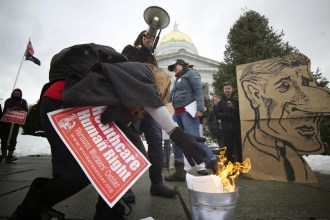
The Workers Center also complained that the entire process “was pursued without democratic input,” crafted “behind closed doors, without public participation or broader input from the many experts in universal healthcare financing.”
Even if this is an accurate description – and it ignores the fact that the Green Mountain Care Board held public hearings twice a week and its agendas, its minutes, and a slew of documents are available on line – it displays a misunderstanding of what democracy requires.
Democracy requires that final proposals of the executive branch be published, that legislative committees consider them in open hearings where public comment is welcome, that the amended bills as they go to the floors of the legislative houses be available to the public, and that those houses debate and vote on them in open session.
It never has and does not require that all deliberations, calculations, analysis, discussions and disputes be held in public. Experts need the freedom to explore – and to express – bad ideas so they can be shot down as part of the process of finding good ideas. That can’t be done in public.
Did Shumlin’s health care economists, numbers-crunchers, and assorted experts often meet behind closed doors?
They did. So, some years back did the members of the Advisory Council, the Cabinet Committee, and the Technical Board drawing up something they called the Economic Security bill. When they were done, they made their product public and sent it to Congress, which amended it and changed its name.
To the Social Security Act of 1935.
It’s worked rather well.

