


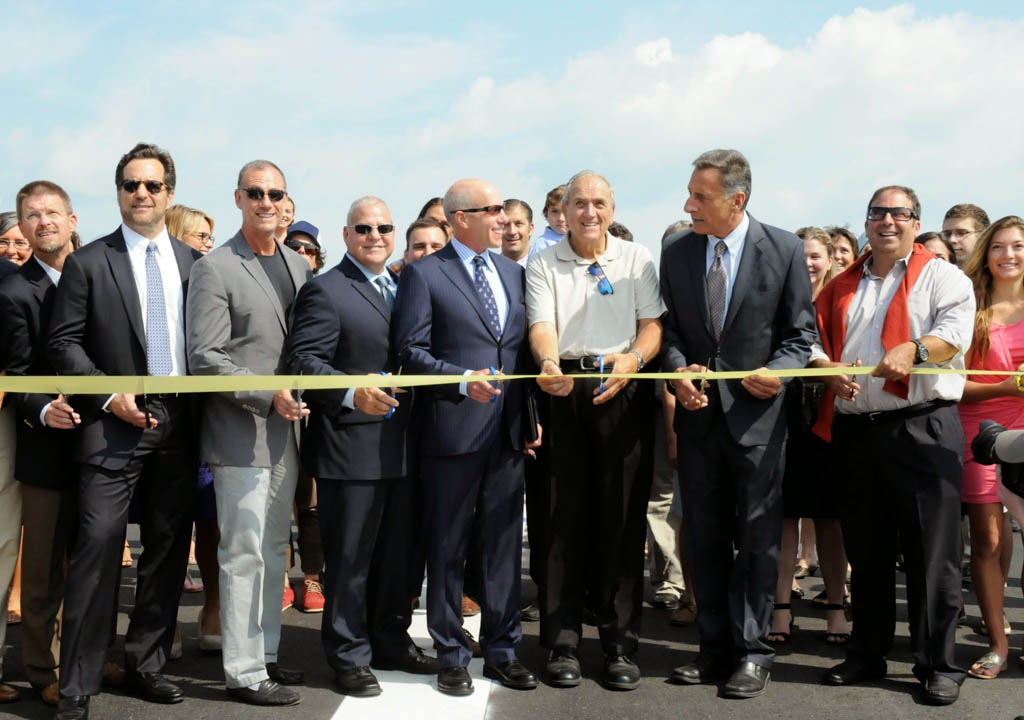
MORRISVILLE — You could say the runway expansion at the state-owned Morrisville-Stowe State Airport started five years ago, when then-14-year-old Harrison Barr told his parents he wanted to learn to fly planes.
Russell Barr said his son learned to pilot in what the community called a “bucket of bolts,” a 1960 Cessna 150. The local airport was rundown, the runway was crumbling, and flight training opportunities were hard to find.
Watching his son learn aviation protocols made him realize what an untapped asset the Stowe airport was — for economic development and youth educational opportunities.
Barr went on to found Stowe Aviation LLC, which took over management of the airport from Whitcomb Aviation on July 1.
“I simply wanted to bring this opportunity to other kids in our community,” Russell Barr said. “I was convinced that we were missing something.”
Harrison and his parents, Russell and Toni Barr, were joined by Gov. Peter Shumlin, a host of other state officials and about 100 onlookers for a ribbon-cutting to celebrate the airport’s latest improvements, part of a $27 million public-private upgrade.
“This collaboration is a part of a vision that came locally and trickled up to Montpelier, with partnership from the federal government,” Shumlin said.

Monday night, Harrison, now 19, flew a group of his parents’ friends and advisers up from White Plains, N.Y., for Tuesday’s ribbon-cutting.
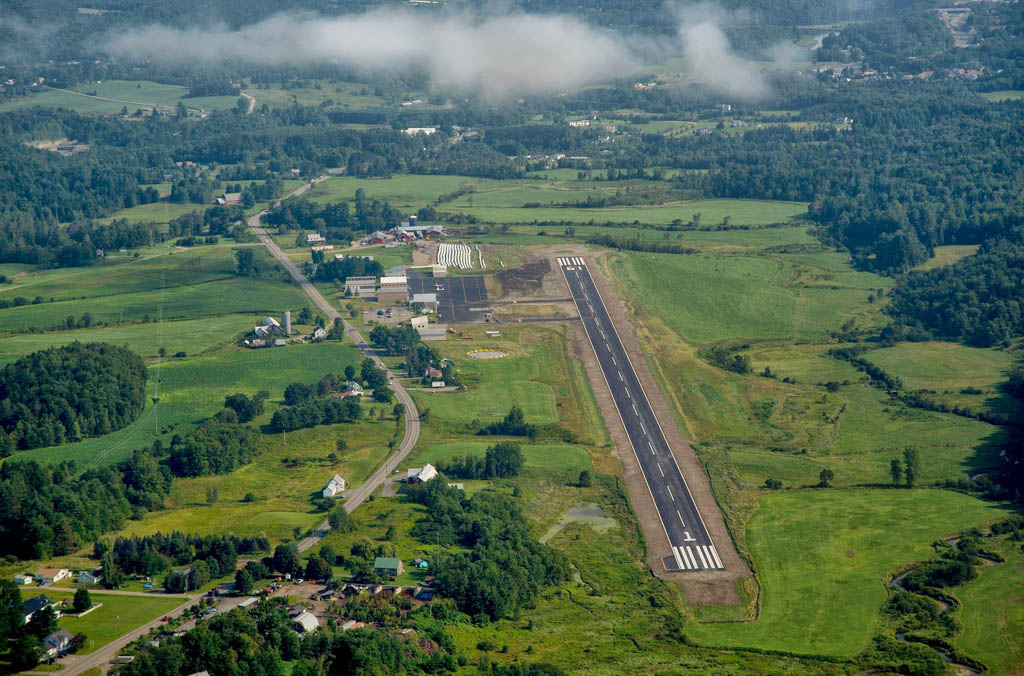
The airport technically reopened Aug. 1, after being closed since April 4 for a facelift funded by a combination of federal, state and private funds.
A $4.5 million Federal Aviation Administration grant, matched 10 percent by state money, paid for most of what has been completed, including runway reconstruction, installation of a new lighting system and drainage structures, and a reconfigured aircraft parking apron.
Renovation of the tiny terminal building was paid for by private funding through Stowe Aviation.
Stage two improvements will include a new charter flight company called Green Mountain Air, a U.S. Customs building to facilitate international travel, a flight academy, a maintenance facility and a professional aircraft management company. The operations will be anchored by a 21,000-square-foot hangar and 7,500-square-foot terminal that will house a 29-seat cafe and a flight simulator.
Down the road, the 3,700-foot runway may be expanded to 5,000 feet, to allow larger planes to fly in and out.
For now, small planes like the four-passenger Cirrus SR22 and nine-passenger Pilatus PC-12 use the site, which like other small state airports operates without an air traffic control tower.
Green Mountain Air, the charter company, also to be run by Stowe Aviation, will look to employ four, four-passenger Cirrus and two, nine-passenger Pilatus models once the charter flights are up and running.
For now, Russell Barr said, he’s focused mostly on infrastructure. He hopes stage two will be complete within 12 to 18 months.
Remaining costs are estimated at about $20 million, to be raised privately.
Barr said he’s looking into the federal Immigrant Investor Program EB-5, which allows would-be immigrants to invest $500,000 or $1 million in business ventures in exchange for conditional visas. If each investment can be proven to create at least 10 jobs, the investors and their immediate family members receive permanent residency in the U.S., and the chance to apply for citizenship.
Jay Peak Resort in the Northeast Kingdom has used EB-5 extensively to fund its transformation from a ski resort into a four-season destination. Developers there are also looking to EB-5 to finance development at Q Burke Mountain ski resort, plus a biotechnology research and manufacturing facility and a mixed-use development in Newport.
The Trapp Family Lodge and Sugarbush Resort also have tapped the EB-5 program to fund their growth.
Stowe Aviation signed an agreement in late May with the Vermont EB-5 Regional Center, which administers the federal program in the state, that permits the company to solicit EB-5 investors. But other private financing options remain on the table, Barr said.
Barr practices law in Stowe at Barr Lajoie Goldfine. The firm, founded in 1993, counsels in aviation law, among other specialties.
Private investors and a heavy-hitting roster of advisers have helped Stowe Aviation get off the ground. The “muscle,” as Russell Barr calls them, are mostly old friends, including David Mendal, president of Forest Travel Agency; David Tate, the “architect” of Virgin Atlantic’s business plan; and Tom Buda, a New York-based private investigator, longtime adviser to the U.S. Department of State and Barr’s childhood friend.
CORRECTION: This article was corrected at 9:55 a.m. on August 6, 2014, to clarify that the size of the new terminal to be constructed is 7,500 square feet.
