

WATERBURY — Federal and state officials want to improve Vermont’s resilience to the severe weather that has scarred the state in recent years and, they say, threatens to increase due to climate change.
The Institute for Sustainable Communities has been gathering feedback from residents for a plan to mitigate the impact of natural disasters since the fallout of Tropical Storm Irene, which devastated the state with heavy rain and flooding in 2011.
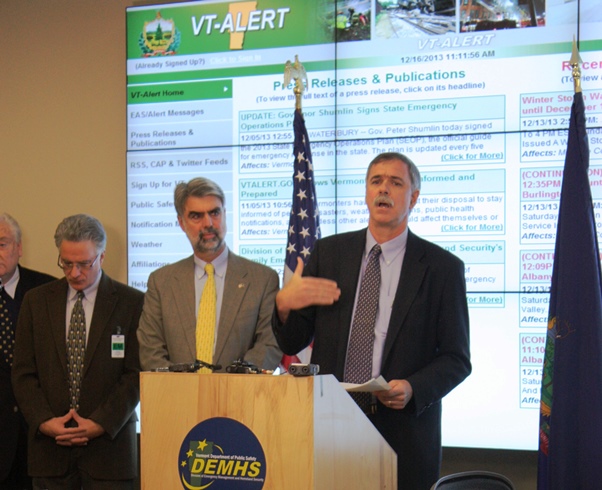
At a Waterbury news conference inside the State Emergency Operations Center overlooking the construction site of the former Department of Environmental Conservation’s offices flooded by Irene, speakers announced two reports on resilience and disaster damage prevention that call for more statewide collaboration and smarter land use policies.
Secretary of Administration Jeb Spaulding said as the post-Irene recovery continues, the state must begin to implement a resilience strategy to better prepare for the growing frequency of extreme weather associated with a changing climate.
“What we are here today to talk more specifically about is what we can do to prepare in advance for natural disasters, what kind of steps we can take to lessen the impacts of the weather and … learn from the experiences of not only ourselves, but other states and other countries, as a matter of fact,” he said.
Spaulding said the reports will receive the attention of the state’s highest office holders.
George Hamilton, president of the Montpelier-based Institute for Sustainable Communities, which prepared one of the reports on resilience, said Vermont’s climate is now comparable to Virginia’s in the 1960s. The state should begin planning to mitigate the inevitable changes associated with the erratic weather patterns tied to the transformation of the Earth’s climate.
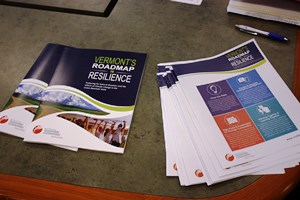
The institute’s report, titled “Vermont’s Roadmap to Resilience, Preparing for Natural Disasters and the Effects of Climate Change in the Green Mountain State,” features 23 recommendations ranging from predicting the weather to collaboration between state departments, communities and the private sector.
Hamilton said the state must build “regional capacity” to better implement mitigation strategies, including public and private partnerships.
Green Mountain Power, the state’s largest electricity utility, and IBM, a multinational technology corporation, should begin analyzing data, he said, to evaluate weather risks three days in advance, Hamilton said.
Robert Dostis, director of government affairs for Green Mountain Power, said the utility has spent about $30 million in reliability projects, such as moving transmission lines closer to the road for easy maintenance.
Hamilton added that with reductions in federal funding for disaster recovery, state departments, as well as other levels of government, must collaborate to better determine risks and build disaster prevention strategies. The Federal Emergency Management Agency, which will soon close its Williston offices, has spent more than $185 million in Vermont since Irene.
The report recommends building a statewide association, called the Vermont Strong Network, he said. Hamilton said this learning network will be used to better understand the “new dynamic” of climate change.
A similar report released Monday, “Vermont State Agency Policy Options, Disaster Recovery and Long-Term Resilience Planning in Vermont,” highlights specific tasks for each of the state’s agencies and departments. The report was drafted by the U.S. Department of Homeland Security with support from U.S. Environmental Protection Agency and FEMA.

