

Statewide education tax rates are likely to increase between 3 cents and 7 cents next year as Vermont struggles with spending that outstrips recent revenue growth. To alleviate the strain long term, lawmakers are considering a restructuring of education funding.
That’s the takeaway from a four-hour meeting of the House Ways and Means Committee on Thursday. Members of the tax-writing committee are preparing for the upcoming legislative session in January by revisiting their work from the spring and looking ahead.
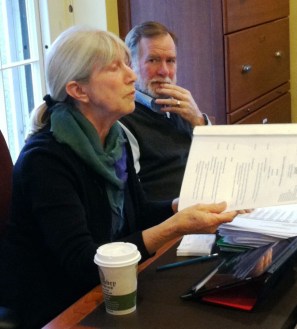
“The whole day has been a little bit depressing,” said committee chair Rep. Janet Ancel, D-Calais.
Most of her colleagues also appeared sobered after about a dozen presentations from the Tax Department, the Joint Fiscal Office, Legislative Counsel, the Vermont League of Cities and Towns, State Treasurer and Agency of Education.
The upshot? The state’s revenue growth continues to lag behind expenditures.
The House Ways and Means Committee is responsible for raising money and is not authorized to restrict budgets. For that reason, committee members worked from an assumption of continued growth in education spending. Their charge is to figure out how to pay for it.
“That’s the question: Where do we want the (tax) growth to occur,” Ancel summarized.
Where to raise revenues
Ancel and others — including ranking member David Sharpe, D-Bristol, and Jim Condon, D-Colchester — agreed that they prefer to see tax increases based on income levels rather than property values. Such an arrangement is fairer to people with low or fixed incomes who might live on valuable property, they said.
Ancel pointed out that the current system is income-based in this way (through income sensitivity), but Condon is working to make it more so. He also wants education funding formulas to be clearer to taxpayers.
“The system now is too confusing,” he said. “When the average voter goes to the polls to decide their school budget, there’s a disconnect between what they’re voting on and how that’s going to affect their tax bill — what they’ll actually have to pay for the statewide education fund.”
Condon said the current system might work “in a Rube Goldberg kind of way,” but it’s too complex to figure out, and therefore unfair.
In H.164, he’s suggesting a “substantially lower,” flat property tax rate payable by all, in addition to an income-based education tax.
“Ideally, the property tax rate would stay where we set it, so the growth would be on the income side,” Condon said.
Many questions remain unanswered about Condon’s proposal, including how to charge a property tax on renters without effectively double-taxing them — given that most rents implicitly compensate landlords for the property taxes they pay on rental property. But his colleagues thought the presentation, which included various fiscal scenarios estimated by the Joint Fiscal Office, was helpful in shaking up the conventional paradigm.
Property values down, property tax rates up
For the time being, Tax Commissioner Mary Peterson predicted a statewide property tax rate increase between 3 and 7 cents. Her final and official recommendation is due Dec. 1.
Peterson suggested that Vermont’s education funding formula might be nearing the end of its lifespan. At about 15 years old, Act 60 is “elderly for education funding systems,” she said.
She encouraged lawmakers to consider holding a symposium with state and national education finance experts in early January to help them frame discussions in the 2014 session.
Peterson noted that, since the recession, housing prices have not rebounded to their earlier peaks. A recovery in the housing market will help, but no one is expecting a housing boom, she said.
Senior fiscal analyst Mark Perrault said the state had been expecting the statewide grand list value to grow modestly for the first time since the recession hit. That hope has been pushed back until 2017, he said. And even then, any growth is likely to be incremental.
“We’re not going to see double-digit growth in the list, as with previous years, that was taking pressure off the base rate,” Perrault said.
There was one note of relative reprieve in Peterson’s message, though. Education spending had been predicted to increase by about $72 million, but she said that figure has come down to roughly $57 million since last spring.
Other considerations
Many pieces aside from income levels and property values fit into the big picture of education funding. Ways and Means members also absorbed updates about federal funding, education-related study committees, teacher retirement and more.
Vermont schools lost roughly 6 percent of federal funding in 2013 due to federal sequestration, according to a presentation by Bill Talbott, deputy commissioner of the Agency of Education.
He’s concerned that Congress will not reach a successful budget compromise before their next deadline, in which case still more reductions could come in 2014.
“We always live in uncertainty, but it’s a little more now than it has been,” Talbott said. If more federal funding is cut, the state’s education budget likely would increase to compensate for programs that can’t be cut accordingly, such as special education, he said.
State Treasurer Beth Pearce reprised a presentation on the costly way the state is now paying for health care for retired teachers. Unlike the state employee pension system, the teachers’ pension essentially borrows health care costs, drastically increasing the system’s long-term liability, she said.
Despite significant reductions in liability through restructured benefit packages and several federal programs, Pearce said the gains are outpaced by inadequate health care funding. She asked the committee for an additional $20 million in the next fiscal year to help stem the tide of the system’s growing debt.
Methods of raising more money, including reforms to the Current Use program and a roster of property tax exemptions, also are on the table. No concrete plans for either were discussed Thursday.
Lawmakers also were briefed on a Supplemental Property Tax Relief Fund, which currently holds about $11.8 million. Perrault, from the Joint Fiscal Office, said applying that money to the Education Fund may be enough to shave a property tax rate hike by a penny this year, but the advantage wouldn’t last long.
“It’s one-time money,” he said. “So if it’s used in (fiscal year) 15, then in (fiscal year) 16 you’d be looking to make up that one penny.”
Options that remain on the committee’s to-do list — some of which were opposed by their own chamber in 2013 and some of which were lost in the Senate — include:
• pressuring towns to count their actual pupil numbers;
• phasing out a grant program for small schools;
• lowering the percentage of applicable rent for rental rebates;
• raising the floor on the base household income tax rate;
• lowering the maximum property tax adjustment per household;
• extending the slope for income sensitivity.
Committee members also asked Brad James, education finance manager for the Agency of Education, to provide guidance on statutory language that might be needed to require school towns, districts and supervisory unions to accurately and thoroughly report the student-teacher and student-staff ratios. More accurate data would help to inform the committee’s decisions.
“It’s been a long time we’ve been saying it’s really hard to get this,” Ancel told James.

