

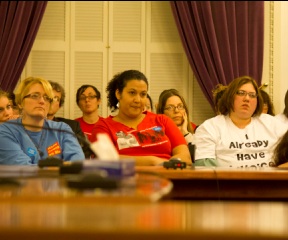
Home health care workers have been authorized to unionize, and even state’s attorneys have been given the green light for collective bargaining.
The same right to form a union, however, has eluded home-based child-care providers.
Though a measure passed the House two years ago, it has been controversial in the Senate from the start. Child-care workers tied to the American Federation of Teachers have tried since 2011 to get authorization to engage in collective bargaining activities in Vermont.
Sen. Dick McCormack, D-Windsor, hopes to change that state of affairs before the session ends. McCormack says the ability to bargain for wages and work standards is a “fundamental human right,” and he hopes this time a new compromise approach will make the proposal more palatable to members of the Senate.
On Friday, his committee, Senate Education, voted 4-1 to approve an amendment to the miscellaneous education bill, H.521, that smoothed out wrinkles in a plan that would allow home-based childcare providers to participate in the formation of a union that would negotiate with the state over policy issues. This move appeased Sen. Bill Doyle, R-Washington, who objected to the original language, which excluded small home businesses that do not receive subsidies from the state.
The third time could be the charm. The effort was first stalled in 2011 by large child-care centers, including the YMCA and the Burlington Boys and Girls Club. When these groups were removed from the bill, the legislation still went nowhere.
Then last year, Senate President Pro Tem John Campbell, other blue dog Democrats and Senate Republicans blocked the legislation because of alleged AFT strong-arming tactics (including a threat to pull campaign funding for a Senate political action committee). This year Campbell, who professes to be pro-union, has said he won’t stand in the way of a child-care unionization bill.
Others in the Senate, however, including Sen. Kevin Mullin, R-Rutland, remain adamantly opposed to the unionization of child-care providers. Mullin’s committee, Senate Economic Development, killed a similar bill earlier this session.
No guarantees, McCormack says, but it appears the amendment now has the votes in the Senate to pass. If there’s any trouble, he says he’s going to present a side-by-side analysis of the home health care bill (a nearly identical measure that passed with no debate last month) and the childcare unionization legislation to drive home his point — there is “no rational reason” to respect the rights of one group and deny those same rights to another.
In order to get the bill out of committee, McCormack says he had to make a major concession. (As he put it, “you can’t go off and be a leader if people aren’t following.”)
The amendment, he says, makes “no effort” to collect so-called “agency fees” for providers who don’t receive subsidies from the state. The House and Senate both recently passed legislation that allows unions in the public sector to collect a percentage of union dues from non-union employees because they benefit from the collective bargaining process.
Still, McCormack says, the amendment could meet with resistance, and he is prepared to counter attacks.
“My observation of the arguments against giving early child care providers the right to union is that these are generic anti-union arguments,” McCormack said. “They are the same arguments that were used in the Tennessee coalfields in the 1890s, the New York sweat shops in 1910 and in the Midwestern automobile factories in the 1930s. We as a people have generally decided collective bargaining is a fundamental human right.”
The AFT said in a statement that 13 states have similar legislation.
Sheila Reed, associate director of Voices for Vermont’s Children, a nonprofit group that has advocated for the unionization effort, is pleased with the committee vote. “We are now one step closer to ensuring that the people who care for our children every day will have a full voice in developing state child-care policies,” Reed said.
