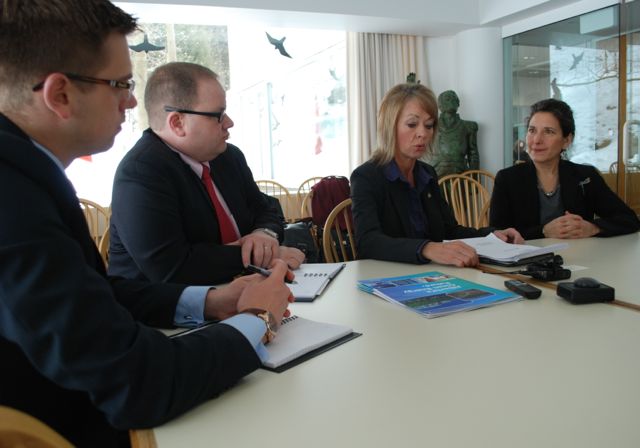
Alberta environment officials met with Vermont legislative leaders on Tuesday to discuss Alberta’s energy development plans. Though the meeting was not ostensibly about the possibility of tar sands oil being piped through Vermont, that topic was, as Sen. Ginny Lyons, D-Chittenden, put it, an “elephant in the room.”
Lawmakers have proposed legislation that would require regulation of the pipeline under Act 250 if the heavy crude flows through Vermont.
Alberta’s environmental minister, Diana McQueen, said the delegation wasn’t in Vermont to lobby for the pipeline.
“Our oil will be having many markets,” said McQueen. “Certainly into the United States, the West Coast as well, Alaska’s another route that we’re working on, the East Coast, as well. We know that there will be many different routes and they’ll be over many different time frames, but we will develop our resource.”
McQueen and three other Canadian officials met privately with Speaker of the House Shap Smith and Lt. Gov. Phil Scott before a public meeting that was open to the press. Secretary of the Agency of Natural Resources Deb Markowitz and Lyons attended the public meeting.
The pipeline in question, owned by the Portland Pipeline Corp., runs from Portland, Maine, to Montreal, Quebec, through a corner of the Northeast Kingdom.
Environmental groups are concerned that the pipeline might leak. Because tar sands oil is often diluted with a lighter fossil fuel so that it will flow, when it spills the lighter fuel evaporates, leaving the heavy, sludge-like oil to sink into soil or under water. This makes it extremely difficult to clean up.
Alberta’s tar sands underlie an area the size of New York state. Because the land in which tar sands occurs is publicly owned but privately developed, the province receives royalties from the production of tar sands oil. Alberta, which is landlocked, must pipe oil to refineries near coasts before exporting it.
Enbridge Oil, which owns another part of the west-east pipeline in Canada, applied last November to reverse the flow so that it could pump tar sands oil from Ontario to Montreal. Though Enbridge says there are no plans to pipe that oil from Montreal through Vermont, environmental groups say it looks otherwise.
Markowitz asked if tar sands oil could be refined in Montreal before flowing through Vermont, but the Canadian officials did not directly answer her question.
Tristan Sanregret, director of Alberta-U.S. relations for the province, only reiterated that Canada has plans to move oil from sources in the west to markets in the east. Though Canada is a net exporter of oil, it is still imported in the eastern part of the country.
McQueen repeatedly emphasized Alberta’s commitment to environmental sustainability. Alberta was the first jurisdiction in North America to legislate a price on carbon, which it did in 2007. The province is also pursuing ways to reduce emissions, including wind and solar energy and carbon sequestration.
“We’re all committed, globally, to moving off of fossil fuels, it’s just it’s going to take us some time to do that,” McQueen said.
Markowitz said that piping tar sands oil through the state is a “tough issue” here because a lot of Vermonters are concerned about climate change.
“There’s a sense of urgency in terms of what we’re seeing, even here in Vermont — Irene and the devastation that brought to our communities and families and certainly our infrastructure,” the secretary said.
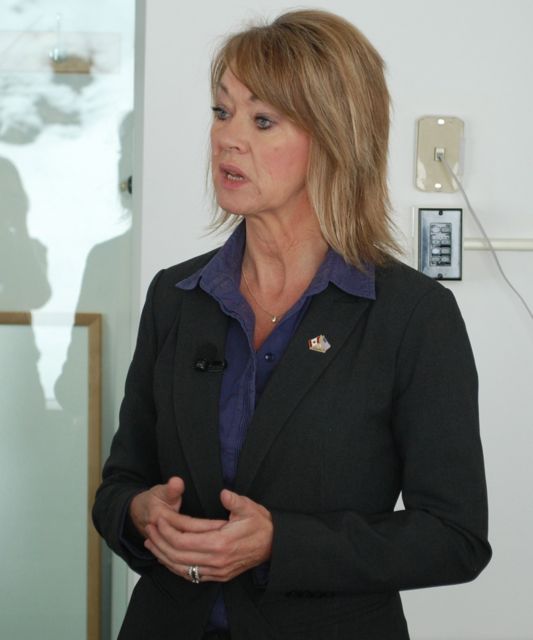
McQueen was clear that she wants people to understand the facts about tar sands. She cited an independent study released Monday that found that tar sands oil is not more corrosive than any other crude.
“We know that it’s an emotional issue as well, but we’re here just to let people know here’s the facts on it, here’s the data, and if you have questions we’re more than happy now or in the future to answer any of those,” she said.
After the meeting, Markowitz said that it was interesting that within two weeks the Statehouse had been visited by the president of the Portland-Montreal pipeline and Alberta officials.
“It just shows that the pipeline matters,” she said. “In my office, some of the things we are thinking about are could it potentially have an impact on air quality, on water quality; we have regulatory programs that we’re wondering how those programs and existing programs might apply to the pipeline reversal.”
She added, “And then there’s the broader public policy question about climate change. It is alarming what we’ve seen already. Vermonters overall are really committed to finding ways to get ourselves off of our addiction to fossil fuels but we’re also concerned locally about the global addiction to fossil fuels and I know there are prominent Vermonters who talk about resisting the inevitability of natural resource extraction.”
Ben Walsh, a clean energy advocate for the Vermont Public Interest Research Group (VPIRG) said his organization is opposed to piping tar sands oil through Vermont. “Our bottom line is both to protect our natural resources and our environment here in Vermont and to protect the climate, we really shouldn’t be moving tar sands through Vermont and certainly not through this pipeline,” Walsh said.
VPIRG was among several environmental groups that asked the Northeast Kingdom Act 250 district coordinator to issue a jurisdictional opinion on whether Act 250 would apply to using the pipeline for tar sands oil. Act 250 is the state’s land-use law that governs commercial development. The pipeline, which was built in 1941, almost 30 years before Act 250 was passed, was grandfathered in without Act 250 review.
“We believe, along with a number of other environmental groups and individuals from the Northeast Kingdom, that if they try to pump tar sands through today, then Act 250 would apply,” said Walsh. “That being said, I think legislation that underlines that and strengthens state oversight of this sort of project is absolutely appropriate.”
Rep. David Deen, D-Westminster, and Lyons introduced bills last month to give the state regulatory power over the pipeline by putting it under Act 250 jurisdiction. VPIRG also testified in the House Fish, Wildlife and Water Resources Committee two weeks ago, urging representatives to strengthen the bills.
Gov. Peter Shumlin said last week that he opposes piping tar sands oil through Vermont, but he didn’t openly support the proposed Act 250 legislation.