

When David Lillard looks at his land in Rochester, he doesn’t see a rental property anymore. Nor does he see the future second home he dreamed of. He sees a bench, perhaps a trail, maybe even a put-in for canoes and kayaks to access the stream. He sees a town park.
Lillard’s property is perched downstream of a culvert where a small mountain brook runs under Route 100. When the culvert clogged during Tropical Storm Irene, the stream “took 30 dump trucks full of gravel — at least — through the property and destroyed everything,” said Lillard.
In the last year, like many Vermonters, Lillard has been looking for ways to recover financially. He, in partnership with the town of Rochester, has applied for the Federal Emergency Management Agency (FEMA) buyout program. If his property is accepted, Rochester will get a town park that may even absorb some floodwater, if another Irene-like storm hits.
That’s just one of many ways riverfront land can make the state more resilient to flooding.
David Mears, commissioner of the Department of Environmental Conservation, said the state is developing a vision for flood-resilient land management, such as conserving forests or wetlands that absorb and slow floodwaters while protecting historic and valued infrastructure — like village centers — from flood damage.
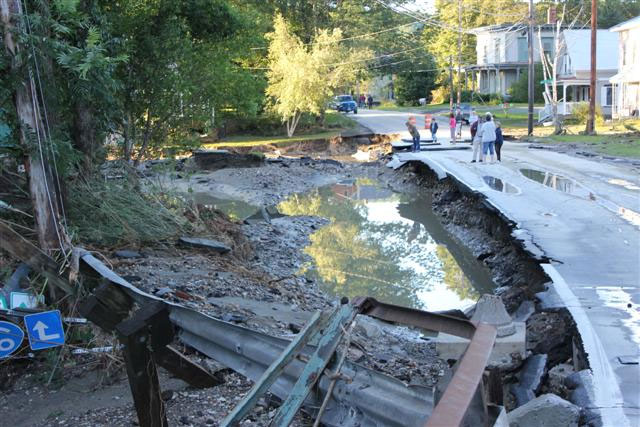
State agencies are just beginning discussions about how to do this, and when they planning process starts they will involve local and regional governments, businesspeople, state scientists, and consultants and will likely recommend conservation of land as well as protection of infrastructure.
“State and local government need to work together to manage how communities are developed,” Mears said.
The challenge is to plan future recovery efforts carefully.
“In the immediate aftermath of a flood emergency is not the time to be making decisions about where should you rebuild,” said Mears. “The immediate reaction in the aftermath of a flood is to try to put it back the way it was. Those are in many cases not the right decisions to be making when you think about it in the long term.”
Mears continued, “We’ve got to do a better job of thinking about it in advance.”
Officials from the Agency of Natural Resources and the Vermont Agency of Transportation (VTrans) met weekly for the first few months after Irene, now every few weeks, to make sure they are on the same page regarding issues like design standards for bridges and culverts.
Mears also says that recently there have been “robust conversations” about merging river corridor, transportation, and community development plans so that the three work together under a common vision.
“We really have to sync them all up. It doesn’t make sense for my agency to do a whole river corridor plan independent of the community development plan and to also have that be completely separate from what VTrans is thinking in terms of their planning,” said Mears. “We’ve had a couple of pilots — one in the Mad River Valley — to coordinate planning around those three things. That could then be franchised across the state.”
This fall, the Institute for Sustainable Communities, in partnership with the state, will bring together local decision-makers, experts from in-state and from states that have experienced similar disasters to “discuss how to build a better process for where and how we develop,” said Mears.
These experts will include local government officials, business representatives, and regional planning commissions, as well as state officials from North Carolina, Iowa, and New Orleans, all of which experienced significant flooding in recent years.
FEMA buyout
Even though state agencies are a long way from having a unified vision about how and where to develop land in floodplains, some of the decisions are being made for them.
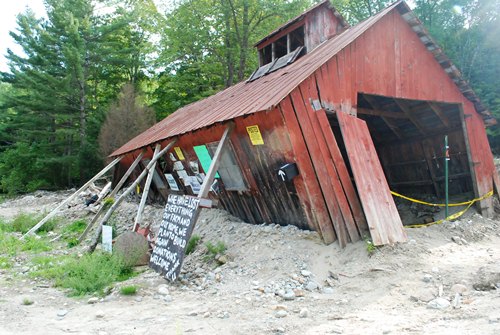
Some individual landowners are rebuilding. One property along Route 100 in Plymouth, owned by the Pingrees, frequently causes drivers to rubberneck or pull over and snap pictures. A small red barn leans downhill at a precarious angle, propped up by logs, in what looks like an avalanche chute. Huge light gray boulders are piled willy-nilly on top of each other along a tiny creek devoid of plants. A painted sign propped next to the barn reads, “We lost everything, our farm and our home. We plan to build again. Donations welcome. Thank U.”
Others, like Lillard, don’t want to settle in the path of floodwaters again.
“I love Rochester,” said Lillard. “The dream was always to have [my land] as a rental property and then one day be able to move there or at least spend part of the year there. I still have that dream but it wouldn’t be on that lot.”

Lillard is enthusiastic about turning his property into a park. “I think the land would make a wonderful park. I know that’s what the selectmen want in the town, what the people want in the town.”
Rochester Selectman Larry Straus said that two other properties in his town have been accepted for the FEMA buyout program.
In this program, said Ray Doherty, the state Hazard Mitigation officer, a town works with a landowner to apply for FEMA funding to pay the owner the pre-disaster value of the property and transfer it into the town’s ownership for greenspace.
The property must be in the floodplain as defined by FEMA’s inundation maps and it must have sustained damage from a flood. FEMA pays for 75 percent of the cost, the rest must come from a local match. The state has apportioned some grant money from the Department of Housing and Urban Development (HUD) to pay for the remaining 25 percent for all FEMA buyouts.
Doherty said there are about 114 Irene-related applications for FEMA buyouts in 34 towns concentrated mostly in southern and central Vermont with a price tag of $20.4 million. Seventeen have been approved, but Doherty expects they nearly all will be.
“Some of the ones that it seems like they are going to deny, we’re looking for ways for them to say yes. There’s some flexibility there,” said Doherty.
One house on a riverbank in Bethel was washed to an island in the middle of the river, and yet was completely undamaged from floodwaters. FEMA was initially reluctant to fund the buyout because of the lack of damage, but Doherty and his colleagues convinced them to approve it.
These properties are typically an acre or two in size and “at the end of the day when the project is done and the house is demolished you have a green, open space where nothing can be developed,” said Doherty.
Natural solutions
Another option to prevent future losses of infrastructure in flood-prone areas is a conservation easement. A river corridor easement preserves land along a river in a natural condition forever, allowing floodwaters to spread out, slow down, and be absorbed by vegetation and soil.
Mears said these kinds of lands are essential to a flood-resilient region, and that by slowing floodwaters, they can protect infrastructure up- and downstream.
A river corridor easement is an agreement in which the landowner continues to own the land but sells or donates the right to develop or manage the river corridor to the conservation organization, which agrees not to develop the river corridor. Often, easement agreements are negotiated that allow particularly activities within the corridor, such as maintaining a bridge that allows the owner access to a hayfield. Agriculture is allowed within an easement, but armoring riverbanks is not. Landowners may receive a tax break, depending on the value of their land, how they use it, and whether they donate or sell the easement.
The state initiates conversations with landowners in areas that would benefit from river corridor easements. If landowners are interested, they are referred to organizations like the Vermont River Conservancy to work out the terms of an easement.
Lydia Menendez, assistant director of the conservancy, acknowledges that letting rivers move freely is ideal for flood resilience.
“The river science behind it is that the more we try to restrict the movement of the river, the more impacts will happen” up- and downstream, she said.
Conserving lands to absorb floodwaters is critical, she said.
“It not only makes good sense, but it makes such good sense that we’ve got to do it. Because otherwise we’re just passing future flood damage issues on to the future and even exacerbating them.”
But Menendez recognizes the difficulties that landowners face.
“It’s great for people who don’t own land to say, ‘Oh yeah, let the rivers move,’” said Menendez. “These landowners are in somewhat challenging situations of having to weigh” multiple factors, including “how they make income from their land, or how they move around their property, or what they see the long-term vision of their land is for their children. … I’m really proud of them for making these choices, they’re not easy ones.”
Steve Libby, the executive director of the Vermont River Conservancy, said that there has been increased interest in conservation easements since Irene. The Vermont River Conservancy works with the state to establish conservation easements on properties with willing landowners that are at a high risk for erosion from the next flood and that could provide what are called “flood attenuation” services — that is, slowing floodwaters down.
The approach looks at a whole watershed, similar to what the state is working toward, and applies it to individual properties, said Libby.
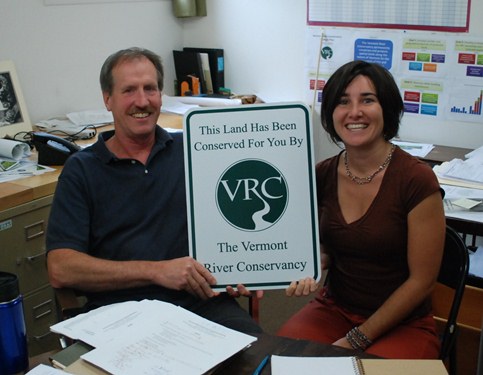
The Vermont River Conservancy has over 10 miles of river corridor conserved through the river corridor easement program.
Libby said that although the state and the Vermont River Conservancy has been working on finding properties that attenuate floods, Irene made that work easier, in a way.
“After Irene it became very obvious that there are certain properties that are key sites for attenuating floodwaters, nutrients, sediments,” said Libby. Recognizing these properties “allows us and the river scientist folks [at the Agency of Natural Resources] to really focus on parcels that are most vulnerable. It’s no longer theoretical, it’s obvious.”
What happened to the properties that already had conservation easements when Irene hit?
Menendez said that because the landowners had planned for their property to flood, it wasn’t a big deal. “They flooded, there was some extra debris moved around, and no one was complaining about massive damage or huge problems. Amidst all this intense destruction, our easements were like, ‘Oh yeah, it flooded.’ And they did exactly what they were supposed to do. The land allowed the water to come up, move across it, and recede.”
One river that shows the benefits of these kinds of lands is Otter Creek. According to the 2012 State of the Lake Report issued by the Lake Champlain Basin Committee, Otter Creek flooded more slowly and less dramatically than other rivers in the state. This is attributed to the protected wetlands, agricultural and forested lands along the river.
The Vermont River Conservancy also conserves lands that provide public access to streams. The FEMA buyout program provides opportunities to make this happen. “It’s really intriguing to us because we could conceivably in the end have lands that had a high vulnerability pre-flood, through this process you reduce that vulnerability, and you also add this added benefit of public access to the rivers,” Libby said.
The state may not yet have a clear vision for how Vermonters will relate to rivers, but Libby, who has been talking to the conservancy, does.
“The dream would be that we look at rivers as public assets. That we, as citizens of the state, steward and conserve elements of those that are important to conserve. But that it is recognized that rivers are part of the way we live here, and how we live here. Access to recreation and swimming holes is a key element of Vermont life and we want to be sure that that’s always there. And to support that is the whole ecological context of the river corridor and the meandering ability of the river and good, effective riparian buffers.”
Mears is also hopeful.
“Some of the challenges in front of us are not small challenges. But I’ve never been more hopeful in terms of the potential for our state to come together to identify ways that we can live in our river systems in ways that reduce the risk to public health and safety, that reduce the costs to private investments, and have concurrent benefits in terms of better water quality and fish habitat,” said Mears.
He is impressed with how much collaboration is occurring between interests that were formerly at odds, such as developers and environmental conservationists.
“We are coming off the 2011 floods with a recognition of how much we have in common.”

