


The Federal Emergency Management Agency has dropped a $120 million fiscal bombshell on Vermont and it landed with dramatic thud at the Statehouse Friday.
State officials announced that after nearly a year of discussions, FEMA has reversed course and is indicating the state can’t count on major financial help to rebuild the flooded Waterbury state office complex and a new state hospital, both damaged by tropical storm Irene.
Parts of a revamped mental health system approved by the Legislature last session may also prove ineligible for FEMA funds or receive a greatly reduced amount, officials said.
The $120 million figure is the gap between the $182.8 million the state estimates it will cost to renovate and replace state assets and the $62 million that the state or its insurance has pitched in to cover damage costs.
Since Irene’s devastation last August, state officials have consistently said they been assured FEMA will kick in a good chunk of money to restore or replace state assets at the historic Waterbury complex, which has 70 buildings that housed some 1,200 state workers and the state hospital.
The pricetag for restoring the office complex and bulding a new state hospital in Berlin is currently estimated at around $152 million, according to Deputy Secretary of Administration Michael Clasen.
Clasen drew the unfortunate job of delivering what may just be the worst fiscal news the state has ever received to a packed Statehouse hearing room Friday.
He said it appeared FEMA could no longer be counted on to substantially fund the state’s rebuilding effort and bridge that $120 million gap.
Using a baseball analogy, he said if the state had earlier been under the impression it had hit a funding home run, “today FEMA is giving a signal we may not even make it to first base.”
But a FEMA official said Friday that analogy is premature.
Deputy Federal Coordinating Officer Steven Ward, who is working in Vermont with a team evaluating the state’s documentation, would not agree with the state’s assessment.
“The process is not complete. We have a long way to go,” he said, declining to hazard a guess on where funding will end up, but saying FEMA was working to “maximize” funding for the state.
Sitting before several high-powered legislative panels that had gathered for an update on the Waterbury complex and mental health overhaul, Clasen told lawmakers that state expectations on FEMA money started blowing up a few weeks ago.
Clasen said the state has had lengthy and elaborate conversations with FEMA and consistent indications since Irene struck last August that FEMA would pitch to help restore and rebuild the complex or fund alternate replacement structures.
“A FEMA representative was actively working with state employees providing information and guidance, to where we were going to have a significant stream of funding,” Clasen said.

But when new FEMA officials began working with state officials last month, FEMA’s previous reassurances were “for all intents and purposes disavowed,” he said.
“We are now being told by FEMA that the state hospital is not eligible for FEMA funds,” he said.
Further, assurances that rebuilding the office complex would be eligible for reimbursement are also uncertain, including such key parts as moving the heating plant out of the floodplain before the complex is reconstructed.
William Duhac, a fiscal expert for the state buildings division, said FEMA may also not be funding facilities for six new acute care mental health beds at Rutland Regional Medical Center and 14 at the Brattleboro Retreat, which are expected to cost a total of $10.6 million. The state has the backup option of paying for the new units with higher rates, which would get a 60/40 federal-state match.
“They have walked away from that commitment,” he said.
“These are shifting waters we are working with and that is very difficult,” he said.
FEMA is now reviewing the state’s extensive documents and expects to give the state guidance in about a month for a “range of values” on what it might pay, Clasen said.
Calling the development “stunning,” he said if FEMA substantially scales back its contributions, the state may have to revisit its extensive post-Irene plans for everything, including a new 24-bed state hospital planned next to the Central Vermont Medical Center and the new state office building proposed in Waterbury.
“If significant funding is not forthcoming from FEMA, we believe collectively we may have to re-evaluate current plans,” he said.
“All options are on the table,” he said.
Speaking for FEMA, Ward said he was hesitant to characterize the new staffing as a “changing of the guard.” He said FEMA had brought in more expertise to look at the state’s situation and funding requests, and that had prompted a deeper look at the “worksheets” FEMA develops to decide what is eligible for reimbursement.
“I’ve got to be honest with you, it was one of the most complex projects I’ve ever been involved in,” he said. “We’re well aware of the governor’s and Legislature’s goals and objectives for the Waterbury complex and potential move of the Vermont State Hospital.”
“Both the state and FEMA recognize that currently there is a (funding) gap,” he said, insisting that FEMA would work the issues through with the state to develop “a range of values.”
At the same time he seemed to indicate that FEMA might opt to have the state repair some buildings and bring them up to code rather than going the route of new construction. He did say that FEMA does not want to fund repair of buildings that might face flooding again.

He also stressed that the agency, whose failures after Hurricane Katrina made it a whipping boy for derision, had contributed substantially already with $126 million in public and private assistance.
As for the old state hospital, he said a determination as to whether to repair it or replace “truthfully, has not been made by FEMA.”
Clasen said FEMA seems to be shifting its terminology on the state hospital. Whereas they considered it eligible for reimbursement because it was badly damaged by flooding, now FEMA seems to be saying it would only be eligible if it was “destroyed.”
“Their current reading is that the building is still standing, that the building was not destroyed,” he said.
Gov. Shumlin and the Legislature, counting on FEMA funds to replace the 54 beds lost at the hospital, cast their votes for closing the facility and spreading acute care beds around the state in Brattleboro, Rutland and Berlin. FEMA’s decision on funding may throw a giant monkey wrench into those plans despite Shumlin’s vows that no one would ever be housed in the antiquated facility again.
For lawmakers who watch state dollars, workers who are displaced, the town of Waterbury itself and state government, the implications of greatly diminished FEMA reimbursement are hard to overstate. The news rippled across the Statehouse into numerous hearing rooms where lawmakers took in the news and wondered what it meant if the flood of expected FEMA dollars turned into a trickle and didn’t help float the state’s rebuilding effort.
Sen. Ann Cummings, D-Washington, called Clasen’s report “overwhelming.”
Sen. Jane Kitchel, D-Caledonia, was distressed at the potential delays in the rebuilding effort that could face the state if FEMA funding fall substantially short.
“It seems like a year later, and we’re just starting this process,” she said.
“This is, to put it very mildly, very bad news for us,” she said.
I’m stunned.”
Clasen told Kitchel the state was going to continue to fast-track plans for the state hospital and state complex restoration while the FEMA situation seeks resolution.
According to state Buildings and General Services Commissioner Michael Obuchowski, whose office has worked heroically to plan the massive rebuilding of the state complex and other damaged state structures, said as late as June 21, the administration had tallied $88.8 million in work sheets that it expected to get reimbursed by FEMA. That left the state with a manageable shortfall of $32 million.
“We really have no idea of what this process is going to yield,” he told lawmakers, except that if FEMA doesn’t provide a major chunk of money the state will have to re-evaluate its rebuilding plans.
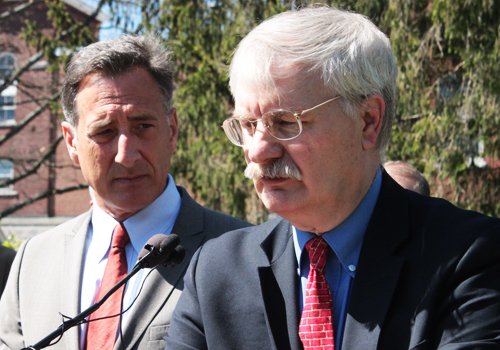
“FEMA is going to have to come through or we’re going to have to recommend changes,” he said.
The FEMA news obliterated or overshadowed some positive post-Irene developments, including a progress report from Obuchowski and architect Jesse Beck of Freeman French Freeman, the firm hired by the state to design the new office complex in Waterbury. Beck said extensive surveying and discussions indicate about 950 Human Services Agency employees would move back and be housed in Waterbury in a new and revamped office complex and a proposed building design was expected to be ready by the end of the summer.
Duchac reported that about $50 million in insurance settlement monies are expected by the state. Of that amount $15 million is “new money” that is not allocated and the state can use for a range of projects on the table. A final settlement is due toward the end of August, he said.
But the FEMA news was the cold shower on a warm sunny day. Rep. Alice Emmons, D-Springfield, whose House committee oversees state buildings, said it appeared FEMA was not familiar with the Vermont way of doing things “with a handshake.”
“We expect the other side to come through with their commitment that they gave to us,” she said.
Her Senate counterpart Robert Hartwell, D-Bennington,
said the state poured money into its infrastructure, fixing its roads and bridges and communities after the storm in “an absolutely fabulous example for all of America to see, and FEMA needs to take a hard look at what we’ve done.”
He said the state office complex and state hospital are the equivalent of state government’s “infrastructure.”
“This is where the hub of state government gets carried out,” he said.

