

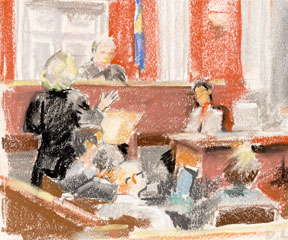
As the issue of shuttering the Vermont Yankee Nuclear Power Plant heads to the Second Circuit Court of Appeals, legal experts say the case may affect areas of the law beyond regulation of nuclear energy.
The Vermont Attorney General announced Saturday that the state would appeal federal district court Judge J. Garvan Murtha’s decision in favor of Entergy Nuclear Vermont Yankee.
The judge’s lengthy decision, which focused heavily on legislative discussions of radiological safety, could have ramifications for many state legislatures, Vermont Attorney General William Sorrell said Tuesday. Judge Murtha found that Act 160, a law that would allow the power plant’s license to expire if the state did not act, was pre-empted by the Atomic Energy Act because the state was attempting to regulate radiological safety.
Although Judge Murtha’s decision is technically binding only in Vermont, it could serve as persuasive precedent for judges to look at the deliberative process of lawmaking in an attempt to decipher the legislative intent behind statutes.
About half of Murtha’s 102-page decision addresses discussion by Vermont lawmakers about radiological safety.
Under a 1983 U.S. Supreme Court case, judges are not supposed to delve into the legislative history of a law to find an improper purpose, Sorrell said.
“No matter where you stand on nuclear power or this particular plant, this approach of going into the details of legislative history in this way has ramifications for any congress,” Sorrell said.
Allowing this kind of inquiry, Sorrell said, could lead judges to invalidate any number of state laws that could potentially conflict with federal legislation. If it stands, Murtha’s ruling could also encourage corporations to go back on their word, Sorrell said.
In 2006, Entergy signed a memorandum of understanding with the state saying it would accept Vermont law and not raise pre-emption issues, which it later did.
“Murtha’s decision if left unchanged will be cited for the proposition that corporations can walk away from written agreements,” Sorrell said.
Sorrell said there have been conversations with attorneys general in New York and Massachusetts about whether those states will file briefs as friends of the court in support of Vermont.
Representatives for both offices declined to comment on the likelihood of supporting the state. The New York Attorney General’s office, which has haggled with Entergy over the Indian Point plant, filed a brief in November in the D.C. Circuit Court of Appeals supporting the Vermont Department of Public Service in its case against the Nuclear Regulatory Commission for issuing a new license to Vermont Yankee without water quality certification by the state under the Clean Water Act.
Patrick Parenteau, a professor of law at Vermont Law School, recently wrote an extensive commentary about why the state should appeal the district court decision. Parenteau thinks the state has a strong legal case because Murtha failed to accord the proper weight to the presumption against pre-emption outlined by the U.S. Supreme Court.
Parenteau said he hopes the state will allow David Frederick of the Washington, D.C., firm Kellogg, Huber, Hansen, Todd, Evans & Figel to argue the case in the Second Circuit. The Vermont Attorney General’s office consulted with Frederick at the lower court level, and Sorrell said he will play a more prominent role on appeal.
“If Kathleen Sullivan [former dean of Stanford Law School] is going to argue for Entergy you need to have comparable heavyweight on the other side,” Parenteau said.
Christopher Kilian, vice president and director of the Conservation Law Foundation in Vermont, said the case brings to light important legal issues regarding states’ rights.
“It’s obviously an important case that goes right to the heart of states’ rights in the face of large corporate interests,” Kilian said.
Kilian said he is concerned that Judge Murtha appears to have cherry-picked statements from the legislative history.
“It’s troubling and unsettling that there’s U.S. Supreme Court precedent that says specifically that federal judges should not go down the rabbit hole of trying to figure out what state legislature meant because it’s an impossible task,” he said. “It’s troubling that Murtha did exactly what the Supreme Court said he should not do.”
Entergy is asking for $4.6 million for legal fees from the state for the lower court case. The company declined to comment on the appeal.
Vermont Yankee’s currently license expires in March. A status conference for the Public Service Board proceeding will be held March 9 at the Statehouse.

