

MONTPELIER – Two distinct themes emerged in Vermont’s debate on how to rebuild the state’s shattered mental health system.
One is that Vermont’s effort to strengthen and broaden community mental health treatment and peer services is laudable, essential, workable and long overdue.
The other is that Vermont’s proposal for replacing the acute-care mental health beds lost when Tropical Storm Irene flooded the Vermont State Hospital is ill-advised, insufficient, inadequate for care, geographically unbalanced and will stress the entire system.
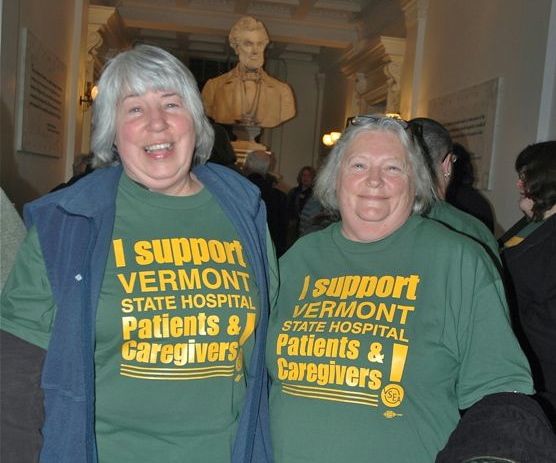
That, in general, is what emerged from morning legislative testimony in the House Human Services Committee and from an emotional, standing room only afternoon hearing that packed one of the largest rooms in the Vermont Statehouse with more than 80 people from around Vermont.
Take psychiatrist Terry Rabinowitz of Fletcher Allen Health Care in Burlington, who said the state’s plan for acute mental health care falls short and marginalizes the state’s most vulnerable population. He called it “not only a disservice but a dishonor.”
“Do we Vermonters want to do this to our most vulnerable population? I think not,” he said.
There’s no shortage of moving parts as Vermont attempts to rebuild its mental health system after Irene wiped out use of the Waterbury state hospital’s 54 beds and the experienced staff who had expertise in treating the most acutely ill patients.
Gov. Peter Shumlin has proposed spreading out 36 acute care beds to replace the state hospital, using three facilities: 14 at the Brattleboro Retreat, six at the Rutland Regional Medical Center, and a new 16-bed facility expandable to 25 beds to be located near Central Vermont Medical Center.
The plan also calls for expanding community services, from emergency intervention, housing, crisis beds, services provided by peers (people who have been in the mental health system and can relate to patients) and intensive local mental health outpatient and residential services. Administration officials contend those services will preempt the need for more acute care beds.
Criticism of the acute care part of the plan has been building as discussion continues in the Legislature and on Tuesday it turned into a crescendo.
In the morning, Dr. Peter Thomashow, medical director of Central Vermont Medical Center, and James Tautfest, a psychiatric nurse who heads the 14-bed psychiatric unit, added their voices to those of other key medical professionals in the state who say the governor’s plan doesn’t provide enough acute- care beds for the mental health system.
In testimony to the House Human Services Committee, Dr. Tomashow said the state needs a 30 to 40 acute care bed facility in central Vermont, much more than the 16-bed facility proposed. He said he strongly supported the governor’s overall plan, but he and Tautfest said the state desperately needs the intensive care “safety net” that the former state hospital beds provided for assaultive and dangerous or self-harmful patients.
His comments mirrored those of the state hospital director and head of Fletcher Allen’s psychiatric unit, who have already advocated a similar number or even more beds. Tomashow said the governor’s plan simply underestimates the difficulty of the patients who were sent to the state hospital, many involuntarily. Professionals in the wards and emergency rooms see things differently, he said.
“We’re talking about the most difficult population in psychiatry,” he said.
He also said the governor’s plan does not provide enough acute care in northern Vermont where the biggest population is, and suggested that an uptick in acute care needs from aging baby boomers means even more beds may be needed in the future.
Tautfest suggested the state consider reopening – only temporarily – a ward at the state hospital to ease the crunch that has existed since Irene, which forced regional and community hospitals to treat patients who would have ended up at Waterbury and has flooded emergency rooms with “very sick” people.
More than 40 people, many of them also nurses, doctors and mental health professionals, as well as relatives and patients, testified along the same lines in short yet emotionally packed 2-minute statements in the late afternoon.
“I do believe that we need a state hospital in one central location, not for or five little bitty ones located around the state,” said Nancy Colby, a Chittenden County resident who said she had 25 years of personal experience with mental illness. She said having several small acute-care facilities would duplicate services and not be as effective as one larger facility.
“We worked with people no one else was able to treat,” said Kristy McLaughlin, a social worker at the Vermont State Hospital. “A decentralized system will not be making us better,” she said, warning that the state’s plan would “demolish” the mental health equivalent of an excellent intensive care unit if the governor’s plan goes through.
Dr. Ruth Grant of Waltham, who said her 20-something son had schizophrenia, said the state needed a “no-reject” acute care full-service facility in the northern part of the state and more beds than proposed. She urged the panel to listen to the opinions of the front-line care providers who were saying the governor’s plan falls short.
Jack McCullough, a legal aid lawyer with long experience in mental health judicial proceedings, agreed that community treatment is the ideal, but when it came to acute beds, he said “my judgment is that scattering beds around the state is not an efficient way to provide care.” And he said the governor’s plan is a “dramatic shift of resources down to southern Vermont” to private facilities, which raises legal issues the state needs to address.
The rights of patients when it comes to involuntary admissions and medication was also a concern to Ann Klein, a nurse at the state hospital. She said staff there were well-trained and kept up-to-date on involuntary procedures ordered by the courts. “We’re the most vulnerable patients’ protectors,” she said, but if the acute care is split into three places, two of which are not state run but private, “there will be no continuum of care.”
Many testified to the benefits of the community care proposals and urged lawmakers to make sure funding is sustained for the long term, noting drastic cutbacks in recent years.
Roxi Smith urged more support for organizations such as Another Way in Montpelier, which provides peer support and has helped her overcome “a lot of my own fears.”
“Peer support works,” she said. “Only people who have had mental illness can understand it,” she said.
Josh Sawyer, 43, of Montpelier choked up as he told lawmakers he had been at the state hospital twice and how Another Way had helped him and now he was on its board of directors.
“I ask you to continue funding for these programs,” he said.
Marla Simpson of Randolph provided a patient’s stark perspective, explaining she was one of the last to be evacuated from the state hospital when Irene hit. She called involuntary hospitalization, seclusion and restraint the same as “psychological rape,” but at the same time she praised the “outstanding” staff at the shuttered state hospital and said a 16-bed northern facility was not enough either for the acute care needs or to maintain expert well-trained staff.
Erica Smith of East Montpelier, a psychiatric nurse for 15 years who worked at the state hospital and now is in community mental health, said community treatment can have “wonderful” results for some people. But she cautioned that people misunderstand the high level of illness that afflicts some patients and some just do not do well in community programs and need intensive care.
“I am very fearful 16 beds is not enough and people are not going to survive in the community with this many beds,” she said.
That was also the message from Allison Hall, a psychiatrist at Fletcher Allen in Burlington. Hall said while she has been on call duty she has seen the hospital struggle to deal with patient emergencies since the state hospital closed. Fletcher Allen, along with the Brattleboro Retreat and Rutland Regional Medical Center and others, has had to take on many added patients in crisis with the state hospital’s closing.
She said she was “very concerned” that the governor’s acute care plans would be inadequate to treat the patients she has been seeing, she said. And she said state hospital staff, who are assisting around the state since the closure, are far better trained and able to de-escalate difficult situations.
“I strongly feel breaking up a strong team and scattering them around Vermont is unwise,” she said.
A physician’s assistant questioned why the state is even considering anything but building a new central state hospital, noting if a “top flight emergency room” had been wiped out in a flood, no one would even question rebuilding it. Mental health patients’ suffering is just as real, he said, and they deserve a top-flight hospital, too. Another psychiatrist made the same analogy, saying the governor’s acute care proposal “falls far short of the current and future needs of the state, ” noting it was tantamount to replacing a specialized cardiac care unit with a community health center.
Alexandra Forbes raised another problem with spreading acute care around to several community facilities. Speaking for the Vermont Psychological Association, she said one centralized facility with several units would provide the best clinical treatment and staff. She added that transferring people among three facilities means transporting them by sheriff in shackles, which is traumatic and humiliating.
“Truly it is embarrassing that the state is not committed to what we really need, a state-of-the-art facility,” she said. “The state should make that commitment.”
Several people lamented that the dispute over beds has overshadowed the larger issue of the positive transformation that the state is undergoing. Others said the state needs to go slow and make sure it gets it right.
Becky Moore, a state hospital social worker, said the rush to come up with a solution to the state’s crisis worried her and reminded her of the saying, “Marry at haste, repent at leisure.” She said an unfortunate “fallout” of the hospital’s closing was that different parts of the system felt they were being pitted against each other.
“It’s a false dichotomy or trichotomy, or whatever, because were all part of the same continuum,” she said. “I implore all of you as you make this decision, as you decide the future or mental health in our state, remember, we need all the parts of the mental health system.”
Mental Health Commissioner Patrick Flood, who sat in on the hearing, has said he finds the testimony in support of community services “very affirming” about the state’s direction. But he insisted despite the criticism Tuesday that the state’s proposal for acute-care replacement beds is “on the right path” and at this point said there was no plan to change it.
He also said the idea of reopening a ward at the state hospital even temporarily to handle some patients is “just not feasible” for a host of reasons.
Correction: Alexandra Forbes spoke for the Vermont Psychological Association; her affiliation was incorrect in an earlier version of this story.

