


MONTPELIER – Gov. Peter Shumlin announced on Tuesday that his administration plans to replace the Vermont State Hospital in Waterbury with a decentralized, “community-based” plan with 40 inpatient beds in four locations around the state.
Shumlin described the emergency closing of the 1935 Brooks building in the wake of flooding from Tropical Storm Irene as a “golden opportunity,” a chance, as he put it, to create a new mental health system that would “deliver the best quality care of any state in the country.” The governor made the announcement at an unusually crowded press conference on the Fifth Floor, with several dozen advocates, lawmakers and hospital administrators in attendance.
The unveiling of Shumlin’s proposal came on the same day a top mental health psychiatrist called for almost the exact opposite of what the governor proposed. Dr. Jay Batra, medical director of the state hospital since 2009 and a professor at UVM, told lawmakers at a hearing on Tuesday that the state should have one central mental health facility serving 48 to 50 patients in order to provide the best clinical treatment and best staffing model.
That accidental juxtaposition highlighted the continuing upheaval created by the state hospital’s closure Aug. 28. The state has been struggling to cope with acute treatment needs as a result of the closure and has rushed to develop a proposal – amid no shortage of conflicting opinions – to present to lawmakers to rebuild the system. Shumlin’s proposal sits atop a tall pile of previous ideas: The debate over the state hospital and what form its replacement should take has stretched on for around a decade. In 2003, the Centers for Medicaid and Medicare Services decertified the Vermont State Hospital because the facility didn’t provide patients with a therapeutic environment. Nonviolent patients with severe mental illness were housed with patients with violent tendencies, making treatment extremely difficult.
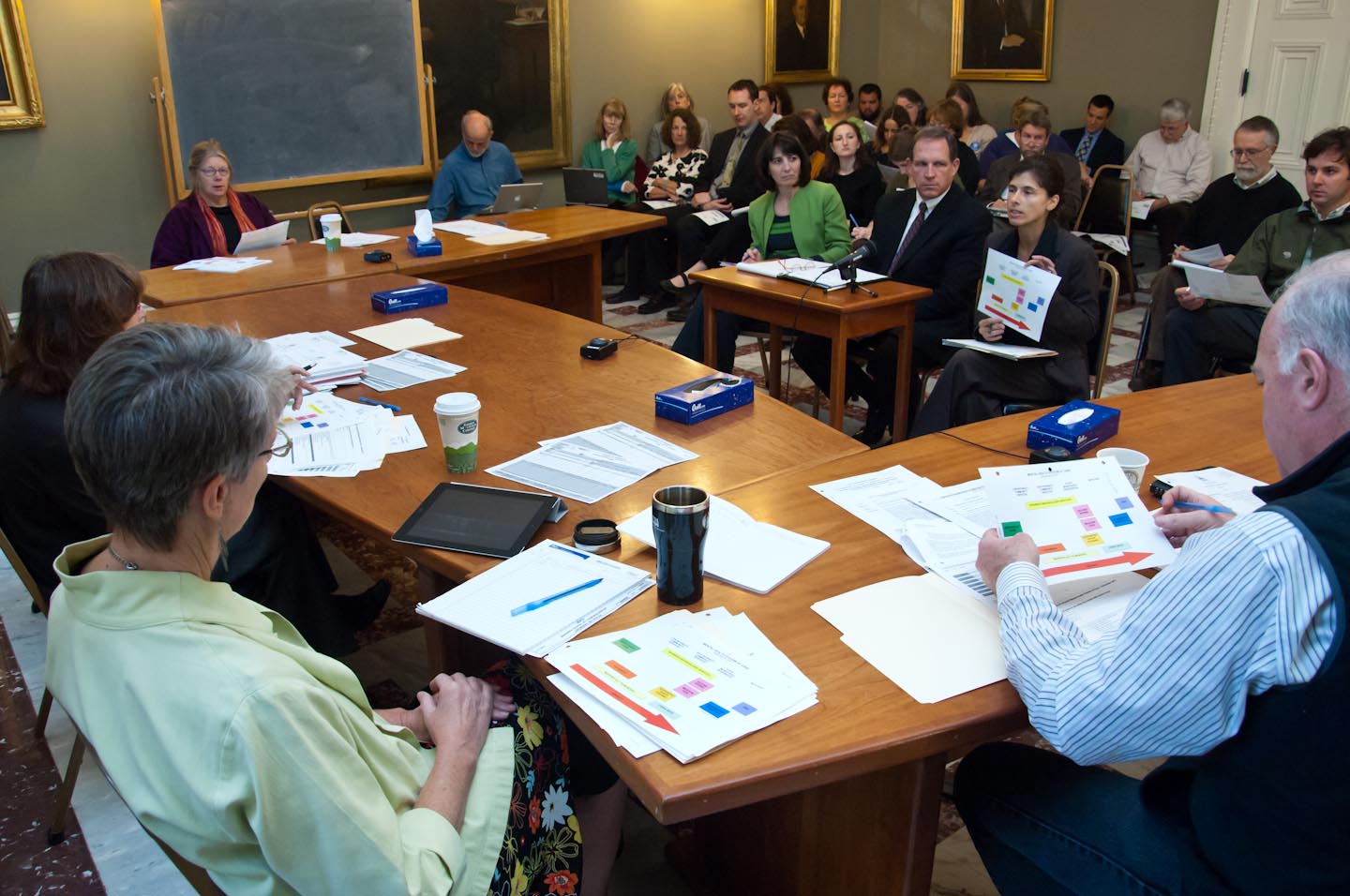
While several mental health and hospital officials gave cautious backing for the governor’s plan at the press conference, one legislator who attended the presser gave the idea a lukewarm greeting. The scattering of the state’s acute care system to four locations also appears to run counter to some parts of a draft report by the Legislature’s Mental Health Oversight Committee also released Tuesday, whose “guiding principles” include a call for any acute care facilities to be integrated and co-located as part of a medical hospital.
“This is really an odd flip,” said Rep. Anne Donahue, R-Northfield, one of the committee’s members and a lead policymaker on mental health issues. She said she supported the administration’s previous move toward one main facility near the Central Vermont Medical Center in Berlin. Donahue is less enthused about the decentralized plan.
“I think now we’ve shifted to expediency: What can we do with FEMA and insurance money instead of paying attention to what quality care means,” she said.
The Shumlin administration must seek legislative approval. On Monday, Jeb Spaulding, the secretary of the Agency of Administration, told a legislative panel that the plan must be passed as soon as possible.
The details of the administration’s proposal call for replacing the 54-bed state hospital with a new 15-bed state-managed facility near Central Vermont Medical Center; 14 inpatient beds at the Brattleboro Retreat; six at the Rutland Regional Medical Center; and up to 5 beds at the Windsor Correctional Facility to handle patients under court jurisdiction.
It also relies on a broad continuum of additional community services, including transitional beds for people moving off acute care, improved emergency services, housing vouchers and peer support, as well as an expanded case management system. The state is working with the designated mental health agencies throughout the state, HCRS in southwestern Vermont; Northwest Counseling Support Services and Central Vermont Medical Center to expand community treatment options.
Floyd Nease, executive director of the Vermont Association for Mental Health and Addiction Recovery, praised the community model and said it has the potential to work if it is “executed well.” He said he would monitor the process” and will be looking for some “canaries in the coal mine” as the system evolves.
The Vermont State Hospital replacement beds are expected to cost $22.5 million a year, or about what it cost to operate the Waterbury facility. The difference now is federal money. The Centers for Medicaid and Medicare, which had decertified the hospital in 2003 and cut off money for patients eligible for federal funding, is now reimbursing the state for patient care in the regional hospital facilities. The 60 percent federal, 40 percent state match makes it possible for the state to invest more money in community services, officials said.
Shumlin said the new system will be “more affordable” and offer better care than could be provided at the antiquated state hospital building. The governor went out of his way to make it clear he felt VSH staff provided excellent care, but were hamstrung by the facility.
The capital investments in facilities would be $26.6 million, most of which would be reimbursed by FEMA and insurance monies, the governor said. The additional community services have a price tag of $16 million, $9 million of which is federal money.
The 15-bed facility in central Vermont would be on 8 acres of state-owned land adjacent to the regional library in Berlin, which is about a mile from the Central Vermont Medical Center. The initial cost officials said is roughly $15 million; Shumlin said expansion would be possible if needed. The 14 beds at Brattleboro Retreat are already being used to handle acute patients who, under the contract with the state, may not be rejected. Capital improvements at the facility would cost about $4 million.
The six Rutland beds are new and would come at a cost of $6 million. The five beds at the Windsor prison ($1.6 million) would be for patients that need to be in a secure setting for transitional housing for legal and other reasons, according to Christine Oliver, the commissioner of the Department of Mental Health. Forensic psychiatric treatment will be offered at the Brattleboro Retreat. Patients will also continue to be treated at the state’s correctional center in Springfield, until the 15-bed facility in central Vermont is constructed.
Differing points of view
In testimony on Tuesday, Dr. Batra told lawmakers that the state needs a state hospital that can treat different types of high intensity patients at one site. In his view, a 48 to 50 bed facility would be the “bare minimum,” based on national and Vermont data and his experience at the hospital. He said the facility should be integrated with a medical hospital and include four-units with 12-15 patients per unit.
Dr. Batra, who was questioned closely by lawmakers, said that a central facility works best because staff can train together and gain the expertise to deal with severely ill patients and patients can get peer support. He also said he felt there was a demonstrated need for 48-50 inpatients state hospital beds.
That view resonated with Donahue, who called the governor’s proposal “untenable” and said it was a “couple of decades behind state of the art” for not co-locating patients in a medical facility. That, she said, “perpetuates the stigma and isolation” mental health patients face.
Donahue also criticized the geographic “spreading around” of patients, which shifts most of the beds to the southern part of the state when she said two-thirds hail from central Vermont and the northern tier.
Becky Moore, a social worker at the hospital who also testified before the mental health oversight panel Tuesday, said after the hearing that the governor’s proposal was “very disheartening” and “ill-advised.”
“I think he’s inadequately informed and and has an inadequate grasp of the most acutely ill of the psychiatric population of the state,” she said.
She said VSH workers were a “well-oiled human hospital machine” with a passion for their work and scattering the workforce was neither cost effective nor the best option for treatment of patients.
Sen. Sally Fox, D-Chittenden, co-chair of the oversight panel, said some of what emerged Tuesday is a “difference of philosophies” between the mental health administration and the staffers who actually work at the hospital on the front lines.
“I think we realize that the state hospital had a place in the system and there’s some different thinking going on,” she said.
The community based system proposed by the governor raises a host of questions. One is what will happen to the 240 state employees who worked at the Vermont State Hospital. They are currently dispersed and working throughout the state at hospitals and other facilities that have taken on acute patients. The governor responded defensively to a question about their future Tuesday.
Conor Casey, government relations director of the Vermont State Employees Association, said he’s pleased the governor wants to move ahead with a state-owned and operated state hospital, but the union has qualms about the much smaller size of the facility, which he said is far from sufficient to care for Vermonters with acute mental illness.
“You’re going to lose a lot of expertise if you choose to privatize the state hospital,” Casey said. “When you have only 15 beds, you don’t have a large enough safety net and you might see … added pressure on correctional facilities as people are rejected from hospitals.”
Casey said lawmakers who will be evaluating the plan need to determine whether the private entities meet the criteria of the privatization contracts under statute. When state employees are replaced by private contracts, the entities are obliged to show that they will provide the same service at comparable cost. Privatization will also likely lead to less transparency as the hospitals and other agencies won’t likely be subject to public records requests, he said.
Another issue is how the administration will move the proposal through the Legislature and how much leeway lawmakers will have to weigh in with their concerns and objections. Deputy Human Services Secretary Patrick Flood discussed with lawmakers Tuesday afternoon, saying he welcomed their input.
Lawmakers will have a say through appropriations via the budget process and also the capital budget, which sets aside money for new construction such as the proposed 15-bed facility in Berlin.
Sen. Fox said there was a clear need to move as quickly as possible considering the stresses on the mental health system, but also noted that any decision would affect care for a long time – Gov, Shumlin said for the next “hundred years.”
“I think the bottom line on this is the Legislature does need to weigh in,” she said.
Editor’s note: Anne Galloway contributed to this report. A write-thru and quotes from Conor Casey were posted at 7 a.m. Dec. 14, 2011.

