
Burlington Police Chief Michael Schirling, left, and Rutland Mayor Chris Louras testifying before the Joint Legislative Corrections Oversight Committee. VTD/Josh Larkin
MONTPELIER — The top police officer in Vermont’s largest city gave lawmakers a street level view of crime Monday — and it wasn’t pretty.
Burlington Police Chief Michael Schirling laid it on the line in no uncertain terms for legislators at a hearing of the Joint Corrections Oversight Committee at the Statehouse, saying criminals are “running roughshod over our communities.”
“Since I last saw you we’ve had the worst year in history,” Schirling said. “The conditions on the street are challenging.”
Schirling oversees 100 officers at the largest municipal police department in the state. He is seeing increased drug problems and violent crimes, a tough economic climate pushing people into crime and awareness that the prison system has space constraints.
But the main issue, he said over and over again, is a revolving door criminal justice system that means there is little consequence for all but violent, higher-level crimes.
“That is the message that’s resonating on the street,” he said. “You’re operating with impunity in a huge cross section of what happens in the system.”
To make his point, Schirling ran through a litany of recent offenders in the city who have cycled through the courts to go back out and commit the same crime, sometimes even the same day they were arraigned.
“I could go on with literally dozens of these cases,” he said, then added one more for emphasis: He told lawmakers of an alleged burglar arrested over the weekend for numerous burglaries, who had a previous record for burglary, who was released and now is the suspect in more burglaries.
“It’s not working,” he said flatly. “We have to deliver a swift and harsh message that that type of conduct will not be tolerated in Vermont.”
He was even more direct about the relationship between drugs and criminal behavior. Drugs, he said, is the “No. 1 thing that drives crime” in Burlington.
“We need a hammer for violent offenders or folks who come to Vermont to deal drugs. That is increasingly a problem,” he said.
From his political seat as Rutland’s mayor, Chris Louras, a former legislator, delivered much the same message about what he called “the revolving door thing.”
“It’s clear that anecdotally, the folks in the street in the Rutland area understand as long as they don’t commit certain types of crimes, they will not be locked up,” he said.
Louras also elaborated on incidents in which criminals commit the same offenses, such as burglary or theft, over and over again — with no consequence.
“That resonates in the community that the system is broke,” he said.
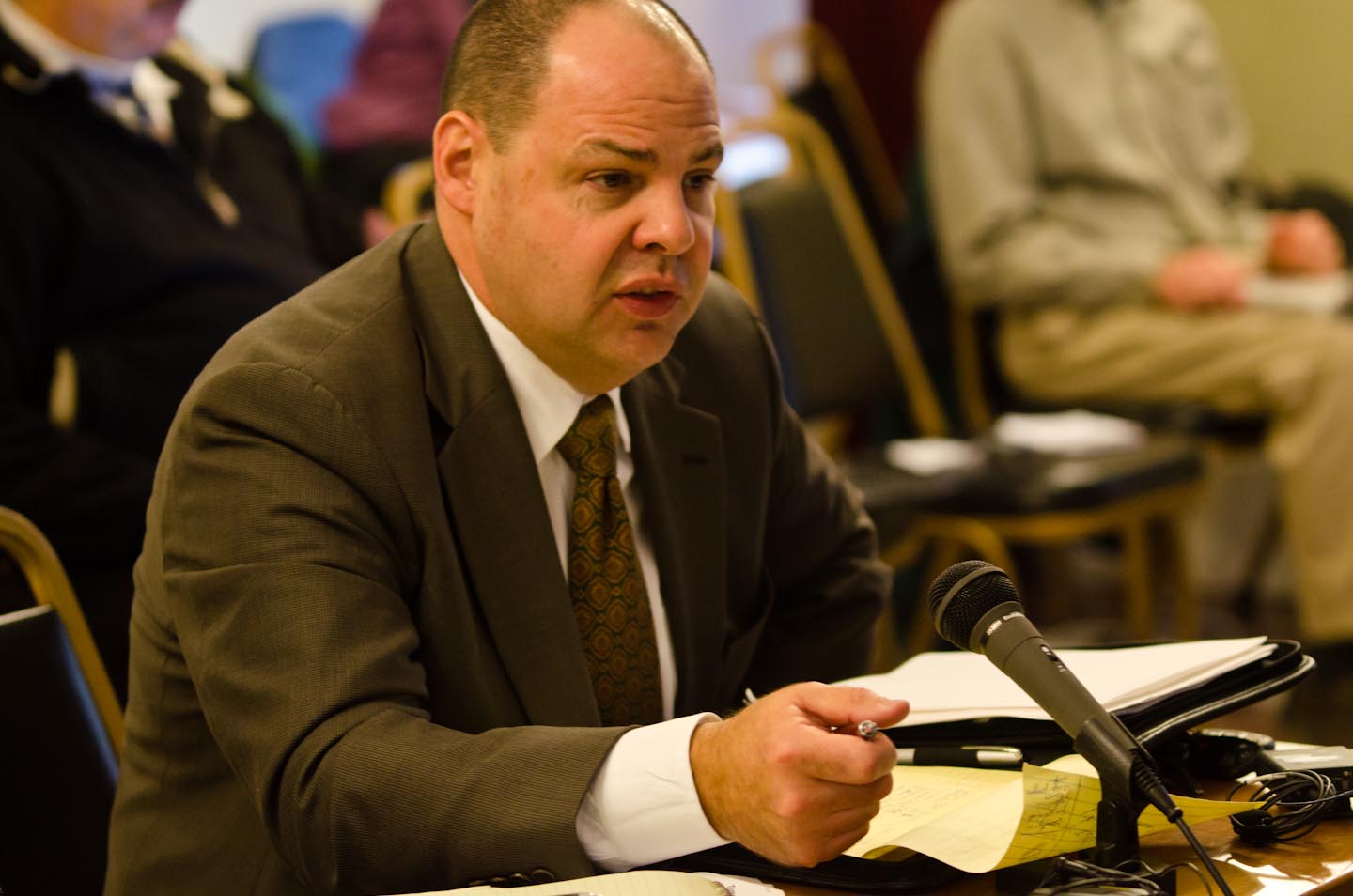
The two ostensibly came to testify about so-called Justice Reinvestment programs, which are locally based plans funded by the state that are designed to cut the recidivism rate.
Schirling made it clear he did not want to imply the criminal justice system “is coming apart at the seams.” He said some programs are working, such as diversion, which sidetracks offenders using innovative methods outside the court system to prevent repeat crimes — and wipe out a criminal record — if offenders meet certain standards.
“Diversion has had great success in Vermont over the decades,” he said.
Transitional housing for offenders newly released from jail is an effective crime prevention program, Louras said. When former inmates have stable housing repeat offenses decline and the system can better cope with a host of issues such as drug dependency that can tip someone back into crime, he said. He said education and counseling and treatment were essential to any success in dealing with crime.
“You can’t just lock people up and expect the problem to go away,” he said.
Schirling said in his opinion the crux of the problem is that there is no consistent “carrot and stick” system for criminals. The “word on the street” is that criminals can refuse alternative justice programs because they know there’s little risk of punishment.
“This is my thesis. If you have a credible threat (of punishment), you will be less likely to have to use that credible threat,” he said.
But his officers and all the street outreach workers are hearing that offenders don’t see any incentive to go into alternative programs, he said, because of a “lack of meaningful sanctions.” According to Schirling, in Chittenden County the state’s attorney’s office is running the reinvestment programs with a $100,000 legislative grant.
For the system to work, Schirling said there needs to be a clear continuum of consequences so offenders know “what’s coming behind is not as pleasant.”
“What we’re failing to do collectively is we’ve not created a system that has predictability to it,” he said. “If you use a marketing analogy, we’re not marketing that we have a justice system that is meaningful in delivery of services and outcomes.”
Offenders are aware that the state is trying to limit how many people end up in Vermont jails, he said.
Louras said communities that decline to help while others like Rutland bear the burden of transitional housing may need to be forced to step up to the plate. It’s a view that is a definite shift in his thinking — one that’s come from being “hit over the head with a brick” by his police chief, he said.
Sen. Diane Snelling, R-Chittenden, said the essential dilemma she sees is that the courts, states attorneys and law enforcement are all separate entities and there is no way to create a “100 percent consistent system.”
“Obviously, it’s a huge problem,” she said.
In morning testimony, corrections officials said an effort to integrate justice and law enforcement information technology is just getting under way. Snelling said the new system would cost about $10 million.
Schirling said his department is finding it incredibly difficult to get court data that allows the police to assess what alternative justice programs work and what don’t. The information is in different systems and has to be entered manually, “which is an enormous amount of work,” he said.
“We need to make an informed decision rather than a random decision, and right now I think we’re stuck with a random decision,” he said.
Monday’s discussions about alternative justice are part of a larger picture in a legislative effort to ease the high cost of incarceration. Charts provided by corrections Monday showed no significant rise or drop in inmate populations but showed that the state is seeing a spike in detainees who clog up jails while waiting for court disposition.
Rep. William Lippert, D-Hinesburg, said he appreciated Louras and Schirling’s frank message about what their communities are experiencing, and he appeared frustrated at the tangled and overlapping jurisdictions that underlie the criminal justice system.
“We’ve got to get these people in the same room at the same time to talk with each other,” he said.


Permalink |
“The Vermont Department of Corrections is a broken system in that its a front based response system, and needs to become a back based preventative one.”
Burlington Police Chief Michael Schirling
December 4th 2008 Ward Six Burlington NPA meeting
Permalink |
Very powerful testimony which fits in with the need to make sure the social fabric does NOT unravel through increased poverty, loss of jobs and lack of adequate mental health and substance abuse programs which can work. This also speaks to the recommendations made by several in the system that we move to decriminalize marijuana use and tax its sale. The quote above is right on! Do we have the political will to tackle this problem in our small state?
Permalink |
Ann, your cogent comments cause me to urge you to visit the Facebook page: CURE VERMONT.
There, you will see some of what the state chapter of Citizens United for the Rehabilitation of Errants is doing.
We need people like you.
Gordon
Permalink |
The VT legislature worked on a bill (I think last session) that would have created a law allowing police to ticket adults smoking in their cars, when there was a child/minor present in the vehicle.
Here is a perfect example of over regulation by government, which ties up resources, and takes police (and our court system) away from more serious crime prevention. Wonder why the police can’t catch the bad guys?
Unintended consequences of legislators trying to save everyone from themselves. You will never be able to legislate common sense.
Permalink |
For many reasons we have become way to soft on criminals
It used to be Do the Crime serve the time – now its do the crime and law enforcement does the time – often time the paper work is not completed and the criminals are back out on the street -
Vermont state is stuck in a bind as it has no funding to go toward law enforcement.As the current economic times bring on more and more crime Vermont has less and less money going into law enforcement and the justice system. We let the violent and dangerous out and that creates more fear in people to not report crimes to local law enforcement
Citizens are also to blame. If they see anything out of the ordinary, they need to report it. Neighbors have to watch out for neighbors.People need not to stick their heads in the sand but rather band together to help.
Law enforcement is trying to do all they can with limited resources You need to support your local and state law enforcement agency 24 x 7 and not only when you have a problem.
We also need funding for more jail space as we suffer from
“no more room at the inn” and we release the criminals before proper time served.
Permalink |
It’s impossible to make sense in a fact-free zone, and that’s what Andrew Nemethy gives us. Not his fault, he’s reporting an self-serving testimony (inherently interest-conflicted) at a public hearing. None of it provides context, scale, measurable data (other than “dozens of these cases,” which means nothing). Anecdote and prejudice and preconceived notions without real world confirmation just produce more wheel spinning activity, where traction becomes a matter of luck, not design.
Permalink |
I live in Saint Albans and we have a revolving door that turns so fast that it must need daily maintenance. This problem is not going to “go away” until and unless, the Governor who campaigned on and stands by his “reasoning” that all non-violent offenders be dumped from our prisons and monitored by the Probation and Parole office, with no viable plan in place to increase staffing or education to the PPO employees.
There is no “victimless crime”. That term is a near-oxymoron. What is a low risk offender??? That depends on the psychological health of the offender. Our Governor all but ordered our Judges to pass out non-incarceration sentences to low level, low risk criminals. I remember the big drug bust/round-up, here in the city, a few years ago; when a State Trooper in the Drug Task Force was quoted as saying that the minute we take them to jail, the judge allows them to bond out.
There need to be enforceable guidelines by which to classify and quantify low, medium and high risk offenders. The state needs a facility for the criminally insane (pedophiles, rapists and violent robbers). We can’t solve the problem without facing the problem from its very beginning and solving each portion in a hierarchy of steps that are cast in stone so that police, judicial folks and PPO folks know exactly how to handle each case. This will require more than a cursory review of each offender and case, which might start with more stringent position description guidelines for the respective departments.
A perfect example of laxity is a Mayor who instructs the Police to set aside the city law/ordinance that forbids overnight camping in city hall park. Instructing law enforcement to disregard the law, is not a good way to handle situations that arise.
No wonder our law enforcers and judicial system are jaded and feeling ineffective.
Permalink |
Mr. Boardman
Please speak to any victim and they will give you fact
Mike
Permalink |
FYI
Vermont Constitution of 1777, Preamble
Thorpe 6:3737
Whereas, all government ought to be instituted and supported, for the security and protection of the community, as such, and to enable the individuals who compose it, to enjoy their natural rights, and the other blessings which the Author of existence has bestowed upon man; and whenever those great ends of government are not obtained, the people have a right, by common consent, to change it, and take such measures as to them may appear necessary to promote their safety and happiness.
Permalink |
Sounds like the chief wants to militarize the Burlington police department like big cities have done across America. This is a direction that has been warned about since the times after WWII. What is needed is jobs and not more police jobs, but real jobs for real families that are taking it hard in this recession. The reason for crime rising is for just that reason. So the answer is not more cops but jobs, jobs, jobs. Police mentality won’t solve this supposed crime rise.
Permalink |
My question is simply, which private prison company is funding the gentlemen who gave this testimony? Follow the $$$.
Permalink |
Tom and Breda
Did any of you take a second to stop and think about the poor people who are the victims. What happens when you fall victim to crime Tom and Breda ? What happens when a family member falls victim to crime I bet you will not down play it then. Yes we do need jobs and we do need prisons private or not but I will tell you one thing its never nice to be a victim of crime – I was one I hope you never are.
Permalink |
Michael,
I’ve been the victim of crime but I’ve also been the victim of flagrant and serious police misconduct right here in Vermont.
Vermont by the way is three and a half times the national average for police misconduct per capita of it’s police officers (NPMSRP.)
Our “Victim Services” in Vermont is a JOKE and its highly discriminatory, giving preferential treatment to women over men.
“Victim” is a universal word which applies to those who have been unlawfully and seriously mistreated by police as well, not just criminals.
We need police yes but when the enforcement of our laws becomes such an industry that we’re playing on the fears of a peaceful public just to make a buck, we’re actually building on incarcerating individuals with the “Clean the streets” mentality. Many need other services, NOT PRISON.
Vermont’s prison population EXPLODED within the past ten to fifteen years which is completely uncommensurate to the crime rate.
Prison will not help drug addicts nor the mentaly ill. It will make them much worse at exhorbitant cost to the tax payer. Prison is not the panacea you may think it is.
Prison is a LAST RESORT and should be treated as such.
Re-read Michael Schirling’s quote above. Seems right on to me.
Christian Noll
BS/MS criminal justice
author/publisher
Permalink |
“Burlington Police Chief Mike Schirling made headlines this week by suggesting that efforts to keep nonviolent offenders out of prison have emboldened criminals. Criminal justice officials, however, say there’s no data to support the claim.” … ‘Data, officials contradict chief’s dire warnings about crime’, Times Argus, 12/01/2011
Maybe we could get a follow up to the original story here?