

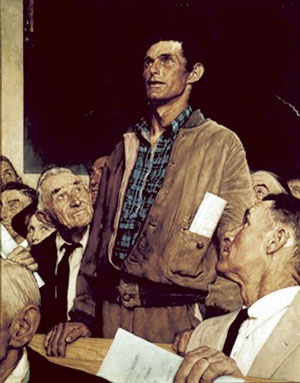
Editor’s note: This essay by Greg Guma is from The Vermont Way: Restless Spirits and Popular Movement, a new study of the state’s evolution and influence slated for release in 2012. To find out more, visit The Vermont Way.
Like a perennial flower that defies climatic change, local control has re-blossomed in Vermont almost every decade since the state’s birth. The forces nurturing this perpetually endangered species have changed – from temperance activists and radical populists in the state’s early days to peace activists and greens in the 1980s, conservative Republicans in the late 90s and the independence movement of recent years. But it never fails to stimulate the public’s political senses – or highlight the distance between image and reality.
The enduring image – some consider it a myth – is that Vermont has a unique democratic heritage tied to traditions like town meeting, a citizen legislature and resistance to centralized power. This is at the root of Vermont’s sense of difference, that hard-to-describe attitude sometimes called the Vermont Way. The term has been used to describe everything from the traditional way to make maple syrup and smart farming practice to a political campaign agenda and the ability to make something out of almost nothing. Sometimes it is extended into the phrase “Vermont way of life.”
When he left the Republican Party, Jim Jeffords said, “Independence is the Vermont Way.” In her autobiography Consuelo Northrup Bailey, a native Vermonter who was the first female attorney admitted to practice before the U.S. Supreme Court and in 1955 became the first female lieutenant governor in the nation, said the character of Vermont was defined by “everyday, common, honest people who unknowingly salted down the Vermont way of life with a flavor peculiar only to the Green Mountains.”
Authors Frank Bryan and John McClaughry tried to define it in The Vermont Papers, their decentralist manifesto: “God-given liberties, their hostility to the central power, whatever it may be, their attachment to their towns and schools and local communities, their dedication to common enterprise for the common good – all these have been among the most cherished Vermont traits, the subject of countless eulogies of Vermont tradition over the years.”
That said, the two libertarian thinkers also admitted that reality is something else. While the 1777 Vermont Constitution included some open government provisions, celebrated the consent of the governed – in theory, abolished slavery and created a comprehensive education system, it also placed considerable power in the hands of the governor and his Council. It has even been argued, notably by historian Nicholas Muller III, that “early government in Vermont functioned more like an oligarchy than a democracy.” Before the State Senate was created, the Council with the Governor combined the power of an upper legislative chamber with the executive branch.
Today Vermonters still elect six statewide officials every two years. Under the original plan, there were annual elections for 15 jobs, including the governor, lieutenant governor, treasurer, and 13-member Council. Councilors could simultaneously serve as Supreme Court Justices. The result of this system was centralized power and few losses for incumbents, leading to longer tenure in office.
After about nine years, before Vermont became part of the United States, the original Constitution was amended, creating something closer to what exists today – three separate branches of government with distinct powers. But the Governor’s Council survived for another half century, and the Council of Censors was retained. This Federalist-inspired holdover from pre-revolutionary days was supposed to somehow oversee both the governor and legislature, making sure that laws were handled properly and the Constitution was being followed. If not, the Censors could call a convention and propose amendments.
Although doubts arose early about how Censors were elected, its vulnerability to partisan control and some proceedings marked by prejudice, Vermont hung onto this unusual institution until 1870. In its first 40 years, only one of its proposed amendments was ratified, however, and that one denied voting rights to foreign-born citizens until they were naturalized.
According to Ira Allen, there was little support for the Constitution anyway. Had it been submitted to the people, he wrote in his history of the state, “It is very doubtful whether a majority would have confirmed it.”
He should have known. Allen was on the Council from the start, along with his brother Heman, trusted associate Thomas Chittenden, Jefferson ally Matthew Lyon, and other Allen associates. This tiny group controlled negotiations with the British during the revolution, the composition of the early Supreme Court, and, for several decades, almost everything that made it through the General Assembly.
The rise of Town Meeting Day
On the other hand, Vermont had the tradition of Town Meeting Day. The roots of the idea went back to England and the Massachusetts Bay Colony, and eventually spread through most of New England. In the days of the Bay Colony, the sense that participation was a social obligation was so great that fines were sometimes imposed for non-attendance. But the crucial business conducted in the 19th century was largely appointive. For example, residents would gather to select “tything men” to act as the general police, and sometimes also pound-keepers or supervisors – known as “reaves” – who cared for hogs and other animals.

In the early 20th century Town Meeting Day gained some traction, becoming the main way for local communities to exercise some measure of control over an increasingly broad range of public affairs. At its best, it epitomized the value of equalitarian democracy. On the other hand, attendance was 20 percent or less in many places, and business was often decided by rural bosses before the formal meeting began. Over time growth brought increased complexity, while state and federal government assumed more local responsibilities, leaving a ceremonial shell in which the purchase of a truck became “major” business.
Frank Bryan began observing these meetings in the late 1960s. In early analysis, he found that participation was relatively greater in smaller towns, that educational level didn’t influence the level of involvement and increased use of the Australian ballot threatened to kill the tradition. He also talked about the “atomizing” of local authority; basically, the shifting of local functions to various regional groups and the state left towns with little to draw residents each year.
In the 1970s, however, a new type of business began to appear on Town Meeting Day agendas – resolutions that dealt with issues beyond the usual boundaries of local government. In 1976 anti-nuclear activists brought up items that called for the banning of nuclear power plants or the transportation and storage of nuclear waste. People knew the towns had no way to enforce such a decision, and yet by 1977 more than 40 communities took such a stand. In subsequent years a majority of Vermont towns voted for a nuclear weapons freeze – a campaign that gained national recognition by 1982 – issuing instructions to the state’s congressional delegation to help lead the charge. Federal officials eventually took their advice.
At the time Bryan and other Town Meeting boosters were concerned that “larger” issues might begin to dominate the annual gatherings and reduce attendance in the long run. In 1974 he had predicted “the functional death of the Vermont town” as rural political systems became “more closed than open, more individualistic than communal, and politically more passive than active.” But in a 2004 book, All Those in Favor, he was more optimistic, praising the global impact of local votes on the nuclear freeze “because the world knows that town meetings are authentic, democratic governments and Vermont has the healthiest system of this kind of government anywhere.”
Pointing to a series of social innovations – from challenging slavery and McCarthyism in the past to leading the national debate on environmental protection and gay marriage in more recent times – he and co-author Susan Clark argued that Town Meeting is the reason Vermont “consistently places better on indices of achievement in the areas of good government, civil society, social capital, collective generosity, and political tolerance.”
Among their observations:
- An average 20 percent of eligible voters attend Vermont town meetings, a more significant figure when you consider the amount of time involved and the fact that voter turnout for local elections across the United States is only 25 percent.
- 44 percent of those who attend actually speak — a high number for any legislative process.
- Women fare better than in any other part of the U.S. political system. Less than 20 percent of the Congress is female; in the Vermont state legislature it is around 30 percent. But according to 2003 study of 44 town meetings, 48 percent of those involved in passing local budgets and setting the tax rate were women.
- The level of participation varies widely. Small towns average more than 30 percent attendance, while only about 5 percent show up in larger communities. Bryan and Clark suggest that town meetings aren’t that effective in participatory terms when the community grows beyond 5,000 people, and recommend that larger places consider either a representative town meeting or division into “neighborhood meetings.”
Aside from the Australian ballot, which lets voters avoid discussion and instead use pre-printed forms, the largest threat they see is the long-term loss of decision making power to other levels of government. Until 1947, Vermont towns conducted their own business on Town Meeting Day without much state interference. Since then, however, the Legislature has been tinkering with the process, gradually usurping local power in more areas. In response to town meeting initiatives like the nuclear freeze votes, for example, there was an attempt in 1983 to raise the petition requirement for placing items on local ballots. It didn’t happen, but the intention was clear – to make it harder for people to raise issues not in favor with elected leaders.

Political power rests with the state
This dynamic illustrates an inconvenient fact. Although the state has a tradition of local democracy and an accessible citizen legislature, it also has one of the nation’s most centralized governments, due in part to the weakness of county structures. Beyond that – and also contrary to myth – both its citizens and leaders, progressives and conservatives alike, have repeatedly opted to expand the state’s authority in areas ranging from roads and the environment to health and education. Much of what makes Vermont attractive to those bewitched by its image can be traced to the use of state power.
Based on the state’s contemporary image as a liberal stronghold, it is easy to forget that Republicans largely made Vermont what it is today. GOP governors were among the most ardent early proponents of a statewide tax to fund education. Governor Ernest Gibson Jr. said – as early as the late 1940s – that the greatest problem facing Vermont was “equalizing educational opportunity and distributing the costs as equally as possible among the towns and school districts.” Thirty years later, another Republican, Richard Snelling, called for a state-administered property tax to spread the burden between rich and poor towns. The proposal failed when rich towns squealed, while communities that would have come out ahead worried instead about a loss of local control.
Despite such occasional setbacks, Republican leaders had little difficulty embracing centralization for most of the century they dominated Vermont politics. After the Civil War, the issue was state aid to highway programs, designed to help farmers transport their milk.
In the early 20th century, under Fletcher Proctor, it was centralization of rural schools and industrial education. Far from being a libertarian, Proctor also supported prohibition, only relenting when a “local option” movement for liquor licensing threatened to overturn GOP rule. Subsequently, he struck a deal with liquor distributors and managed to maintain state control of local license committees.
Republicans were firmly in command when the state stepped into education management, passed and increased the income tax, and established the state highway system after the flood of 1927. In each case, they were accepting reality; namely, that local communities needed outside help. By the 1940s, it was common knowledge that individual towns couldn’t handle all the necessary services properly on their own. In addition to looking at education, Gibson established the State Police and argued that state government should take the leading role in providing for public health and welfare.
Although Phil Hoff was both praised and blamed for expanding state services and power in the 1960s, the stage was actually set by yet another Republican. In the late 50s, insurance executive Deane Davis chaired the Little Hoover Commission, a reorganization study that called for agency consolidation and more control by the governor. The buzzwords then were simplification and efficiency. A decade later, Davis succeeded Hoff and presided over the formation of what became known as “super agencies.” It was precisely the type of bureaucratic centralization that Republicans today view as a threat to personal rights and local autonomy.
Davis, who succeeded Hoff as governor in 1968, was also “godfather” to the first major land development control law in the country, Act 250. Like Hoff, he wanted a statewide land use plan, but was blocked by large landowners and conservatives in his own party. Though he euphemistically labeled the approach “creative localism,” the main objectives were to regulate development and protect the environment through consistent statewide policies. In more optimistic and trusting times, these sounded like common sense notions that might actually help local areas cope with development pressures. Thus, when Snelling proposed a statewide property tax he was building on an established Republican stance, the moderate centralism of the Vermont party’s Aiken-Gibson wing, a combination of populist rhetoric and policy pragmatism.
In recent years, state government has increasingly regulated, and sometimes even negated, changes in local policies and practices. The legislature’s 1989 attempt to strip local communities of the power to choose alternatives to the property tax is only one episode in that struggle. On the other hand, people have continued to use Town Meeting – in many cases the only forum open to them – to influence the policies and decisions of “higher” levels of government.
Advocates of local control and direct democracy are a diverse bunch, and not always the most comfortable of allies. But they nevertheless share a sense that Town Meeting and other forms of local power can still be effective in countering the seemingly inexorable movement toward centralized systems of authority. The main advantage of centralization is said to be efficiency, by no means a small matter. But without widespread participation at the grassroots efficiency can degenerate easily into stagnation or repression.
Participation in Town Meeting is a process of self-regulation that can benefit both the community and its neighbors. It isn’t just a quaint tradition, to be praised but set aside when it is convenient. It is the heart of political democracy.

