

For family, friends and loved ones, a suicide has profound effects, with the added burdens of guilt and questions about missed signals and chances for intervention.
Yet because suicides are often largely private tragedies and not widely reported by police agencies — many may be quietly categorized as a drug overdose — they rarely capture the public eye in the same way a tragic auto crash, homicide or accidental shooting death does.
Two recent, publicized suicides reported in the last week have drawn attention to the issue. One involved 35-year-old Josh Pfenning a transient who police believe shot himself to death inside a tent at the Occupy Burlington encampment in City Hall Park Thursday night. On Monday, state police said a student at Castleton State College, Brian Dagle, age 19 of East Lyme, Conn., died of a suspected suicide.
New statistics also provide grim visibility on the issue — and added impetus for policy makers who are redesigning the structure of Vermont’s mental health system after the closing of the Vermont State Hospital.
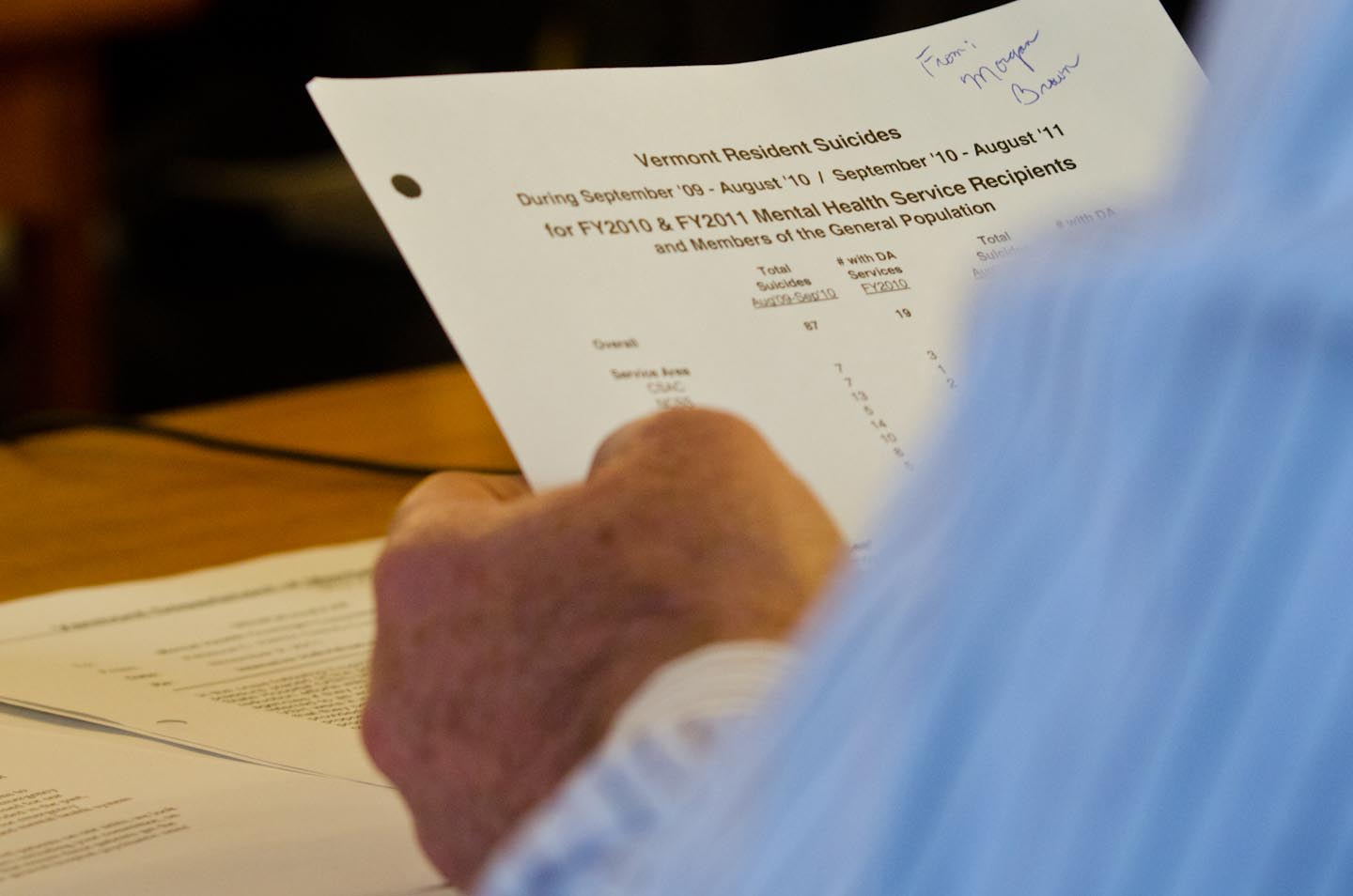
The figures, compiled and released Nov. 4 by the Department of Mental Health, show a 15 percent jump in suicides in the last two years. The report, culled from Vermont Department of Health data and information from 10 other agencies, found there were 87 suicides in the state between Aug. 2009 and Sept. 2010 and 100 suicides between Aug. 2010 and Sept., 2011.
The most recent figures show that the majority of suicides involve older adults: Thirty-one in the 30-year-old to 49-year-old age group, and 48 in the ages 50 and up category. Nineteen people under the age of 30 killed themselves in 2011. The majority of suicides in Vermont are male (82 males and 18 females based on the 2011 figures). Certain geographic areas, such as Rutland (from five to 10) and Springfield (14 to 22), have also seen increases.
Deputy Human Services Commissioner Patrick Flood asked for the compiled figures after mental health organizations and advocates raised questions about the state’s tracking system following the closing of the Vermont State Hospital in Waterbury. The hospital served clients in acute crisis and its emergency closing caused chaos in the mental health system.
Mental health blogger and advocate Morgan Brown of Montpelier asked the state for statistics after the hospital closed, and recently posted a story on his blog about the implications and causes for the increase.
Brown said anecdotal reports from the state’s 10 community mental health agencies and emergency services providers that left him ”a little bit shocked” and prompted him to press for up-to-date figures.
He said that he felt the state needed to keep better track of statistics since “suicide is a huge indicator” of problems in the mental health system
“It seems like the tracking stopped happening after 2006-2007,” he said.
Previous reports show a mix of suicide reporting methodology and reports that make year to year comparisons difficult.
A study from the Health Department from 1999-2005 cites suicide as the 9th ranking cause of death in the state. Over that period there was an average of 80 suicides a year, or 1.5 every week. That same report showed that for each suicide in 2006, as many as five suicides were attempted, two-thirds of them by women.
Vermont had 13.7 suicides per 100,000 people, according to the report. The U.S. average was 12 suicides per 100,000.
A 2008 report on the Health Status of Vermonters indicated the suicide rate was 14 per 100,000 in 2004. The state’s goal was 4.8 or less. A previous report found Vermont’s suicide rate varied from just above 10 per 100,000 in 1988 to a high of 17.9 in 1988.
In 2007, the Centers for Disease Control in Atlanta, Ga., as cited in a recent article by Art Woolf in a post on Vermont Tiger, found:
- Vermont has the 16th highest suicide rate among the 50 states and well above the U.S. average of 11.3. Most of the states with higher suicide rates are in the West.
- Only two states east of the Mississippi River, Kentucky and West Virginia, had higher rates than Vermont.
- Connecticut, Rhode Island, New Hampshire and Massachusetts had rates below the U.S. average. Maine’s rate was just under Vermont’s.
Brian Remer, the project manager for Vermont Youth Suicide Prevention in Brattleboro, said suicide remains an uncomfortable subject that is difficult for people to discuss, and mental health issues such as depression still are viewed as a “sign of weakness.”
“We know now that’s not the case,” he said, but society isn’t ready to view coping with a mental health issue the same as a physical injury such as a twisted ankle or diabetes. “It will be a great day when people have the same attitude about mental health conditions,” he said.
According to the Centers for Disease Control, “every 15 minutes, someone dies by suicide in this country” and for every person who dies, there are many more who plan or attempt suicide. The CDC singles out mental health issues as a primary underlying factor, saying 90 percent of suicides involve a mental health issue, including abuse of drugs and alcohol. Underlying chronic diseases and ailments and difficult personal and family problems and bullying can also be significant factors, according to the CDC.
Mental health officials say suicide can be prevented if peers, teachers, family and friends offer help — even when they don’t have answers. His project, Vermont Youth Suicide Prevention, is run by Brattleboro’s Center for Health and Learning, and has a three-year $1.5 million grant to prevent suicides among young people. The nonprofit is working with a wide variety of groups to help them recognize warning signs and get early screening and interventions, which prevent problems from become more severe, and more costly to treat.
Brown, who had his own personal crisis with suicidal feelings in the 1980s, said getting a handle on the size and nature of Vermont’s problem is a first step. But he worries that cutbacks to the mental health system and the closure of the state hospital may be leaving some people in crisis without immediate access to help from a mental health screener or agency.
“My understanding is not everybody gets seen,” he said.
“I think our suicide rate’s too high and I would like to see more done to make it lower. One suicide is one too many for me,” he said.
Editor’s note: In the editing process, we mistakenly omitted a citation to a blog post by Art Woolf on Vermont Tiger. We also incorrectly reported that the suicide rate was up by 13 percent in 2011. We miscalculated the figure. The rate increase is 15 percent.

