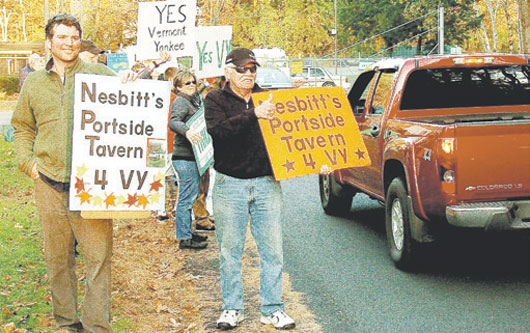
Cameron and Dick Nesbitt of Nesbitt’s Portside Tavern in Vernon show their support for Vermont Yankee’s workers at a rally at the plant on Sunday. Photo by Randolph T. Holhut.
This article, by Randolph T. Holhut, was first published in The Commons.
VERNON — Workers during Sunday afternoon’s shift change at the Vermont Yankee nuclear plant were greeted by a group of sign-carrying people standing at the gates.
Only on this day, the people standing in front of the plant were waving and shouting their encouragement.
In what Vermont Yankee Site Vice President Michael J. Colomb said was likely a first at the plant, about 30 people gathered to express their support for Vermont Yankee.
“They see a lot of the other side, so it’s good for the workers that they get to see some supporters at the gates,” said Colomb.
The event was organized by Howard Shaffer, Meredith Angwin, and Cavan Stone, who are part of the Energy Education Project, which is sponsored by the Ethan Allen Institute, a Vermont-based, conservative-leaning think tank. The project was created to provide “reliable and unbiased information about energy in Vermont,” according to the project’s website.
“We wanted to pep up the people who are working here during the outage,” said Shaffer, a former nuclear engineer who lives in Enfield, N.H. The plant is not producing power as it undergoes its every-18-months refueling operation.
“We timed this event so it would happen during a shift change, so we can let the workers know they have support,” Shaffer said.
“People working in nuclear power get a lot of negative blowback,” said Angwin, a physical chemist and former project manager at the Electric Power Research Institute who writes the “Yes Vermont Yankee” blog. “There has been a lot of tension here over the last few months with the trial and the uncertainty over the plant’s future.”
Entergy, the owner of Vermont Yankee, is awaiting the outcome of a civil suit it filed in U.S. District Court. It is suing the state of Vermont, challenging the state’s role in regulating the Vernon plant and the Legislature’s decision to bar the state Public Service Board from issuing a Certificate of Public Good.
The town is really hopping now with all the workers here for the refueling. When they’re here they’re not just working and leaving, the town benefits from them. They’re buying groceries, renting rooms and hotels, and shopping at the local stores.”
- Cavan Stone
The U.S. Nuclear Regulatory Commission issued a 20-year license extension for the plant earlier this year, but the state CPG is necessary under state law for the plant to operate past the expiration of its original operating license in March 2012.
Cheryl Twarog of Keene, N.H., understands the financial pressure workers are under. She was there Sunday with her two children, Cam, 11, and Evan, 14. Her husband, John, has worked at Vermont Yankee for 12 years, and he stopped by the rally before he started the overnight shift.
“We have had some very sleepless nights,” Cheryl said. “It’s a bad place to be when your major source of income is being threatened. And we certainly aren’t the only ones going through this.”
John, who works in operations, said he and the other 650 workers at the plant are now joined by about 850 outside workers that are assisting with the current refueling and maintenance outage.
“We’re working at a very fast pace,” he said. “We’re on a tight schedule to get the work done, and it’s being done around the clock.”
While most of the people who showed up on Sunday came from the area, Dick and Kay Trudell drove from Grand Isle — about as far away as you can get from Vernon and still be in Vermont — to be part of the event.
“We support the plant,” Kay Trudell said. “We think it is safe, and we want it to keep on being safe.”
“We can’t afford to shut down a good source of electricity,” Dick Trudell said. “If this reactor is near the end of its life, they should be making plans to build another one here.”
As workers arrived at the plant, they honked horns and waved at the supporters.
“You can see their faces light up, especially the out-of-staters,” said former state Rep. Patty O’Donnell of Vernon. “They’re not used to seeing something like this.”
Cavan Stone, who the runs the Energy Education Project web site, said that the positive response from workers was one of the primary reasons why they decided to rally at the plant.
“We appreciate all the work they do, and all the jobs they provide,” he said. “The town is really hopping now with all the workers here for the refueling. When they’re here they’re not just working and leaving, the town benefits from them. They’re buying groceries, renting rooms and hotels, and shopping at the local stores.”
One of those local businesses benefitting is Nesbitt’s Portside Tavern, about a half-mile from the plant.
Cameron Nesbitt and his father, Dick, said business has been brisk with the arrival of the out-of-state workers. “We refuel the refuelers,” Dick said.
Angwin said the rally was held last Sunday so it would not conflict with an anti-nuclear rally planned for Oct. 30 from noon to 3 p.m. That rally is organized by the SAGE Alliance, a consortium of anti-nuclear groups. For more information, visit the group’s website.


Permalink |
The irony should not be lost on people that after spending millions of dollars on an ad campaign designed to convince Vermonters that this plant, and this company, are something that it is not, they were only able to drum up 30 people to support the plant.
One would be led to believe that with the orchestrated letter writing and media campaigns that there is overwhelming support for this leaking, aged plant and its owners who misled regulators under oath.
Apparently, people have not forgotten that the plant caught fire; that its cooling towers collapsed, not once but twice. They have not forgotten that the plant sprung three leaks in three days in the opening week of the legislative session. They have not forgotten that the plant’s owner, Entergy, attempted a clever Ponzi scheme first called Spin-Co and later changed to Enexus; a plan to shelter the parent company from liability. People have not forgotten that the control room opertor tested positive for pot. They have recently learned that those responsible for misleading regulators, legislators and Vermonters were rewarded for their misbehavior with nice jobs.
It’s nice to see that the local bar is “refueling the workers”. One wonders if this is the bar patronized by the person who was in charge of the substance abuse program at the plant who blew a positive reading on a Breathalyzer upon returning to work after lunch.
All in all it’s amazing that they were able to muster 30 people to support this company.
Permalink |
Bravo Supporters of Vermont Yankee! We’ve just sold Vermont’s largest power company to a Canadian company who is pushing to sell power to Vermont from Hydro-Quebec. Now we’re trying to shut down Vermont Yankee over safety concerns? I don’t buy it, there’s more going on than anyone’s saying. This would put a lot of Vermonter’s out of work and shift those jobs to Canada.
Permalink |
So Dan, just so I understand correctly, you’re not really interested in whether or not the plant is safe, you’re only interested in whether or not someone is going to make a buck. Is that about right?
And before you decide to label me as a left wing anti-nuclear commie, let me just say that I have no problem with nuclear power. There are plants all over the world that are safe, clean and up to snuff. VY is none of those things. It’s old, its tired, its leaky and its time to shut it down.
Somehow I think that health concerns trump your compulsion to make a buck.
Permalink |
Weird, I never see references to VPIRG or GMD, etc referenced as “liberal” leaning institutions.
Nor is Bob Stannard noted as a PAID anti Nuke Lobbyist
Permalink |
@ Roy:
“So Dan, just so I understand correctly, you’re not really interested in whether or not the plant is safe, you’re only interested in whether or not someone is going to make a buck. Is that about right?”
So, Roy, just so I understand correctly, are you admitting that Vermont’s concern with VY is safety? Because Shumlin and Sorrell claim that it isn’t, and they paraded a bunch of witnesses to the stand at the recent trial, who all said, under oath to tell the truth, that Vermont’s concern in attempting to shut down VY was NOT about safety, but rather about other things, because they understand that safety regulation of nuclear power plants is exclusively within federal jurisdiction.
Most of us who weren’t born yesterday recognize that the Vt. state senate vote last year was EXACTLY about safety despite Team Shumlin’s efforts to pretend it wasn’t. It seems you are recognizing that as well.
At least you’re telling the truth, unlike Shumlin, Sorrell, and everyone else involved in the charade of that vote.
Permalink |
@edd Admitting? Yeah edd I’m admitting MY concern is safety. I’m not a member of the Legislature or the Attorney General or the Governonr. I didn’t look at the evidence they looked at nor have I explored the legal argument behind their claim. I have no standing in the legal argument one way or another so it doesn’t make any difference what I “admit” to now does it? And edd, as a card carrying member of the right-wing republican crowd, tell me how it is that in this instance you champion the role of the federal government over state interests yet in every other instance you scream about federal intrustion? You can’t have it both ways edd. Oh, I forgot. You guys like the Federal Government when they are putting a buck in your pocket. Does this scream hypocritical to you Edd??
Permalink |
You folks seem to (again) be forgetting that VY is not a good deal for Vermont, which is why our utilities have had to go elsewhere for power. Both HQ & Seabrook have offered better deals than VY.
Permalink |
“And edd, as a card carrying member of the right-wing republican crowd, tell me how it is that in this instance you champion the role of the federal government over state interests yet in every other instance you scream about federal intrustion? You can’t have it both ways edd. Oh, I forgot. You guys like the Federal Government when they are putting a buck in your pocket. Does this scream hypocritical to you Edd?”
Mr. Moss, can you tell me a couple of things. First, can you tell me where you derived that I am “a card carrying member of the right-wing republican crowd”? I only vote Democratic. Like hundreds of union members who support VY.
Second, can you tell me where you deivered that “in every other instance you scream about federal intrustion?” I don’t recall every doing any such thing. But maybe you can point out where I did that.
Thanks.
Permalink |
@ edd foerster Well I stand corrected. One naturally assumes that someone that is willing to throw the health and safety of his neighboors under the bus for the sake of a buck must be a right wing Republican.
Permalink |
Sure, like all the union workers at the plant. They must all be “right wing Republicans.” And like all the communists and socialists in France who strongly support their country’s nuclear energy program. Your opinion that everyone who supports the continued operation of VY is a “right wing Republican” makes no sense at all.
Maybe you should consider the possibility that not everyone thinks there’s any danger. Not everyone share’s your opinion.
I live close enough to the plant that if I thought there was any danger, I wouldn’t be supporting it. And I have kids.
Try to see that there are reasonable, rational people who don’t see it your way.
Permalink |
This is a good time to clear up some confusion about the question of safety and the Vermont Yankee court case.
Edd Foerster suggests that an individual – in this case Roy Moss, is “admitting that Vermont’s concern with VY is safety.” Roy correctly responds that, as an individual, his admission is irrelevant. Nothing in law prevents individuals from taking positions on any issue they please wherever they please. That’s precisely what the First Amendment is all about.
Let’s go just a bit further however. The Atomic Energy Act preempts States from REGULATING nuclear power safety and radiological concerns, NOT from expressing them. Not only are ALL Vermonters, INCLUDING state officials free to express their concerns; they’re also all free to act on them in the legally permitted forum: which is Congress and the NRC. Indeed, States have the right to intervene in NRC proceedings and do so frequently.
The issue being litigated in federal court is quite separate: namely, whether in successive acts requiring legislative approval for a certificate of public good, the Vermont legislature intruded itself into the NRC’s regulatory field, as Entergy alleges, or whether, as the State maintains, the decision to hold legislative votes (and ultimately, the Senate vote itself) can rationally be attributed to those aspects of power generation which are OUTSIDE of the NRC’s range of concerns, and acceptably within the State’s fields.
I will not re-litigate the case here. The point is that there is nothing whatever contradictory, preempted, or illegal in Shumlin or other state officials taking positions about VY safety. Indeed, as public officials, I would argue that is precisely what they SHOULD be doing. The only legal question is not WHETHER this is the case, but WHERE they should be acting on their concerns.
Permalink |
That’s a good description of the situation, and one that I’ve never seen articulated before.
I always thought it made little sense for Entergy to argue that the MOTIVE of a specific move was of such importance, because the motive of a legislative body is so hard to prove.
At the very least the legislature could simply say they were doing it to please their constituents, which would be an easy way of passing the buck someplace where no one can chase it.
In this case regulating the safety would be trying to pass a law stating that the plant had to make certain upgrades, or operate in a certain way, that the state deemed more safe. THAT would be the NRC’s job, and NOT something the state would be allowed to do.
Do I have that right?
Permalink |
John Barton:
Your next to last paragraph is certainly correct: States may not mandate changes based on safety or radiological health.
Your two middle paragraphs are more problematic.
Entergy is indeed arguing that, despite what Vermont’s legislation actually said, the “real” motivation behind it “could only be” safety” and that therefore, the legislature was, as a matter of law, regulating Vermont Yankee for safety reasons. That is something it may not do. And in fact, Attorney Sullivan actually used your third paragraph argument a number of times during the trial. Entergy’s not suggesting that these legislators are bad people, she said in effect. Their constituents were pushing them about safety issues and, knowing that writing a law on that basis wouldn’t pass constitutional muster, they disguised their efforts in the law they actually produced.
There’s a whole lot wrong with this argument both factually and logically – THAT’s a very long argument which I’ve made elsewhere, but you are certainly correct to note that attempting to prove legislative intent by looking AWAY from legislative text is, at best, a highly problematic exercise. Put differently, the legislature’s intent DOES matter and courts normally look for that intent right in the text of the contested laws themselves. Entergy’s whole argument consists of a variety of flamboyant attempts to prevent the judge from doing just that in this instance. Their whole case boils down to a series of sleights of hand, all intended to keep the judge from focusing on the obvious.
I was trying to avoid arguing the case itself here, but I’ll go this far. If the judge looks at the actual text of the laws under consideration, he will find clear, unambiguous, reasoned and reasonable justifications for the actions taken, none of which come within the fields which have been preempted by Congress. In that case, he’ll not have to go any further and he’ll find that there’s nothing preempted about Vermont’s actions.
On the other hand, if, as Entergy asks, he ignores all of this and focuses instead on Entergy’s concatenation of disconnected, out-of-context snippets from selected portions of the legislative record, he may find himself believing the preposterous notion that 180 legislators and a governor with radically different ideologies and political postures came together (in some instances, unanimously) in a vast conspiracy to write language which would hide their “real” motivation which was to regulate the fields allotted solely to the federal government. But were he to do so, he would find that Vermont’s laws are prempted.
For the record, I should add that I am NOT an attorney, and that while I have studied this issue in some depth, I have no formal legal training.
Permalink |
“The point is that there is nothing whatever contradictory, preempted, or illegal in Shumlin or other state officials taking positions about VY safety.”
True, except when last year’s state senate vote not to allow the PSB to consider VY’s relicensing request was based on safety concerns. Which it was. That was illegal.
“knowing that writing a law on that basis wouldn’t pass constitutional muster, they disguised their efforts in the law they actually produced.”
Yes. And barely disguised at that. Legislators kept talking about the vote being about “safety” before and during the debate on the vote, and the vote’s sponsors kept telling these legislators, in effect, to shut up about safety and stop using that word.
“[Judge Murtha] may find himself believing the preposterous notion that 180 legislators and a governor with radically different ideologies and political postures came together (in some instances, unanimously) in a vast conspiracy to write language which would hide their “real” motivation which was to regulate the fields allotted solely to the federal government.”
This statement shows how your personal hopes for shutting down VY have completely clouded your ability to view reality. IT WASN’T 180 LEGISLATORS WHO VOTED. It was 24 Democratic Senators. The House never voted. Why do you keep repeating this falsehood about 180 legislators???
I don’t know if it might be preposterous to think that 180 legislators engaged in a conspiracy, but it’s NOT preposterous to believe that 24 Democrtaic senators were willing to go along with Shumlin’s little game of garnering favor with the base of the Democrtaic Party in Vermont in preparation for his run for Governor. Not even hardly.
“For the record, I should add that I am NOT an attorney, and that while I have studied this issue in some depth, I have no formal legal training.”
True. And many people who ARE lawyers, including several professors at UVM, are not having any trouble with the notion that Judge Murtha may find that the state crossed the line of federal pre-emption here.
Permalink |
The reactor produces 1912 MW of heat which is converted to electricity at 32% efficiency to generate the 620 MW electrical output. As a result of an NRC approved Extended Power Uprate (EPU), Vermont Yankee achieved its new rated power of 1,912 MWth (120% of its original licensed thermal power of 1,593 MWth) on May 6, 2006. My questions is why did the NRC uprate the aging, leaking, nuclear power plant at the end of its engineered life and then want to extend the plant’s productivity another 20 years? Are we in that desperate need for electrical power?
Permalink |
Edd Foerster’s response to my comments focuses exclusively (and falsely) on the 2010 Senate vote, but this narrows Entergy’s claims considerably. The fact of the matter is that Entergy’s suit is claiming that the requirement for legislative votes in Acts 74 and 160 were unconstitutional. As I wrote, these laws were passed by the full legislature and signed by then governor Jim Douglas. My previous assertion stands as written.
As to Foerster’s claims about the senate vote, there are several problems. Foerster suggests that “24 Democrtaic senators were willing to go along with Shumlin’s little game of garnering favor with the base of the Democrtaic [sic] Party in Vermont in preparation for his run for Governor.” There were, in fact, 26 votes against VY, and 5 of them came from Republicans, presumably not very interested in “garnering favor with the base of the Democratic Party.” Second, 2 of the Democratic votes came from senators who, at the time, were running in primaries against Shumlin, and therefore can be presumed NOT to have had a great deal of interest in assisting in his “preparation for his run for Governor.” But why let facts get in the way of good rhetoric?
That said, Foerster’s main argument COULD still be correct: perhaps overwhelming majorities of senators in both parties were motivated solely by their concern for safety when they voted. That COULD be true; but it isn’t.
The most telling witness against this theory was Entergy Vice President Kurt Hebert, who was sent to Vermont a few weeks after the tritium leaks were made public in an effort to impose damage control prior to the Senate vote. He testified (via video deposition) about a memo he had sent to Entergy CEO Wayne Leonard at the time, which outlined the 5 political difficulties faced by Entergy at the time of the vote. NONE of them was safety related.
Specifically, he spoke to the “corrosive effect on our supporters throughout the state particularly … James Douglas” [quoted from my notes at the trial] of the testimony, now established to have been false, which had been offered under oath to the Public Service Board, as well as to other Vermont officials. It wasn’t the tritium leaks per se that bothered officials; it was the fact that Entergy had denied the existence of the pipes that leaked in various official settings. The issue, in other words, was credibility, not safety.
Hebert noted Entergy’s failure to execute a power purchase agreement, a point repeatedly raised by Vermont politicians from both parties. He also spoke to the deep distrust of the Enexus spinoff, which was pending at the time. But much of his testimony, as his efforts, focused on Entergy’s failures to communicate accurate information in a timely fashion to officials who needed it. He told Leonard that his primary strategy to reverse the negative momentum would be to reverse this last failure and to implement what he colorfully termed an “open kimono strategy.” Significantly, he never mentioned ANYTHING safety related or even what Entergy would consider the false perception of safety problems at the plant at all.
Finally, it is worth noting that one of the reasons why there was no vote in the House was that Hebert and other Entergy representatives met with Speaker Smith and demanded that no vote be held. Indeed, according to Hebert, Entergy threatened to shut down the plant if such a vote were held. Smith testified at the trial the following day and confirmed this version of events. He too mentioned both the lack of a PPA and the Enexus spinoff, but his main reason for not holding the vote, a decision he made after consulting with members of the House and outside persons as well, he said, was that it would have been “superfluous.”
Entergy’s and Foerster’s claims rely principally on the notion that Vermont legislators used safety to disguise the fact that they wanted to shut Vermont Yankee down, but the theory is belied by the facts at each juncture:
1) Had the legislature wanted to shut Vermont Yankee down in 2005, instead of passing Act 74, it could simply have refused to act. This would have made it impossible for Vermont Yankee to offload fuel from its spent fuel pool into dry casks (since a legislative vote was required by longstanding Vermont law) and thus would have forced the plant to shut down (since the spent fuel pool could not have accommodated more fuel). Had shutting down the plant been, in fact, the desired result, inaction would have been the simplest recourse. Alternatively, instead of requiring a FUTURE legislative vote on spent fuel storage after 2012, the legislature could have voted then and there not to allow it had it been so motivated. Instead, it required a later vote.
2) Similarly in 2006, instead of requiring numerous studies of non-safety issues and the considerable public input required prior to a legislative vote by Act 160, the legislature could simply have voted not to allow further operations after 2012 had it been so motivated. Instead, hundreds of pages of documents and testimony were assembled on a variety of issues, none related in any way to safety or radiological health.
3) Finally, in 2010, when the Senate did vote to deny operations after 2012, had Vermont politicians been scheming to shut the plant down for safety reasons, Shap Smith could and would have held the vote in the House, the effect of which, according to Entergy, would have been to shut the plant down then and there. It is worth noting that quite a few of the senators who voted AGAINST further operations actually supported nuclear power in general and, in the right circumstances, Vermont Yankee in particular. Those who listened to the Senate debate in its entirety know that safety was NOT the main point discussed, and those of us who spoke to senators prior to the debate know as well that their concerns were almost entirely elsewhere. I spoke to virtually every member of both houses of the legislature, and the overwhelming majority of them told me that they were NOT allowed to make this decision based on safety considerations.
Far more could be added to show why this theory is, as I suggested previously “preposterous,” but I have confined myself to addressing Mr. Foerster’s specific claims.
Permalink |
Mr. Greenberg, you say my (and many others’) theory that the senate vote was a disguised safety vote is false because of Kurt Hebert. Guess what: Kurt Hebert wasn’t in the Vermont senate. What he said or did, or didn’t say or do, is not evidence of what senators were thinking about when they voted not to allow the PSB to proceed with VY’s relicensure application. What they were thinking and talking about was safety. And that’s why they were told to shut up by the sponsors of the vote.
Second, you give several alternative reasons for the senate vote. None of them are valid. “Credibility” is not a valid issue for anything. It is a vague excuse for shutting down a plant when you have no other legal basis for doing so. And with no PPAs between VY and any Vermont utility, Vermont has no valid concerns over plant “reliability.” It is the utilities that have contracted to buy power from VY that are concerned with reliability, not the state of Vermont.
You’re entitled to your opinion as to whether VY should stay open or not. You are not entitled to make an authoritative pronouncement that anyone who thinks the senate vote was about safety is just “wrong.”
Permalink |
Fred Jansen argues that since Kurt Hebert wasn’t in the Vermont senate, therefore what he “said or did, or didn’t say or do, is not evidence of what senators were thinking about when they voted not to allow the PSB to proceed with VY’s relicensure application.”
Hebert was brought in by Entergy at the time to FIND OUT what senators were thinking and to do everything he could to make that thinking produce a positive outcome for the plant. He was in charge of the company’s lobbying operation, among other things.
His point of view is therefore both informed and highly germane. Nor is it irrelevant that no opposing evidence was ever presented to suggest that Entergy disagreed with his analysis contemporaneously. As has happened so often, Entergy’s analysis conveniently shifted when the forum moved from dealing with the realities of Vermont politics to making an end run around the political process by concocting a spurious legal fantasy, however lacking in credibility.
Jansen also conveniently ignores a point I made later in my comment. I spoke personally with all but 2 (I believe) Vermont senators, in some cases briefly, in other cases, for hours, so I have a fair amount of first hand knowledge of what they were thinking. As I noted, MANY of them, unprompted by me, told me that safety issues were preempted by the federal government and that they must not and would not discuss them. (As noted above, I believe they ARE perfectly entitled to discuss them, though not to vote on them, but I never pressed that point). Jansen attributes to me the “several alternative reasons for the senate vote.” Actually, the reasons referenced here are Hebert’s not mine, though I agree with them. Of course, I wasn’t in the senate either. Nor, come to think of it, was Fred Jansen.
It’s not necessary, however, to rely either on Hebert or on me for evidence of what senators were thinking. I believe that a fair reading of the full legislative record – the hours of committee meetings and the debate on the senate floor supports Hebert’s (and my) contentions. I listened to virtually all of the recorded hearings and to the entire Senate debate. The only point at which I can remember anyone trying to silence anyone was during the Senate debate when Lt Gov Dubie tried to rule that discussion of safety issues was permitted, and Senator Campbell asked for a recess, after which that ruling was reversed. It’s also worth noting that at least one senator – Vince Illuzzi – published an op-ed on the subject of the Vermont Yankee vote in the fall of 2009, focusing especially on the issue of Enexus mentioned by Hebert.
Mr. Jansen is welcome to present his own theory of what transpired and the factual evidence to support it if he wishes to continue to debate the merits of the VY case. I’ve done my best to rebut those offered here previously, and will be happy to continue doing so. Whether or not my pronouncements are “authoritative” is for readers to decide.
Permalink |
1. Um . . . yes . . . but Hebert was not and is not a Vermont state senator. He did not vote. Whatever he may think the senators voted on is ultimately . . . completely irrelevant.
2. ” . . . making an end run around the political process by concocting a spurious legal fantasy, however lacking in credibility.”
So, let me get this straight. According to Greenberg, anyone who believes that the 2010 senate vote was a disguised vote on safety (thinly disguised or not so thinly) is “concoting a spurious legal fantasy?” So I guess these evil fantasy-concoctors include multitudes of people, multititudes of lawyers, a number of legal scholars at Vermont Law School, and a federal judge who didn’t summarily throw out VY’s case as a “spurious legal fantasy”? Greenberg, your rhetoric is so over the top it’s just laughable.