

Judge has yet to grant preliminary order for GMP
This article, by Chris Braithwaite, was first published in The Chronicle.

NEWPORT — Are Don and Shirley Nelson and the activists atop Lowell Mountain a nuisance, or is Green Mountain Power a trespasser?
Those were the legal alternatives set before Judge Martin Maley as a two-day hearing wrapped up late Tuesday afternoon in the civil division of Orleans Superior Court.
Maley had already issued a temporary restraining order, demanding that opponents of GMP’s commercial wind project remain 1,000 feet away from the site when blasting is in progress.
The utility wanted the temporary order extended in the form of a more durable, preliminary injunction. The Nelsons wanted Maley to dissolve his first order, and grant them a temporary restraining order that would stop the Kingdom Community Wind project in its tracks.
Maley reserved judgment, and promised a written decision on Tuesday.
On Oct. 20, the judge extended his original restraining order for 10 days. He also added language that instructs the Orleans Country Sheriff and the State Police to remove and arrest anyone who defies his order.
“It is a court order, and it sounds to the court like it’s being violated,” the judge said. “They are making a mockery of the order, and the court’s not going to stand for that.”
As of Tuesday, however, 11 days after the original order from the judge was issued, there had been no confrontation between police and protesters who continued to defy it. Meanwhile GMP’s contractor, Maine Drilling and Blasting, has continued with a series of carefully controlled blasts that approach ever closer to the protesters’ campsite on the western boundary of the Nelson’s 600-acre farm.
Sheriff Kirk Martin and State Police Lieutenant Kirk Cooper were in the courtroom Tuesday, seeking further instruction.
The judge said he had given the officers an addendum to his order proposed by Jeffrey Behm, the attorney for GMP. The officers were going to show the proposed order to their legal counsel, the judge said, and get back to him.
Behm said disregarding the court’s order would be criminal contempt of court, an “arrestable offense.” He suggested that, if protesters were brought to court late in the day, they could be identified and cited into court later.
“Green Mountain Power has no interest in seeing people held in jail overnight,” Behm said. However, he added, GMP would seek permission to serve protesters with civil contempt complaints. That would enable the utility to seek cash damages from individual protesters.
“If the violations continue, we will definitely pursue civil contempt,” Behm said.
First hearing: Thursday, Oct. 20
If the Nelsons went into court on Oct. 20 with high hopes of dissolving the temporary restraining order that Green Mountain Power had obtained against them, those hopes could not have lasted long.
The first witness was Steven Blaisdell, a vice president of Maine Drilling and Blasting, the company hired to blast a 34-foot-wide crane path along four miles of the Lowell Mountain ridgeline for GMP’s industrial wind project.
Blaisdell had testified that he designed blasts so that they would not throw debris, known as flyrock, onto the Nelson farm. He’d told Behm, the GMP attorney, he was confident the debris wouldn’t fly across the property line.
The Nelsons’ attorney, Scott McGee, returned to that point when he cross-examined Mr. Blaisdell.
“Are you able to tell this court that no blast debris will land on the Nelson property?”
“Yes,” said Mr. Blaisdell.

At that, McGee turned to Maley.
“We ask that the temporary restraining order be dissolved, because it’s unnecessary,” Mr. McGee said.
Behm got on his feet fast. “That is a very simplistic view of the testimony, and also erroneous,” he argued.
Blaisdell had testified that there was no way to guarantee that something wouldn’t go wrong with a blast and send flyrock onto the farm, Behm said. That was a problem, he said, “particularly when you’re talking about human life. That’s why the safety zone is 1,000 feet.”
Maley entered directly into the discussion at that point.
“Didn’t the witness also say he could direct the flyrock, have lower explosions,” the judge said, “but that would cost dramatically more and slow the project down?”
Behm agreed, and the judge continued:
“You could in theory go up there with sledge hammers and take the rock out. Your argument is you don’t have time to do that.”
“The request to dissolve the temporary restraining order is denied,” Maley concluded.
A dueling restraining order from the Nelsons
Nelson fared no better in his attempt to win a temporary restraining order of his own against GMP. He asked the judge to halt work next to his property — until the court could hear evidence on his claim that Green Mountain Power is trespassing on his land.
McGee put surveyor Paul Hannan on the stand late Thursday afternoon. The surveyor testified that portions of the crane path GMP has cleared north of its intersection with the access road from Route 100 in Lowell are on land owned by the Nelsons.
Summing up, McGee argued that GMP’s claims that it must push forward at full speed to meet a Dec. 31, 2012, deadline and collect $47 million in federal tax credits are “simply not credible.”
“We ask the court to instruct GMP not to blast or disturb the area…until the court has the opportunity to complete this hearing,”McGee said. “We ask the court to put a hold on this until we come back.”
Behm said the Nelsons had “brought it (their claim) against the wrong party.” GMP has leased the property from Trip Wileman, who was not in court Thursday.
“It’s untimely,” Behm said of the claim. He argued that the Nelsons had known about the problem for 18 months, but only brought it to court Thursday.
Finally, Behm said, “it’s all about money.”
Any damages to the Nelsons are “not irreparable,” he continued. Citing a specific Vermont statute, he said that “Green Mountain Power could condemn this strip of land.”
Maley did not grant the requested restraining order, leaving GMP free to continue blasting at least until the hearing continued on Tuesday.
Second hearing: Tuesday, Oct. 24
“This is not a nuisance case, this is a trespass case,” said attorney Anthony Roisman, summing up the Nelsons’ case on Tuesday afternoon.
“Does Green Mountain Power have a permit to use any portion of the Nelsons’ land as a safety zone for their blasting?” he asked rhetorically.
“If they have no right to do so,” Roisman continued, “they have no ability to interfere with the Nelsons’ use of their property.”
Under Vermont’s blasting standards, Roisman continued, GMP “must use techniques where no flyrock leaves the permitted area.”
Thus, he argued, “there is no reason the Nelsons cannot use all their land, all the time.”
Roisman compared GMP to a restaurant with a parking shortage that tried to order a neighbor to stay away from home during the lunch hour, so patrons could park on their property.
Arguing the other side, Behm appealed to “a well-known principle of Vermont law”: “You cannot create on your own land an activity whose purpose is to interfere with a neighbor’s use of his property.”
The protesters’ campsite, Behm said, “served no purpose, no independent social value, but to interfere with Green Mountain Power’s legitimate use of its property — a use ruled by the Public Service Board to be in the public good.”
As for Roisman’s charge of trespass, Behm said, “we don’t want to use his property, to invade his property. This is an outrageous case.”
Most of Tuesday’s hearing was devoted to the property dispute between Nelson and Wileman.
Hannan, the surveyor, returned to the stand to offer a detailed analysis of the techniques he used to establish a line between the two properties.
Hannan began with an account of Lowell’s charter, as Kellyvale, in 1791. Lot and section lines were laid out by surveyors at the time, he testified, using primitive tools to establish 100-acre lots.
The location of a section line lies at the heart of the Nelsons’ dispute with Wileman and GMP. He and Hannan believe it lies between 180 feet and 114 feet to the west of a line blazed by surveyor Norbert Blais, on land that has already been clear cut by GMP for its crane path along the ridge line. Blais’ survey was for Wileman.
Hannan found clear evidence of the line well to the north and south of the disputed property, he testified, and used a variety of evidence to draw a straight line between the two points.
In response, Behm put Blais on the stand, along with Andrew Nadeau, a surveyor from New Hampshire who bought Blais’ business last year.
Both surveyors vigorously challenged both Hannan’s techniques and his findings. Under cross-examination, Nadeau said he is working at the wind project site for Green Mountain Power.
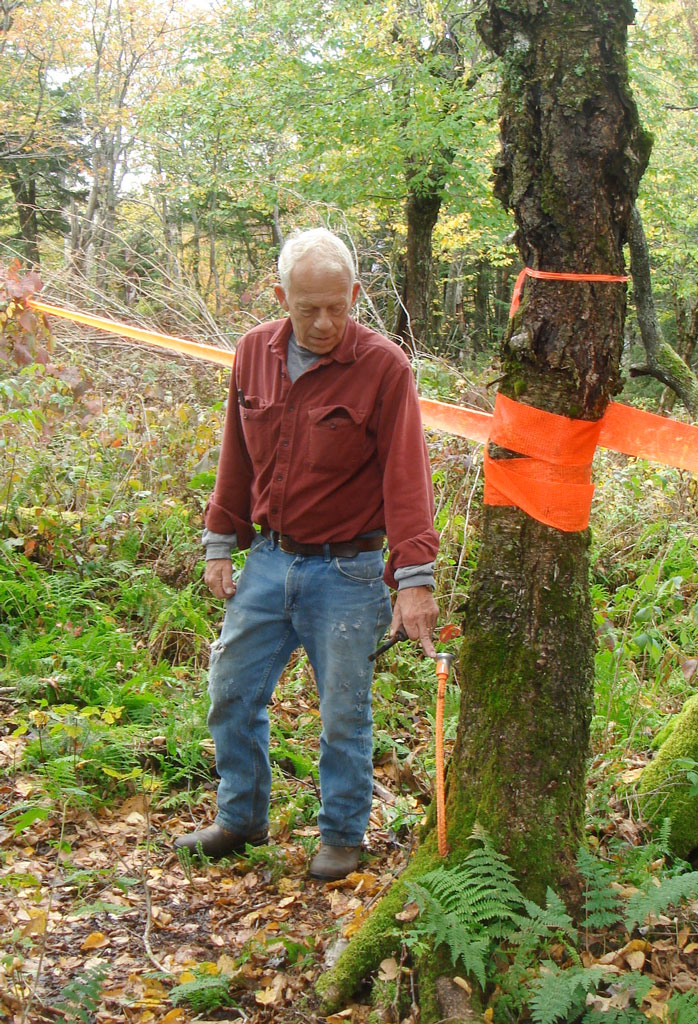
Steve Wright of Craftsbury, a former commissioner of the state Department of Fish and Wildlife, testified that the Nelsons’ property would suffer irreparable damage if construction continued.
In the mountain’s natural state, Wright said, its trees cushion the impact of rainfall to create a sponge that absorbs water and releases it in an orderly manner.
The wind project and its gravel roads, he said, “are reordering the entire hydrology of the mountain.”
The result will affect not only the Nelsons, Wright testified, but others who live down the mountain, “especially the village of Albany.”
Would it be possible to undue the damage, asked Scott McGee, who also represents the Nelsons in the case.
“I’ve seen no situation in which it is possible to unblast a mountain,” Mr. Wright replied.
In his summation, Roisman said Nelson had raised the property dispute during his testimony before the Public Service Board.
The board had ruled that it lacked jurisdiction to settle the matter, the attorney said. However, he added, the board had ruled that “it’s up to the petitioner to ensure they have a legal right to the property needed.”
“It’s Green Mountain Power’s job to get its titles cleared,” Roisman insisted.
He urged the judge to issue a temporary restraining order to stop GMP from making “a major change in the environment on property the Nelsons believe they own.”
According to Wright, the attorney added, “those changes are irreparable.”
“This could all have been resolved years ago,” Behm said of the property dispute.
To get a temporary order, the attorney added, Nelson would have to show the court that he is likely to succeed on the merits of the case. Nobody could listen to the day’s conflicting evidence and come to that conclusion, Behm argued.
Even if the Nelsons ultimately won the case, he added, “the only issue would be how much do you pay them. That’s money damages, and by law money damages are not irreparable harm.”
As for the blasting, he summed up, “no flyrock has entered the property yet, so there’s no trespass.”
If flyrock did accidentally land on the property, he added, the Nelsons could recover actual damages.
