


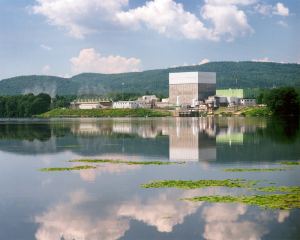
Editor’s note: This story by Olga Peters first appeared in The Commons.
BRATTLEBORO — When U.S. District Court Judge J. Garvan Murtha denied Entergy Corp.’s bid for a preliminary injunction to keep the Vermont Yankee nuclear power plant open, did the state really win round one?
At a Tuesday symposium sponsored by the Safe & Green Campaign, an anti-nuclear group, at the Marlboro College Technology Center, Donald M. Kreis and Pat Parenteau, both attorneys and professors at the Vermont Law School, offered their interpretation of Murtha’s ruling and the likely outcome of the trial.
Parenteau, the senior counsel to the Environmental and Natural Resources Law Clinic and Professor of Law, compared their analysis to the insights of ancient Druids. “We’re studying entrails. We have no idea, frankly,” Parenteau said.
On Monday afternoon, Murtha issued an 18-page decision denying Entergy’s request. He summed up his ruling with the following: “It has failed to show that any irreparable harm it may incur between now and a decision on the merits would be, or is likely to be, ameliorated by a preliminary injunction in the short time before this Court decides [its lawsuit].”
He also set Sept. 12 as the trial date for the Entergy v. Vermont lawsuit.
Kreis and Parenteau said the preliminary injunction ruling played as a sideshow to the main event of preemption — whether the federal government’s jurisdiction over nuclear safety will shield the 39-year-old nuclear power station from state regulation.
Last month, lawyers for Entergy appeared in U.S. District Court in Brattleboro asking for an injunction that would allow the plant to stay open past the expiration of the Vernon plant’s original 40-year operating license on March 21, 2012.
Although Vermont Yankee received a 20-year license extension from the U.S. Nuclear Regulatory Commission in March, Entergy has not received a Certificate of Public Good from the Vermont Public Service Board, and the Vermont Senate voted last year to direct the Public Service Board not to issue a CPG for the plant.
Entergy contends that Vermont overstepped its regulatory bounds with Act 160, a 2006 law that gives the state Legislature veto power over the continued operation of the plant.
In two days of testimony, Entergy’s legal team stressed that only the Nuclear Regulatory Commission has the authority to regulate nuclear energy.
The state’s legal team countered that Entergy had agreed to the terms of Act 160 and was attempting to go back on previous agreements it had made with the state.
Murtha refused to act on Entergy’s request to invalidate Act 160.
However, in his ruling, he indicated that Entergy “had raised serious questions” regarding its claim that Vermont was attempting to preempt federal law. Those questions, he wrote, warrant “further briefing and a prompt full-dress trial on the merits.”
At the same time, Murtha wrote that Entergy failed to make the case that it would suffer irreparable harm if it had to delay a scheduled October refueling outage while waiting for the case to be resolved.
During last month’s hearing, Entergy officials said that they needed to decide by July 23 whether to buy fuel rods to put into the reactor.
Murtha wrote that the decision to refuel is “a business decision made very difficult by the uncertainties of litigation.” It is not, however, harmful “if Entergy prevails on the merits, or it is not a cognizable injury if Vermont’s statutes are upheld. This may present a dilemma, but it does not constitute irreparable harm that can be resolved by a preliminary injunction.”
Reading between the lines
Kreis took a darker view of the case than Parenteau.
“I feel really bad, I love Brattleboro. I love what you folks are doing. I’d love it if Vermont Yankee was banished from the earth,” said Kreis, assistant professor of law and associate director of Vermont Law School’s Institute for Energy and the Environment.
However, he added, people who oppose Vermont Yankee should take “no comfort in Murtha’s decision.”
In most lawsuits, judges will try to signal the parties on ways to negotiate or settle, said Kreis. But “Vermont can’t kinda sorta shut down” the plant, he said.
Kreis described Entergy’s temporary injunction case as “very thin,” saying that Murtha called the “bluff” of Entergy president, CEO, and chief nuclear officer John Herron.
Herron had testified that Energy would close the plant this summer if Vermont Yankee didn’t receive its preliminary injunction.
“Judge Murtha took note of this and was not swayed,” said Kreis, adding the temporary injunction was really a relief from a garden-variety business risk.
“I flat out predict that they [Entergy] will, in fact, order their fuel rods” and keep the plant running past 2012, said Kreis.
He cautioned VY opponents that Murtha voiced his view that Entergy’s preemption claims raise “serious questions” and warranted a full trial.
Kreis and Vermont Law School colleague Cheryl Hanna both say that Murtha has illuminated his thoughts about the parties’ arguments in a pair of footnotes in the decision.
Kreis said that Murtha essentially asked: Did the intent of the Legislature become relevant 2006, when the Legislature passed Act 160, or in 2010, when the Senate declined to vote to relicense Vermont Yankee?
Kreis thinks “the big moment” is 2006, because that year the Legislature passed a statute stating the plant could not operate past 2012 without the renewed certificate.
In another footnote, Murtha reflected on the word “safety.”
In its arguments before the court last month, Entergy focused on the Legislature’s use of the word, saying it stood in for “radiological safety,” and therefore proved Entergy’s preemption claim.
Murtha, however, wrote that the Legislature’s references to “safety” remain unclear, “some of which may be problematic, [and] some of which may merely reflect legislators’ responsible recognition that Vermont cannot regulate radiological health and safety.”
Kreis viewed Murtha’s footnote as an expression of “real concern” that the state tried regulating radiological safety, and in the process, going against the federal supremacy clause and the federal Atomic Energy Act.
To Kreis, the case hinges on pure law. Did Vermont stumble into the realm of preemption? Or does the memorandum of understanding (MOU) that Entergy signed when it bought the plant in 2002, in which it agreed to seek a state-issued Certificate of Public Good and not sue the state if the CPG was denied, render moot the preemption argument?
Kreis said the absence of a reference to the MOU in Murtha’s ruling backs up his argument on preemption.
He added that he wonders what evidence the court needs from the partiesto decide the case. Preemption, he said, is about law, and not about who said what.
“The state is in a more tenuous place” than Monday’s victory would lead people to believe, he said.
A dissenting view
Parenteau disputed Kreis take on the ruling.
In Parenteau’s view, Murtha seemed to tell the state, “You haven’t given me enough to rule in your favor.”
“They [Entergy] threw everything, and the kitchen sink, at the judge during the preliminary hearing,” said Parenteau.
So now what?
Parenteau said he will not be surprised if Entergy subpoenas Gov. Peter Shumlin or other officials and grills them in court about what kind of safety they had on their minds at the various points when they used the term in the process of crafting the current laws.
“I know how they play the game. It’s not beanbag, folks,” said Parenteau, who has gone up against Entergy in court.
If they want to go “bare knuckles,” they’ll do it, he said, but he was quick to add that “I don’t see a winner in the deck for Entergy.”
However, the state has not won either, he said.
When the state comes back to trial, “it better come better armed” to talk about concerns within its jurisdiction like land use, an energy future, water quality, and better energy options, he said.
“[They need to] make it strong, and make it clear, because Entergy is coming at them with everything they’ve got,” said Parenteau.
“If you were like me, you sat there underwhelmed,” said Parenteau of the state’s legal performance at the preliminary injunction trial.
As for Entergy’s preemption claims, Parenteau said that “I think we can be honest that safety was a concern of people. Why wouldn’t it be?”
Federal law does not forbid individuals from raising safety or reliability concerns, said Parenteau, nor does it block lawmakers from addressing these concerns in the legislative process. However, the law does forbid nuclear safety regulation by the states.
“That narrow question of control: the answer is the NRC. That may not be good public policy, but it is the law. The NRC will decide if that plant is safe, whether we like it or not,” he said.
Parenteau explained that the U.S. Supreme Court ruled on states’ power to regulate a nuclear power plant in the 1983 Pacific Gas & Electric v. State Energy Commission case. In its ruling, the court stated clearly that states can shut power plants for non-radiological safety reasons.
But Murtha is not “satisfied with the state’s other reasons,” said Parenteau.
If the case migrates up the legal “food chain,” toward the Supreme Court, Murtha will want a solid case record because he knows other courts will be scrutinizing the case’s logic, said Parenteau.
Parenteau said he had a “radical idea” for how the state can help itself.
Shumlin should call an emergency legislative session in August to vote up or down on permitting the Public Service Board to decide whether to issue Vermont Yankee’s CPG, he said, and with that vote, “a real clear crisp statement of state policy about why we don’t want a nuclear power plant” should be included.
Parenteau remains confident that Entergy will order the fuel rods for the next scheduled refueling shutdown in October, but he cautioned that the company may change its mind on the matter.
When Entergy testified in court last month to shut the plant permanently this summer in the event of no preliminary injunction, that gambit represented a strategic way of saying “we want a decision soon,” said Parenteau.
The estimated $60 million that Entergy will spend on refueling is a relatively small amount for the corporation, said Parenteau.
Still, the company must weigh costs against a successful litigation and if it will earn enough of a return from its investment.
“We’ve all heard the rumors” that Entergy wants to build an escape hatch that would give the company the ability to say to shareholders, “We fought the good fight,” he said.
In Parenteau’s mind, evidence will win the day.
He also noted Entergy repeatedly signed and supported agreements with the state, except when the corporation stopped getting what it wanted — namely, the CPG.
According to Parenteau, the PG & E case — the same case that gives states the right to regulate non-radiological aspects of nuclear power — also gives companies grounds to sue if a state enacts a law that blocks a plant. Entergy did not sue Vermont in 2006 over the Legislature gaining the right to vote on the awarding of a CPG.
Murtha could say to Entergy that it contracted away its right to sue, Parenteau said.
Parenteau thinks the state’s legal team could win the case, but hopes they won’t grow overly confident. He points out that Murtha went into the case talking about merits of the case, but he flipped in his ruling, ultimately choosing to speak only of the “irreparable harm.”
“The state needs to pay attention to that,” he said.
Kreis admires all the lawyers on the Entergy v. Vermont case, adding, “This is a hard case to argue.”
Whatever the outcome, it will be because the winning side “had the better argument, not the better lawyers,” he said.
