

Editor’s note: This article first appeared on commonsnews.org. Randy Holhut contributed to this report.
BRATTLEBORO — The battle lines have been clearly drawn between Entergy Corp., and the state of Vermont in the first day of scheduled hearings in U.S. District Court over whether Entergy Nuclear, the owner/operator of Vermont Yankee, should be granted an immediate “preliminary injunction” that would block any effort by the state of Vermont to close the Vernon reactor next year.
Entergy’s legal team, led by Kathleen M. Sullivan of the New York-based law firm of Quinn Emanuel Urquhart & Sullivan, contended on Thursday that the state of Vermont overstepped its bounds in denying Vermont Yankee permission to operate beyond the expiration of its original 40-year license on March 21, 2012.
The state’s legal team, led by Assistant Attorney General Bridget Asay, countered that Entergy cannot claim Vermont is attempting to usurp federal authority because of previous agreements the company made with the state.
Judge J. Garvan Murtha will consider these contentions in deciding whether to issue an injunction that would allow the plant to continue operating while Entergy’s lawsuit against the state of Vermont makes its way through the courts.
During opening statements on Thursday morning, Sullivan made the case that state lawmakers were seeking to oversee the safety of Vermont Yankee. Public safety, under federal law, is strictly under the purview of the U.S. Nuclear Regulatory Commission, Sullivan said.
According to Sullivan, the federal government has “exclusive, absolute and complete” authority over the regulation of nuclear power, and she asked Murtha to sharply limit Vermont’s authority over Vermont Yankee.
Sullivan said that the Vermont Public Service Board — which under state law would have to issue a Certificate of Public Good to allow the plant to operate for an additional 20 years — could no longer be objective in its decision making due to its interactions with the Legislature.
Sullivan also said that Vermont can’t regulate Vermont Yankee, because the plant sells electricity on the wholesale market to other New England states, and any decision to close the plant would affect the region as a whole. This would be in violation of federal law, Sullivan argued, which prohibits states from interfering in matters of interstate commerce.
Asay said federal law gives states the right to regulate non-safety related aspects of nuclear power, such as plant reliability, environmental impacts and economics.
While nuclear safety matters are beyond the state’s authority to regulate and are the exclusive purview of the NRC, Asay said there is nothing that prohibits lawmakers from discussing safety issues — a claim that Sullivan pointed to as proof that the Legislature was going too far.
Assay said that the core of Entergy’s case against the state rang hollow, because the company has promised several times over the course of nearly a decade in legal contracts and testimony that it would not raise the issue of federal pre-emption.
She said Entergy had plenty of time to dispute those agreements, but chose not to until now. She said Entergy was trying to “avoid a consequence they agreed to years ago.”
Entergy is suing the state to nullify a 2006 Vermont law that gives the Legislature the authority to determine whether or not Vermont Yankee will be permitted to continue operation. The law stipulates that permission must be granted by both the Vermont Senate and the House of Representatives.
In February 2010, the Vermont Senate voted 26-4 to deny the Vermont Public Service Board permission to issue a certificate of public good to Entergy. In March of this year, the NRC approved a 20-year license extension for Vermont Yankee.
In afternoon testimony, John Herron, president, CEO, and chief nuclear officer for Entergy Nuclear, talked about the economic harm that would occur if an injunction was not granted.
If the plant is forced to shut down temporarily, Herron said the company would lose about $20 million a month.
Herron said that even with the injunction, the plant might have to close before March 2012 due to uncertainty surrounding the timing of its next scheduled refueling.
Entergy Nuclear must make a decision about buying new fuel assemblies for Vermont Yankee’s reactor by mid-July. The plant’s next refueling outage is scheduled for October, at an estimated total cost of about $150 million.
Herron said Entergy replaces about a third of the reactor’s fuel rods during refueling outages, which generally happens every 18 months, at a cost of about $60 million.
The second day of the court hearing, which is open to the public, is scheduled for today.
Murtha may not hand down his decision regarding the injunction until early July.
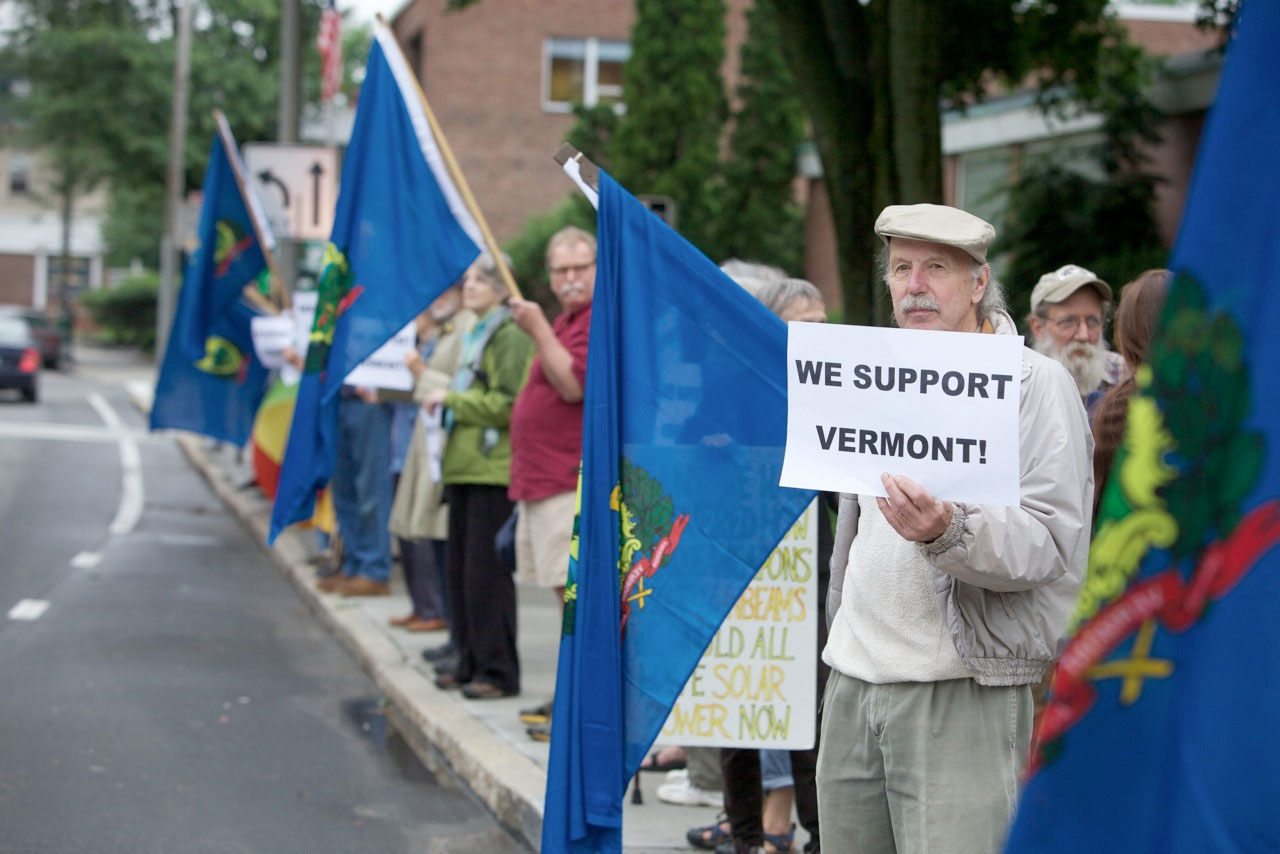
Before Thursday’s hearing began, members of the Safe & Green Campaign, a citizens environmental organization, held a silent vigil in front of the courthouse on Main Street.
According to a news release from the organization, the vigil was held to show support for Gov. Peter Shumlin, Attorney General William Sorrell and Vermont’s Public Service Board, all of whom have been named as defendants in the lawsuit.
Safe & Green had planned a similar vigil on Friday morning.
