

Vermont was immune to the red-hot anti-incumbent fever that gripped the nation on Election Day. Voters instead turned the state a deeper shade of royal blue.
Hawaii, it turns out, was the only other state to elect as many Democrats to office, according to retired Middlebury professor Eric Davis.
Vermonters not only kept the so-called “bums” in for statewide office (not a single incumbent lost), but they also backed President Barack Obama in exit polls, according to Chris Graff, a former journalist and political commentator, who is now an executive with National Life Insurance Co.
Nearly 60 percent of Vermont voters said they approved of the way the president is handling his job. Nationally, Obama’s approval rating after the mid-term election is about 47 percent, according to The Gallup Organization.
“I think if you analyze the returns, Vermont was just about totally immune from the wave that swept the country,” Graff said. “I think we felt that during the fall, and didn’t see any evidence of Tea Party anti-incumbent fever, and to have it proven that way — while all across the country voters going the Republican way — that was a surprise. Vermont truly is an island.”
Congressional Democratic incumbents Rep. Peter Welch and Sen. Patrick Leahy hardly needed to put up a fight in Vermont. Everywhere else, longstanding senators and representatives were in a battle for survival that many, especially in the Midwest, lost to Republicans.

http://www.politico.com/2010/maps/#/Senate/2010
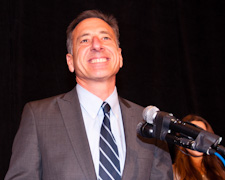
The biggest color swap in Vermont was in the governor’s office. A gubernatorial victory had eluded the grasp of Democrats for eight years, but on Election Day the seat fell to Peter Shumlin – by a mere 4,331 votes, according to the official Nov. 9 tally from the Vermont Secretary of State’s office. (Republican Brian Dubie conceded last week. Because Shumlin didn’t hit the 50 percent mark, under the Constitution the Legislature must vote by secret ballot to confirm him.)
In open contests for statewide office, Republican Phil Scott of Middlesex was the only winner. With the exception of State Auditor, Tom Salmon, all of the re-elected incumbents happened to be Democrats.
Though eight legislative races are subject to potential recounts, the Vermont Statehouse is still held by a Democratic “supermajority,” as outgoing Gov. Jim Douglas likes to put it.
Where does the Vermont GOP go from here?
Davis says the Republicans are falling into a “trap”: Their base is shrinking. The GOP’s core constituents live in parts of the state – namely Rutland County and rural northern Vermont (including the Northeast Kingdom) – where population is stagnant or falling.
The Democrats, meanwhile, hold the fastest growing geographic zones of the state – Chittenden County and the Upper Valley along the Connecticut River, according to Davis.
In addition, exit polls indicate there is an education gap, Davis said.
The GOP’s base consists largely of lower- and middle-income voters who don’t have college degrees, while the fastest growing group of voters in Vermont is college educated – and they voted overwhelmingly for Shumlin in this latest election.

“Their base is a smaller and smaller share of the electorate,” Davis said. “If the GOP nominates social conservatives like Brian Dubie, it’s going to be difficult for them to win.”
Nelson blamed Dubie’s loss on two factors: negative campaigning that turned off voters and the statistical improbability of any lieutenant governor seizing the Fifth Floor.
“The Republican Governors Association has a basic playbook: attack, attack, attack,” Nelson said. “Corry (Bliss) was the enforcer. Brian takes orders–he’s a military guy–and that was my concern about him being governor.”
The late U.S. Sen. Robert Stafford of Rutland, who died in 2006, was the last Vermont politician to win a gubernatorial seat from the post of lieutenant governor — in 1958. Since then, 12 lieutenant governors, including Dubie, have lost bids for governor.
Nelson said the role is akin to serving as a school traffic cop. “It doesn’t prepare you for anything,” Nelson said. “You preside over the Senate, but you don’t vote.”

Graff said over the last 10 years, it has become extremely difficult for Republicans to win statewide office. Gov. Jim Douglas is the notable exception.
“It takes incredible message discipline,” Graff said. “For a Republican to win, everything has to go right in Vermont, and that’s why I was surprised that Brian Dubie was as close as he was to winning. The odds were against him. I never felt this was Brian Dubie’s race to lose. I don’t think a Republican in this state is ever in that position.”
Graff said Dubie was helped by the economy in this election, but going forward, unless Shumlin “makes a serious mistake, he’ll be governor a long time.”
In part that’s because his timing is good, Graff said. There will be budget difficulties this year and next, he predicted, but probably, by the end of his first term “people will feel better about the direction the state is going.” And it won’t necessarily be because of Shumlin’s policies. “He’ll reap the benefit of a turnaround (in the economy) most people see coming in the next few years.”
Graff attributed Republican Lt. Gov.-elect Scott’s clear victory to his appealing personal style. “Vermonters vote based on personality, not party,” he said.
Republican Jason Gibbs’ loss took Davis by surprise. The perception that Gibbs wanted to use the secretary of state’s office as a stepping stone to even higher office may have worked against him, Davis said. Jim Condos, on the other hand, told voters that his only ambition was to be the secretary.
Another factor that may have shifted the race away from Gibbs was a radio ad that featured Republican state Sen. Vince Illuzzi backing Condos, Davis said.
The unsolicited advice department
Now that the die has been cast and the Shumlin’s transition team is working on recommendations for administration appointments, all eyes are on the $112 million budget gap the governor-elect and lawmakers must resolve in the coming legislative session.
Nelson said it’s going to be a tough year.
“They’re going to have to cut something,” Nelson said. “Democrats don’t like to cut programs, and taxes are going to have to be raised.”
Graff said although Shumlin knows what he’s facing because he has gone through difficult budget cycles as Senate president pro tem, in his new role as governor he will, for the first time, be responsible for creating the budget.
“The Legislature plays around edges when they make changes to a governor’s budget,” Graff said. “Shumlin wants to change the priorities of state government, and doing that in the tough budget year he faces will be difficult.”
Shumlin will have a harder time balancing this budget “than Douglas would if he were in office,” Graff said, because the current budget reflects Douglas’ priorities.
Graff said Shumlin will have to choose a new director for the Agency of Human Services, for example, who will reflect his administration’s priorities. (The state spends about $1 billion a year on government services for poor, elderly, disabled and mentally ill Vermonters, and it’s an area that has been targeted for cuts under the Douglas administration.)
Graff said a good sign is Shumlin’s appointment to his transition team of Susan Bartlett, the former Senate Appropriations chair; former Gov. Howard Dean; and Liz Bankowski, former chief of staff for Gov. Madeleine Kunin — “seasoned folks who have seen everything.”
“(Susan Bartlett) is as tough a budget person as you can get,” Graff said. “Susan in her campaign was much more negative talking about what the state was going to face than Shumlin was. It’ll be interesting to see how the arguments and debates work themselves out.”
Graff said Republicans and Democrats alike have a “tremendous respect” for Bankowski. Graff described Dean as “the most fiscally conservative governor in 40 years.”
“For him (Dean) to be willing to help Peter Shumlin to become governor is a great assist,” Graff said.
“(Dean) took Dick Snelling’s plan and made it even more conservative,” Graff said. “(He) helped the state come out of fiscal crisis of the early 1990s…pretty driven to balance the budget.”
Dean, who was governor for 11 years (the longest serving in the state’s history since Thomas Chittenden held the office in the 18th century), brings a perspective to the team no one else has, according to Graff.
“For him to be willing to help Peter Shumlin to become governor is a great assist,” Graff said.
The conciliatory nature of the transition is very important, Graff said.
Bartlett is working closely with Neale Lunderville, Gov. Douglas’ secretary of administration, and Jim Reardon, the current commissioner of the Department of Finance and Management.
Graff noted that Douglas pledged in a press conference last week not to be critical of the new governor.
“Dean made that pledge, too,” Graff said. “It’s a great tradition because you don’t want former governors nitpicking everything. It’s good for them to leave the building and get out of the way.”
Davis speculated that Bartlett will propose new one-time revenue infusions without raising broad-based taxes. He said he expects that the Vermont Tax Commission’s proposals to reorganize the way taxes are collected will create additional revenues as well. A tax on Internet sales, for example, would help fill the budget gap, according to Davis.
“(Shumlin) will squeeze where possible, but he’ll look at new initiatives to close the gap,” Davis said.
Davis predicts that Shumlin will try to incorporate Bartlett, along with fellow Democrats former Lt. Gov. Doug Racine and unsuccessful auditor candidate Doug Hoffer, into his administration. He also suspects that Alex MacLean, Shumlin’s campaign manager, will become his press secretary.
“I see Alex as on much the same career path as Andrew Savage (Peter Welch’s legislative assistant),” Davis said. “She knows the press.”
Of the existing administration officials, only one made Davis’ list of likely survivors in the new administration: David Dill, Transportation Agency secretary. Dill served in the Dean administration and has a reputation as a professional bureaucrat without political baggage, according to Davis.
