


By Susan Bush
Editor’s note: This article is by Susan Bush, a freelance reporter who lives in Pownal.
Read the overview story: Biomass controversy burns in Pownal.
POWNAL – Beaver Wood Energy’s plans to develop a biomass facility at a former horse racing track should be scrapped, according to environmentalist Josh Schlossberg.
Schlossberg, editor of the Biomass Buster newsletter, was a guest speaker Tuesday night for a meeting held by Concerned Citizens of Pownal, a group that opposes the biomass proposal. Schlossberg told local residents that a biomass plant would generate particulate matter in the air, toxic ash and encourage poor forest management practices.
Beaver Wood wants to build a biomass facility and pellet production mill in the Green Mountain Energy Park. A second project would be located in Fair Haven. Each biomass facility would produce 29 megawatts of electric power by burning tree tops and other waste wood, and both would use excess heat generated by the biomass process to dry the wood pellets being made for retail sale, according to Thomas Emero, an environmental attorney and principal owner of Beaver Wood. Emero did not attend Schlossberg’s presentation.
Rep. William Botzow, D-Pownal, encouraged residents to make their feelings known to local officials and members of the state’s Public Service Board.
“There’s a lot of passion about this, and that’s good, we should have passion,” Botzow said. “But don’t be over-ruled by hope or fear. Do your homework.”
“There’s a lot of passion about this, and that’s good, we should have passion,” Botzow said. “But don’t be over-ruled by hope or fear. Do your homework.”
Botzow said Beaver Wood officials plan to apply for a Certificate of Public Good by month’s end, and the application will spark a public process. PSB members will likely establish a timeline dictating various aspects of the process. Residents who own property abutting the site may act as “interveners,” he said.
“There will be a public hearing,” Botzow said. “At that public hearing, people will be able to give their opinion.”
A Certificate of Public Good from PSB would be a significant step toward construction of the project.
Chris Matera, a member of the Massachusetts Forest Watch initiative, told the audience to expect project officials to try and expedite the permit process because $80 million in federal stimulus money is at stake. Entities developing energy projects must demonstrate significant progress with their ventures by December 2010 to qualify for a portion of the funds, Matera said.
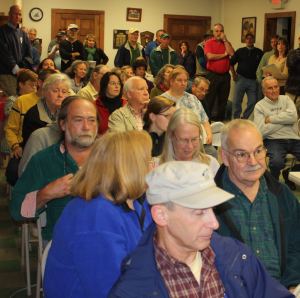
“You’ll feel a lot of pressure to get things moving,” Matera said.
Thomas Emero, of Beaver Wood, wrote in an e-mail that while the federal stimulus program includes a cash incentive to qualifying projects if work begins in 2010, “the project is not contingent on this.”
Schlossberg, an environmental activist, cited studies that show biomass can cause health and environmental problems. He said the Massachusetts Medical Society, the American Lung Association and the Massachusetts Breast Cancer Coalition oppose the projects because of health risks, Schlossberg said.
Citing a 1996 Austrian study, Schlossberg claimed that biomass-generated ash is laced with toxic materials, including radioactivity. Ash from biomass is now being used in the United States on numerous farm fields, he added. He said no level of particulates, which are small particles released into the air as a result of biomass burning, have been deemed “safe.”
“Fugitive dust,” meaning dust escaping into the air as a result of an estimated 70 to 100 trucks dumping wood daily at the proposed site, and the noise, smells, and air pollution stirred up by the truck traffic are causes for concern, Schlossberg said.
Biomass encourages poor forestry, Schlossberg said, and he stressed that trees offer a host of benefits. Heavy cutting means increased risks of flooding caused by erosion, he said, and added that excessive forest stripping is believed to impact regional and global climates. Schlossberg challenged the phrase “waste wood.”
Schlossberg challenged the phrase “waste wood.” “There is no waste in the forest.”
“There is no waste in the forest,” he said, noting that fallen, decaying trees or limbs and tree tops left behind after loggers remove quality wood, eventually break down and return necessary nutrients to the soil. Taking the waste robs the soil, he said.
“Forests are the lungs of the earth and provide many free ecosystem services,” he said.
Schlossberg said he burns wood for fuel. “No one is saying we should never log our forests,” he said. “But it is dangerous to pretend that logging benefits our ecosystem.”
Claiming that biomass facilities help create a market for waste wood is misleading, he charged, because wastewood is already sold as firewood , mulch and particleboard material.
Beaver Wood plans to draw water from the Hoosic River and an aquifer at the park site for cooling purposes. Estimates show that 500 gallons of water per minute may be needed and neither the river nor the aquifer can withstand such heavy water draw without negative impacts, project opponents claim.
Schlossberg attacked the McNeil biomass mill in Burlington, which is the oldest biomass facility in the state.
“In my opinion, we have to stop burning stuff to create energy,” Schlossberg said.
The audience peppered Schlossberg with questions about truck traffic, deforestation, flood risks and the smokestack.
Others said they are fearful because any potentially harmful emissions or particulates are likely to linger at the valley site and create additional exposure to people living on nearby Swallow Hill or Northwest Hill roads. Three mobile home parks are also situated near the energy park.
Schlossberg said that biomass proposals in Florida, Michigan, Indiana, and Washington were abandoned after citizens launched strong opposition campaigns. He urged reliance on other energy forms, such as solar and wind and said he supports expansion of the hemp industry. He also supports initiatives including the Home Star Energy Retrofit Act Efficiency Vermont and Transition Vermont, a grass-roots group dedicated to strategies allowing Vermont communities to transition from oil to other power sources.
“In my opinion, we have to stop burning stuff to create energy,” Schlossberg said.
The citizen’s group may be contacted via e-mail at concernedcitizensforpownal@hotmail.com or on a Facebook page titled “Southern Vermont Against Biomass.” Beaver Wood officials have posted project information, including information about an Oct. 20 bus tour to the McNeil facility, at their http://beaverwoodenergy.com web site.
