


By Susan Bush
Editor’s note: Susan Bush is a freelance reporter who lives in Pownal. She will be covering the Concerned Citizens of Pownal meeting tonight.
Read: Activist says biomass ash, particulates pose health risks
POWNAL – A proposal to erect a biomass power generating facility and a wood pellet production plant at the Green Mountain Energy Park is galvanizing opposition from a newly formed citizen’s group.
The group, Concerned Citizens of Pownal, launched a petition drive a few weeks ago and held a meeting Oct. 5 at the Pownal Center fire house with Josh Schlossberg, an environmental activist.
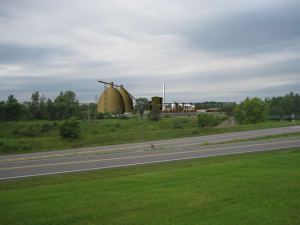
The wood burning biomass facility is the latest proposal for the park, which was once a horse and dog racing facility known as Green Mountain Race Track. The track was abandoned in the early 1990s. Since then, the park has been a venue for special events such as a Lollapalooza concert, antique car shows and carnivals. A successful proposal for a permanent business has eluded Progress Partners Group, the owners of the 144-acre parcel.
Beaver Wood Energy, which has an office Rutland, plans to build two plants in Vermont that would generate 29 megawatts each – one in Pownal and another in Fair Haven. Both would burn waste wood from logging.
Beaver Wood officials say the plants would be “state-of-the-art” and would provide renewable baseload electricity. Each facility would employ 50 people and produce 100,000 tons of wood pellets, according to the firm’s Web site, and the plants would support 1,000 indirect jobs. The multi-national firm Bechtel Development Company is providing capital and engineering services for the project.
At public meetings sponsored earlier this month by Beaver Wood officials, citizens raised concerns about air pollution, noise pollution, truck traffic, and water use and pollution. Opposition petitions were circulated at local stores and businesses recently. At the meeting tonight, environmental activist Josh Schlossberg, of Biomass Busters,who lives in Montpelier, will give a presentation about the negative effects of biomass facilities.
Pam Lyttle, a member of Concerned Citizens of Pownal, a group that opposes the project, said that more than 100 people have signed the petitions. Lyttle lives near the proposed facility.
“We have health concerns, we have water concerns, we have concerns about the trucks that will be rolling in and out,” she said. “We are very concerned that because this is in a deep valley, the air inversion will mean pollution just sits there.”
The proposal
In an interview, Thomas Emero, managing director of Beaver Wood, said the company’s proposal links two forms of renewable energy production. The pellets for residential and commercial use will be manufactured at mills in the Pownal and Fair Haven locations. Excess heat generated from co-located biomass plants will be used to dry the pellets. Water from the Hoosic River and an onsite well would be used to cool the biomass facility in Pownal; opponents question whether the water use will significantly decrease river and well water levels.
Construction costs are estimated at $250 million. The project funding would rely in part on foreign investors via a federal EB-5 initiative. Emero said his ventures would utilize an EB-5 Regional Center program that reduces the required investment from $1 million to $500,000 and requires that they be made in a Targeted Employment Area. In exchange, investors and their immediate families are given permanent immigration status, or “green cards” as an incentive as well as an opportunity for U.S. citizenship after five years. According to a Vermont Web site focused on the EB-5 initiatives, “investors only need show that their investment generated indirect employment of 10 people in the Regional Center economy.”
Emero said each plant would employ 50 workers, 25 at the biomass plants and 25 at the pellet plants. The jobs would be full-time, offer benefits, and pay $30,000 to $100,000 a year, Emero said. “Most of the jobs are in the $50,000 to $60,000 range,” he said. “These are good jobs.”
Electricity produced at the sites would likely be sold in Vermont at a rate of 12.5 cents per kilowatt. “We do not believe we would sell to surrounding states,” Emero said.
Emero said the wood would be purchased within a 50-mile radius of the plants.
Robert DeGeus, a forester for the Department of Forests, Parks, and Recreation, said creating a market for low-grade wood remnants would be beneficial. Southern Vermont has an abundance of low-grade wood, he said, that is currently sold as firewood.
“Providing a market for poor quality wood is environmentally sound.” ~ Thomas Emero
“Biomass enables foresters to take the waste, the tree tops, the limbs,” Emero said. “From that perspective, what you want is an active forest business. Providing a market for poor quality wood is environmentally sound.”
Adam Sherman, a program director for the Biomass Energy Resource Center, a national nonprofit group that promotes the use of “pelletized biomass,” says the Beaver Wood plant would be very efficient. Biomass plants typically operate at 20 percent to 25 percent efficiency rates; the Beaver Wood plants in Vermont may operate at an improved 40 to 45 percent efficiency rate because they would utilize excess heat from the biomass facility to dry wood pellets.
“Now you are making a fuel at the residential level and keeping those dollars local,” Sherman said of the proposal. “There’s always discussion about Vermont’s biggest export, is it maple syrup, is it corn, well, our greatest export is dollars spent on energy.”
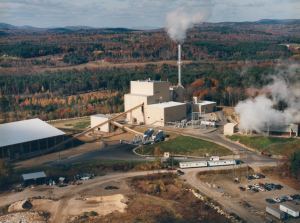
John Irving oversees operations at the state’s oldest biomass facility, the Burlington-based Joseph C. Mcneil Generating Station. The plant has supplied electrical power to Burlington residents since the 1980s; Irving was a project engineer during the entity’s construction phase.
The state’s emissions limits are some of the toughest in the country, according to Irving. “And the permitted of level of particulate is extremely low,” he said in an interview. “Back when we first started, [the low levels] pushed the limits of the industry.”
Biomass is part of the nation’s solution to weaning away from fossil fuels and foreign oil, Irving said.
“If [biomass] is done correctly, if it’s sited correctly, if timber is harvested correctly, it’s a great part of the solution,” Irving said.
Questions arise
Rep. William Botzow, D-Pownal, said the Fair Haven site is an “open, elevated space that is not residential.” In contrast, the Pownal site is in a valley, close to homes located across from the Hoosic River. There are three mobile home parks situated near the property. There are three mobile home parks situated near the property.
Botzow is also concerned about financing for the project. In his view, additional revenue sources to construct the plant will almost certainly be needed.
“At the end of the day, financial backers will give a green light or a red light, depending on the financing,” Botzow said. “There have to be other pockets [of financing] to make this work. The Public Service Board process will be sure that issues are looked at and debated.”
Pownal Selectman Nelson Brownell said the park could showcase Vermont’s commitment to renewable energy. He pointed to the approval of an EOS Ventures solar facility, which would also be located in the park. The Vermont Public Service Board recently issued a certificate of public good for the project. According to the company’s proposal, the facility will generate about 2.2 megawatts of electricity, or enough to power nearly 360 homes.
“[Emero’s proposal] brings two industries in, pellet manufacturing and energy generation,” Brownell said. “The EOS plan is for solar. That would give us three sources of renewable energy, energy that is not foreign oil.”
The biomass proposal is in the early permitting stages and has not received a certificate of public good. Botzow emphasized that town residents should voice their concerns. “Issues are arising and they need to be looked at,” he said. “We need to see if we can work through the issues.”
Botzow urged against a “rush to judgment” about the Pownal proposal.
“We must be very careful about what we mean by ‘biomass’,” he said. “We need good forestry practice. The question is good sitings, sitings that are sustainable over the long term. I would want to be careful, I would want [a project] done so it can be viable long range.”
The opposition
Pam Lyttle, a member of Concerned Citizens of Pownal, said that there are no guarantees that local residents would be hired at either facility.
She said that company officials change their facts and figures on a regular basis.
“At one meeting, they said that trucks would operate between 7 a.m. and 7 p.m.,” she said. “I shouted out that that wasn’t acceptable, and at another meeting, they said trucks would run between 7:30 and 5:30. As soon as they know that we have a concern, they change the numbers.”
Lyttle said that creating a biomass-reliant waste wood market exposes another potential problem. She said she fears that heavy cutting will destroy Vermont’s mountainsides. “We won’t be the Green Mountain State, We’ll be the brown mountain state, “We won’t be the Green Mountain state, we’ll be the brown mountain state.” ~Pam Lyttle she said. “Biomass is not sustainable, and it is not green energy. It is a short-term fix, and we’ll be left with nothing.”
Irving has invited Pownal area residents to visit the McNeil plant in Burlington.
Pownal resident Raymond Shields said: “I’d rather go to Livermore Falls in Maine, that’s a facility he was involved with.”
Previous reports have quoted a Livermore Falls residents as saying the facility corrected problems and acted as a “good neighbor,” while other reports claim the facility has faced ongoing issues. The power plant generates about 39 megawatts of power.
Lyttle said she believes the former race track should operate as a seasonal park or a venue for special events.
“I know that the kids love to go down there with their model airplanes and their motorcycles,” she said. “It would be a great place for horse shows, for car shows. It would be nice if it was a big beautiful park.”
Emero has said that the facility will pay about $525,000 in property taxes. Lyttle said that she believes property values of biomass plant abutters will plummet, and a possible $100-$200 saved on yearly tax bills will not make up for the loss. Selling homes near the site could prove difficult if the facility is built, she said.
“Who’s going to want to live near this?” she asked.
Residents of Williamstown, Mass., the town abutting Pownal to the south, should voice their thoughts about the proposal, Lyttle said.
“I don’t think residents of Williamstown will be happy with those trucks rolling through their town,” she said. “Williamstown will be affected by the plumes and fumes and so will Bennington.”
Additional information about the Beaver Wood proposal is available at http://beaverwoodenergy.com.
Beaver Wood is sponsoring a bus trip to the McNeil biomass plant in Burlington on Oct. 20. The bus will depart the Pownal racetrack at 9 a.m. and return at 4 p.m. Contact Beaver Wood for more information. http://beaverwoodenergy.com/contact-us/
CORRECTIONS: Schlossberg’s town of residence has been corrected. The Beaver Wood biomass plants will burn waste wood. Separate factories on site will manufacture pellets. The company will not burn pellets in its biomass plants as was previously reported.
