

The state’s government reorganization plan is now $10 million short, and if a federal matching fund doesn’t come through, that number could grow to $15 million, according to officials from the Douglas administration.
The Legislature passed a budget in May that assumed $37.8 million in permanent savings starting in fiscal year 2011 from the Challenges for Change restructuring initiative. Though the fiscal year began on July 1, the savings that were banked on have yet to come to fruition.
Download the Challenges spreadsheet from the Joint Fiscal Office
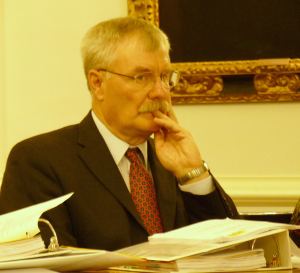
Tom Evslin, the administration’s point person for the Challenges, told the Legislature’s Government Accountability Committee on Monday that the biggest gap is in the projected savings for the Agency of Human Services.
So far, there is a $6.45 million shortfall for the agency, which has been asked to find $16.8 million in reductions. Evslin’s presentation was part of the administration’s July quarterly progress report on Challenges for Change.
Download a PDF of Challenges for Change, July quarterly report
“We made sure we had initiatives under way that were approved, but we still have this large amount of savings we have yet to achieve,” Evslin said.
In addition, he said Congress may not approve additional Medicaid funding, known as enhanced FMAP, until after the November election. The Challenges budget relies on $5 million from FMAP for “reinvestments” in the Department of Corrections and the Agency of Human Services.
Lawmakers and the administration embarked on the reorganization in order to prune back the cost of state government. Stimulus funds from the federal government buoyed the state for two years, but next year there is no anticipated bailout from Washington, and tax revenues are still slowly recovering from the recession. The state deficit is projected to be $122 million in fiscal year 2012, and officials hope to save $72 million through permanent restructuring changes in the next legislative session.
The reorganization in the current budgeting cycle affects the state’s prisons, a wide range of human services programs, environmental regulation, education, vendor contracts and economic development. A smattering of state departments have also opted into the restructuring process through a “charter unit” concept.
Rob Hofmann, secretary of AHS, said his agency has embarked on 12 initiatives. One of those initiatives, “Integrated Family Services,” is purported to save $2.235 million in General Fund expenditures (at the same time, the state will be forgoing about $2.4 million in federal funds).
Under Integrated Family Services, the state is creating an “enhanced family treatment and support model,” which would consolidate seven programs, including intensive family-based services, residential care, crisis response services, post adoption services for children and families with disabilities or mental health, trauma, post-adoption or substance abuse issues. The goal is to provide early intervention and family support services – and to reduce “the use of out-of-home and other more intensive service options.”
Hofmann pointed to the Creative Workforce Solutions project as an example of an initiative that is already gaining traction. The job placement and support initiative, which is based on the agency’s successful vocational rehabilitation program for Vermonters with disabilities, would be expanded to include Vermonters who receive general financial assistance, recently released offenders and individuals with mental health problems. It is supposed to save the state about $1 million.
The shortfall in savings is $1.5 million in the Department of Corrections. Evslin said when the Legislature comes back in January, it may have to consider closing part of a state correctional facility. The administration sought the authority to close a prison during the legislative session, but the proposal was rebuffed by lawmakers.
“I can’t say at this time whether we would be in a position to say if we reduced the population enough to recommend closure, but that would represent one possible savings,” Evslin told the 10 members of the committee.
Evslin expressed disappointment with the economic development challenge, which the Legislature pruned back from $3 million in savings to $965,000. He said the $2 million will have to be found across the other targeted area. Education was another area in which he said they had made no progress, he said, because of an impasse. The administration wanted to impose a 2 percent reduction in state funding for schools or mandate a threshold for student-teacher ratios (Vermont has the lowest ratio in the nation.) The Legislature refused to endorse either proposal for fear of eroding school boards’ authority to control spending locally.
Though a 105-page Challenges progress report was made available to lawmakers, via the Internet, there were no detailed spreadsheets.
The following is a list of “charter unit” proposals the administration is pursuing:
–The Tax Department is looking at creating a “data warehouse” that would include information from other agencies, enabling the state to identify misreported or unreported income. The state can’t afford to buy the expensive program for the “data warehouse,” Evslin said, and so would give the company that designs the software a percentage of the tax revenues instead.
–The creation of a new Web portal that would allow business owners to register with the Department of Labor, the Secretary of State and the Tax Department simultaneously.
–Another Web portal would be used for commodity purchasing. Other states, Evslin says, have been able to get better prices for goods through an electronic bidding system. Small businesses complain about how much it costs to bid for contracts, and cutting down on paper use will save them money, Evslin said. Like the “data warehouse” proposal, the electronic bidding system would be purchased on a percentage basis. The state would give the firm who develops the system a cut of the amount saved.
–The state will no longer send out paper reports, documents and memos. Information will be distributed electronically, Evslin said.
–The Department of Information and Innovation is proposing to consolidate servers “scattered” throughout state government, Evslin said. This is costly and creates a security threat, he said. Though the consolidation project is not one of the charter unit challenges, Evslin said it was a “special initiative” that can save the state money.
–The Department of Buildings and General Services hopes to save $750,000 through a transportation initiative for state employees. The department is urging workers to teleconference and carpool whenever possible. It is also asking more employees to use state-owned fleet vehicles. It costs 50 cents a mile to reimburse workers at the federal rate for use of their own cars, while it costs 14 to 20 cents less for them to use a state vehicle. The typical car is available to workers who travel 12,000 miles a year, according to commissioner Gerry Myers, and he wants to offer state-owned vehicles to departments that have groups of three or four employees who travel 3,000 to 4,000 miles a year.
The members of the Government Accountability Committee present included: Sen. Diane Snelling, chair; Rep. Donna Sweaney, vice chair; Rep. Ann Manwaring, secretary; Sen. Bill Doyle, Rep. Michael Obuchowski, Sen. Ginny Lyons, Sen. Ann Cummings, Rep. Cynthia Brown, Rep. Joey Donovan and Rep. Sandy Haas.
