

Correction: Lorraine Rekmans said leftover crushed rock from the mining process was used as backfill for schools, hospitals and homes. Originally, the story erroneously stated that tailings were used. We apologize for the error.
In an era of climate change, energy experts often talk about nuclear power as a carbon-neutral source of electricity compared with coal-generated electricity.
Vermont Yankee’s Web site says the plant has “prevented more than 50 million tons of carbon and other pollutants from being released into the environment. As a result, Vermont has the second-lowest per-capita carbon footprint of any state in the U.S.”
In fact, if you run a Google search for Vermont Yankee, the plant’s Web site pops up under the URL http://www.safecleanreliable.com/. Those three words — “safe,” “clean,” “reliable” — also dominate the main real estate on the front page of the Web site and serve as the company slogan.
Since a leak of radioactive tritium was discovered at the plant recently, however, Vermont officials have begun to question Vermont Yankee’s motto.
Tritium is a known carcinogen, and water in a monitoring well and a concrete tunnel under the plant has tested for elevated levels of the radioactive isotope. Legislative leaders, the governor and Vermont’s congressional delegation have called for an investigation by the Nuclear Regulatory Commission and have questioned whether Entergy, parent company of the plant, misled regulators and the public about the existence of inaccessible, underground piping under the facility, now suspected to be the source of the leak.

Lorraine Rekmans, the aboriginal affairs critic for the Green Party in Canada, has her own reasons to question the safety of nuclear power — she grew up in Elliott Lake, a uranium mining town near Lake Huron in the Algonquin territory of Ontario.
Her message to lawmakers: Nuclear power isn’t clean energy.
“I’m deeply offended when people say that nuclear energy is clean and safe,” Rekmans said. “If you have a look at my territory, there is nothing clean about it. We can’t eat the fish there.”
What does uranium mining in remote, rural Canada have to do with Vermont?
Members of the House and Senate Natural Resources committees found out on Wednesday.
Rep. Tony Klein, D-Plainfield, chairman of the House Natural Resources Committee, asked Rekmans to speak to lawmakers about the environmental impacts of uranium extraction.
Uranium from Rekmans’ territory, Klein said, had been used to fuel Vermont Yankee before the last of the mines closed in 1996. The plant is refueled every 18 months.
“Proponents of this technology always talk about perceived benefits and always gloss over and sugarcoat the extreme liabilities that go along with it,” Klein said in an interview. “Most people generally understand the liabilities of the spent waste, but they have no idea of the liabilities that come along with the production of the fuel. So I wanted my committee and other legislators to be able to see this in its total life cycle and the effect of the production of this fuel, which is always distant, always out of mind.”
Rekmans told lawmakers that uranium mining in the Elliott Lake region has contaminated the Lake Huron watershed. Ten lakes in her territory are used as cesspools for tailing waste, she said.
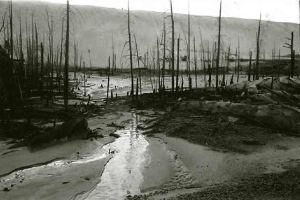
She pointed to a photograph of a tailings dam projected on a screen in Room 10 of the Statehouse showing a stream of effluent running through silt and dead trees. In all, 170 million tons of radioactive tailings have been dumped in the territory, she said; the Southwest Research and Information Center wrote in a report for Northwatch that the Elliot Lake Tailings Management Areas are “among the largest uranium production waste sites in the world.
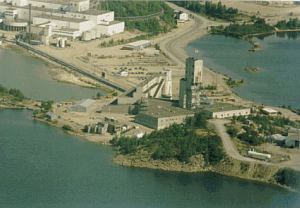
Rekmans described how miners blasted and dug hard rock from uranium ore pits in 11 locations in her territory. The raw ore was then crushed and mixed with sulfuric acid to remove the impurities. The refinery plants extracted one pound of uranium for every ton of rock.
American companies owned the mines and shipped most of the uranium to the United States for use in nuclear power plants and nuclear weapons over a 41-year period.
Rekmans said uranium mining started in the region in 1955, and the last plant was closed in 1996. She said leftover crushed rock from the mining process was used as backfill for schools, hospitals and homes.
Rekmans described how women would hang laundry on the line and would find their clothing full of holes when it was dry. Men who left cash in their pockets when they went to work at the plant found the color had disappeared from their legal tender by the time they returned home. Children came home from playgrounds with disintegrated shoelaces.
Many of her people contracted cancer and silicosis from constant exposure to radon from the tailings, Rekmans said.
“They were not informed that mining uranium was dangerous,” Rekmans said. “They were never told that they would get cancer and silicosis and die. The information came out in 1976, nearly 25 years after
they began working without ventilation. So it really troubled me to see that the corporation had signed on at cost-plus contracts without any risks, and they were too damn cheap to put proper ventilation systems in the mines to protect the workers.
“Uranium mining kills; it’s a fact of life,” she said.
Rekmans’ father died at the age of 63 from a uranium-related illness, and her family was denied worker’s compensation benefits for his death. Though her father worked in the mines, the Canadian government told her he didn’t die because of exposure to uranium. Typically, miners receive a death benefit payment of $35,000.
According to an article in MIT’s Technology Review, uranium shortages are imminent. Michael Dittmar, a global nuclear industry expert, told the Review in November that uranium stocks will be exhausted by 2013, unless the nuclear power industry gets access to military uranium stocks.
The mining industry supplies 40,000 tons of uranium to nuclear power plants worldwide; the industry’s total annual demand for the ore is 65,000 tons, according to the Review. The remainder comes from military and civilian stockpiles.
As the nuclear renaissance gains support in the United States, Rekmans fears demand for more uranium to fuel new plants will lead to the reopening of mines in her territory.
Rekmans took aim at the industry’s claim that nuclear power is inexpensive.
“It is cheap,” she said. “It’s only $35,000 for a dead miner. That’s cheap. I’m really offended. Cheap power, too cheap to meter. At what cost? Who pays that cost? Frankly, we’re not willing to pay that cost anymore. Frankly, sourcing is going to be a real problem. If I have anything to say about it, I am committed to keeping uranium mining out of my territory. Never again.”
QUICK CLIPS
TEN-MINUTE SEGMENTS
