

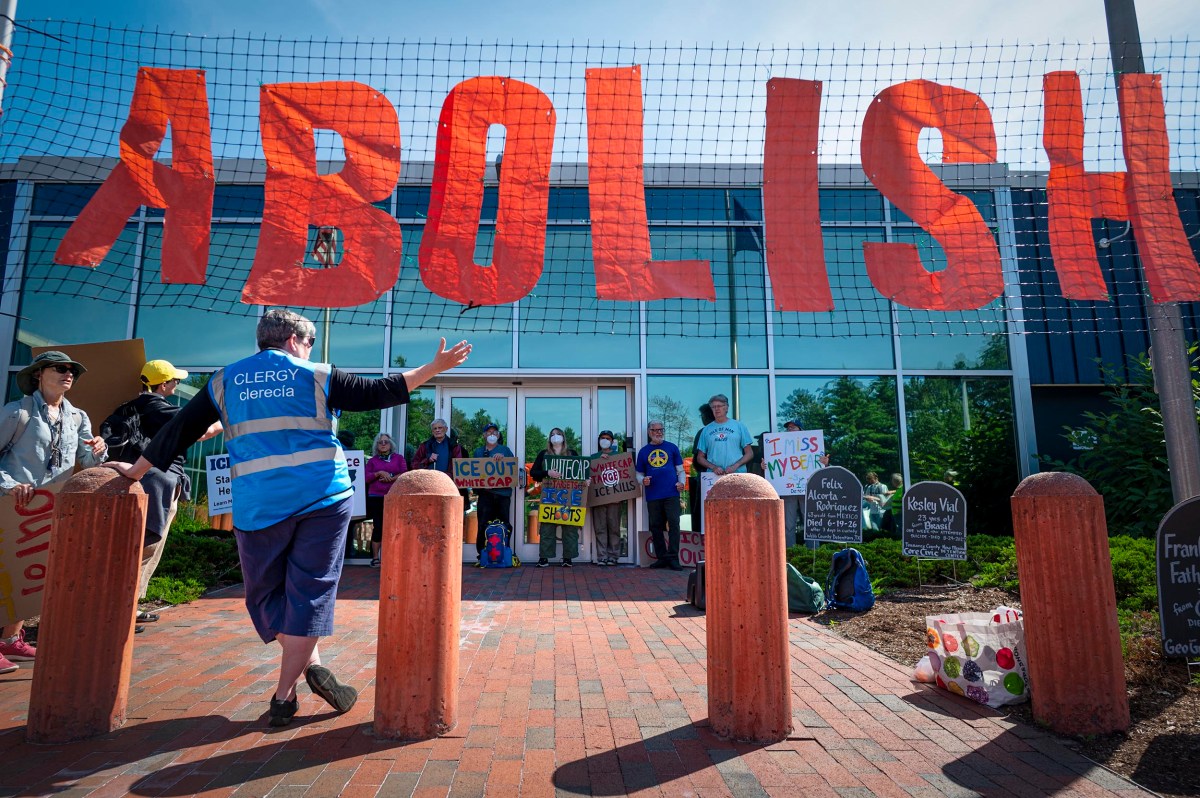
In Chittenden County, State’s Attorney Sarah George has repeatedly declined to prosecute demonstrators arrested while protesting U.S. Immigration and Customs Enforcement, arguing that pursuing the cases did not serve justice.
This week, matters were taken out of George’s hands.
Rather than bringing to George’s office criminal cases against 13 protesters cited in July for trespassing at ICE’s National Criminal Analysis and Targeting Center in Williston, state police routed the citations directly to Vermont Attorney General Charity Clark’s office. Twelve protesters charged with trespassing in adult criminal court were arraigned Thursday.
Clark’s office also initially charged an 18-year-old protester in criminal court even though state law requires 18-year-olds to be processed through family court for most offenses. Vermont’s Raise the Age law dictates that many minor crimes committed by someone under the age of 19 are charged in juvenile court. The attorney general’s office eventually changed course to charge the person as a juvenile.
The 12 defendants being prosecuted in criminal court this week pleaded not guilty.
Sarah George declined to comment on the case due to a busy schedule.
Senate Majority Leader Kesha Ram Hinsdale, D-Chittenden Southeast, said in a statement that she was “deeply disappointed” by the attorney general’s office for taking on the case.
“At a moment when the federal government is escalating attacks on immigrants and our civil liberties, Vermont should not be using its prosecutorial power in ways that chill free speech and peaceful dissent,” Hinsdale said.
The case appears to signal a shift in the way anti-ICE protests are handled in Chittenden County. George, the county’s state’s attorney, had previously declined to prosecute more than 20 ICE protesters in multiple different cases this year.
Moving forward, however, Vermont State Police will go directly to the attorney general to handle cases of trespassing in anti-ICE protests in Chittenden County, according to Vermont State Police Col. Shawn Loan.
Vermont law allows the attorney general to take on cases before they are viewed by local prosecutors, Clark said in an interview. Cases sometimes come straight to her rather than first being prosecuted on a county level, she added.
“The 14 county state’s attorneys have jurisdiction to prosecute crimes in their counties, and the attorney general has jurisdiction statewide,” Clark said. “And it isn’t necessarily a delineated approach to who takes what case.”
Clark used the example of Addison County, where the elected State’s Attorney, Eva Vekos, recently had her law license suspended. Earlier this year, Clark took on all Addison County cases concerning homicide, sexual assault or child abuse.
“There was no lawyer in the office to handle the cases, so that is why we took over the rest of the cases,” Clark said. She said the attorney general’s office has stepped in in other counties as well when county prosecutors were overstretched or other issues arose.
Loan said the charges in the Whitecap Business Park protest were related to trespassing, rather than the protest itself, which is protected by the First Amendment.

“The issue is the violation of the state statute when you refuse to leave a private property,” Loan said. “Because at that point you’re violating that property owner’s rights.”
When asked about the initial decision to charge the 18-year-old protester as an adult, Clark told VTDigger in an interview that she was unable to comment on the specifics of the ongoing case. But Matthew Bernstein, Vermont’s child, youth and family advocate, said that while the court eventually decided to move the teen’s case to juvenile court, some damage had already been done.
One of the major reasons for Vermont’s Raise the Age law, which designates 19 as the cut-off age for family court rather than adult criminal court, is to protect 18-year-olds’ identities in court proceedings, Bernstein said. In the trespassing case, the defendant’s name was published in multiple news sources.
“Once that’s happened, then it’s too late to reverse it,” Bernstein said.
VTDigger is not disclosing the name of the 18 year old.
Bernstein added that the decision to try a young protester for a nonviolent crime in adult court could discourage young people from other forms of civic engagement.
“They’re finding their voice, and raising that voice when they feel like it’s time to raise it is a crucial part of being a young person,” Bernstein said.
George has previously declined to prosecute 13 demonstrators involved in a February protest, declined to prosecute six cases in April, and refused four more cases in May. She wrote in a statement reported by VTDigger that prosecuting the six individuals involved in the March 11 Dorset Street ICE standoff would not serve the community’s best interests, and that police escalation contributed to the situation in question.
“To charge these six individuals with no criminal records, and expect that they bear the burden of all the harm caused that day — is not something I was interested in our office being a part of,” George wrote.
Loan said the Vermont State Police still saw a case for conviction in the cases that George dropped.
“I can’t get into the details as to why she declined, but she did choose to decline them,” Loan said. “We felt these still met criteria, and that’s the decision to bring it to the AG for prosecution.”
When asked whether the attorney general’s office will seek to prosecute seven clergy members arrested in a separate anti-ICE protest, Clark declined to comment.
Clark said her duty is to uphold the Constitution, which sometimes requires her to make unpopular decisions. She added that she cannot allow her personal opinions to influence her court cases.
“Whether I agree or disagree with what a protest is about cannot determine whether someone is held accountable under the law,” Clark said.
Hinsdale, the senate majority leader, cautioned Clark against continuing the prosecution.
“Our courts are already backlogged with real threats to public safety, and this is not what our top prosecutor should be prioritizing,” Hinsdale said. “There is still time to change course, and I urge the Attorney General’s Office to dismiss these charges.”
Gov. Phil Scott said in a press conference Thursday that he knew Clark’s decision was a hard one to make. He said prosecution “doesn’t mean that they’re all going to be thrown in jail, but they’re going to be held accountable for violating the law.”
“So I applaud her for making that decision, and we’ll see where it goes from here,” Scott said.
Amanda Janoo, who is running for governor against Scott, in a statement condemned the actions of Clark’s office. Janoo said Vermont may not be able to influence the federal government’s decisions, but Vermont officials do have the power to decide what they would like to enforce within the state.
“The question for every institution and every elected official right now is not simply: What are we allowed to do?” Janoo said. “It is: What does this moment require of us?”
Correction: An earlier version of this story misstated the status of the case.

