



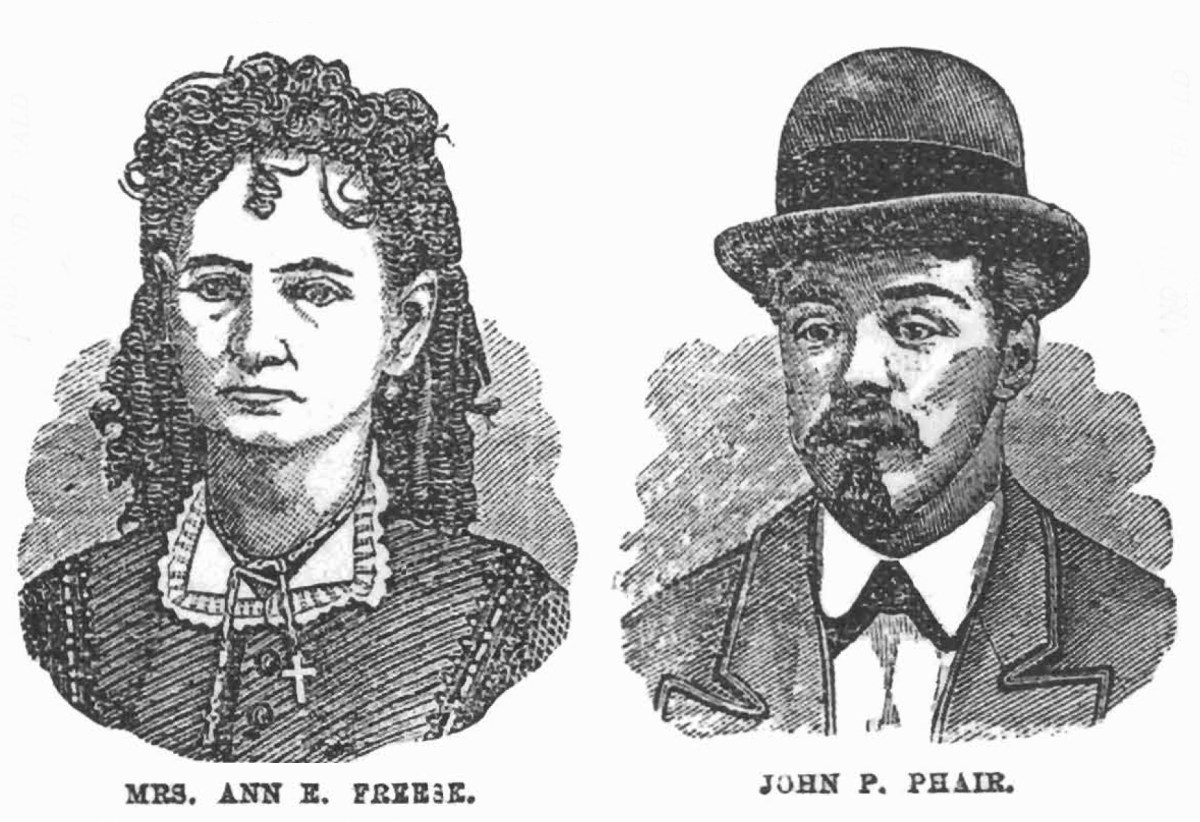
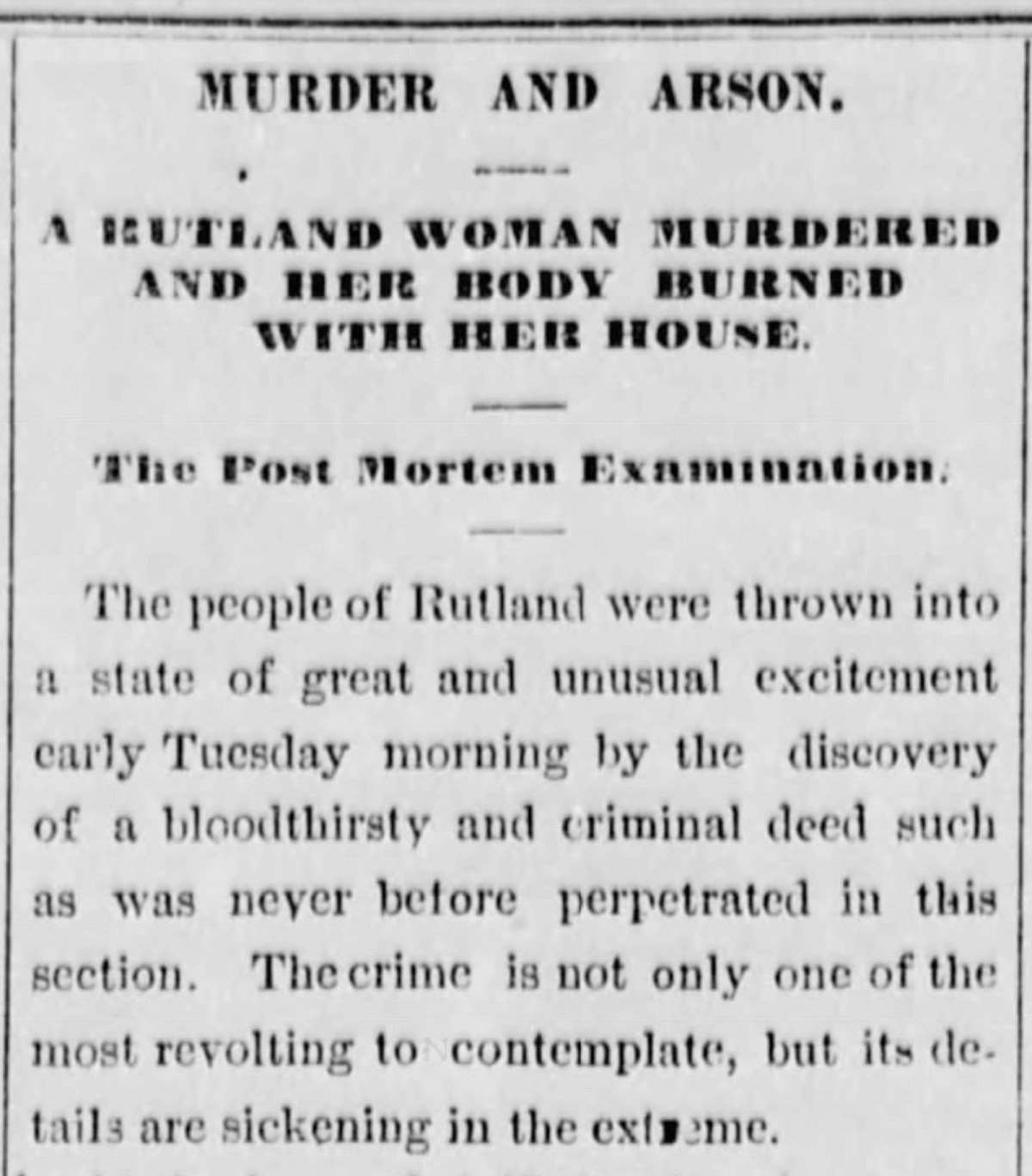
The first sign of trouble was smoke, as it so often is. It signaled that a house was on fire. Several neighbors hurried into the home. Finding no one on the ground floor, they raced up to the landing, only to be met by thick smoke and forced to turn back. Two men then climbed ladders to look for anyone trapped in a second-floor bedroom. Peering through the window, one of the men saw a woman’s body on the bed.
By opening a window, the would-be rescuer allowed a breeze into the room and, as a contemporary newspaper wrote, “like a mighty wave the lurid flames leap(ed) up out of the smoke, and in an instant the room (was) in a blaze.”
It was too late to save the house or its occupant. When the second floor caved in, onlookers watched the body drop into the first floor. Some hurried forward and pulled it from the fiery wreckage on River Street in Rutland.
An autopsy determined that the badly burned body was that of homeowner Ann Freese, basing the identification on dental work performed by a local dentist. As for the cause of death, doctors found no smoke in her lungs, which meant she was already dead when the fire started. The reason was obvious — Freese’s throat had been cut. This was murder. The fire had been set to cover it up.
Those are the most basic facts of an 1874 murder case that riveted Vermonters and drew national attention. Although a suspect was quickly arrested, the case dragged on for years and eventually forced the Vermont Supreme Court, legislature and governor to weigh in.
The motive was money. Freese was known to wear several rings and to own a watch and chain, opera glasses, and two shawls, all of which were conspicuous in their absence from the crime scene. She was also known to keep plenty of cash in the house, often several hundred dollars. This, too, was missing.
Not much else is known about Ann Freese. An 1870 U.S. Census report listed her as being 44, making her 47 or 48 at the time of her death. She was a widow, her husband, Alvin, having died in 1868. She owned her own home and the Census listed her profession as “at home,” meaning she didn’t work outside her home. Press reports said her maiden name was Davis and that her mother also lived in Rutland.
Newspapers often incorrectly gave her first name as Anna and her last name as Freeze or Frieze. But newspapers agreed that Freese had claimed to run a “young ladies social club” from her home, which was said to in fact be a brothel, or as the Rutland Herald put it, “a house of ill fame.”
“Although from the bad reputation of the victim she would not be likely to create a great amount of sympathy under ordinary circumstances,” the Herald stated on Wednesday, June 10, the day after the murder, “yet this foul deed created a great excitement among all classes, and excited crowds might be noticed in all parts of the village discussing the circumstances of this horrible, cold-blooded murder.”
People debated whether the murderer was connected with the P.T. Barnum circus, which had just performed in town. The circus’ entourage included “two bad-looking characters who have been noticed in suspicious attitudes and places,” the Herald reported. “They left town on one of the early morning trains of yesterday, and this leads to the belief in some people’s minds that they are the guilty parties.” Others remembered a “tall stranger” who had been noticed with Freese on several occasions, “notably driving through the streets and at the circus.” But that man had also seemingly disappeared.
Rutland’s selectmen became involved in the investigation, overseeing the search for clues in the remains of Freese’s home and offering a $2,500 reward for the arrest of the murderer or murderers.
The morning after the fire, a detective travelled to Burlington and apprehended a suspect who had recently hired a horse team to carry himself and two other men to Freese’s home. The man was a follower of Barnum’s circus, peddling lemonade and candy, and had a reputation as a thief. But the lead proved false and the man was quickly released.
The following day, at 1:45 a.m., Rutland Chief of Police George W. Crawford and police officer N.S. Stearns were at the Cuttingsville train station, just south of Rutland, to board the northbound train from Boston. By the time the train reached Rutland, they had arrested a 27-year-old passenger named John P. Phair.
The ‘terror of the city’
On the tall side, sturdily built and sporting a mustache and goatee, Phair had been seen several times in recent days with Freese, which made him an immediate suspect. Investigators’ interest intensified when they learned he hadn’t been seen at his lodgings, the Berwick House hotel, since the night before the murder. The fact that he took an early morning train to Boston on Tuesday, the day of the murder, only heightened suspicions. That’s why they intercepted him two days later on his return journey.
Phair professed his innocence. He pointed out that he’d left Rutland on the 4:30 a.m. train on Tuesday. Since Freese’s neighbors hadn’t noticed smoke coming from her house until about 6 a.m., he said he couldn’t have done it.
Phair had been in Rutland working for a couple of months as a machinist for a local company that made equipment for the marble and slate industries, but had recently left that job. That’s why, he said, he had taken the train south from Rutland. He said he had travelled to Providence, RI, to look for work at a screw manufacturing company there. And indeed a man he met on the train ride south did report that the two had shared a hackney carriage from the depot where they arrived in Boston to the one where trains departed for Rhode Island. The man, however, said he didn’t see if Phair actually boarded a train there.
Phair said he hadn’t ended up applying for a job in Providence because he’d learned the company wasn’t hiring. He said he stayed there one night, but couldn’t recall the name of the hotel, before traveling back to Vermont.
Phair had several things working against him. One was his character. Growing up in Vergennes, the Rutland Herald reported, he was known to be the “terror of the city.” On one occasion, he was accused of firing a gun at a man, the shot passing through the man’s hat and grazing his head. Another time, he was said to have dropped a large stone from a bridge, narrowly missing a man walking below. He was accused several times of theft and was eventually convicted of stealing leather hides, for which he served about four years in the state prison in Windsor.
What two Rutland policemen found in Boston also didn’t help his case. N.S. Stearns and a second Rutland officer searched city pawnshops for Ann Freese’s missing jewelry, on the theory that Freese’s killer had sold her valuables in Boston. Their task was daunting. Accompanied by a Boston policeman, their plan was to make the rounds of the city’s roughly 280 pawnshops.
After visiting about 50, they entered the pawnshop of Meyer Abraham and asked if he’d recently purchased a ladies watch and chain. Abraham said he had. Locating the watch in his safe, he read out the make and serial number of the watch, which matched the one Freese had owned. Abraham had bought the watch from a man who identified himself as E.F. Smith of St. Albans, Vermont. Shown a photograph of Phair, Abraham identified him as Smith. A second pawnbroker, James Pierce, told police that he had also acquired items, a pair of opera glasses and a shawl, from an E.F. Smith.
The policemen found that a man registering himself by that name had stayed overnight at a Boston hotel. Just as Abraham had done, the hotel clerk identified the photograph of Phair as being Smith. The clerk mentioned that after Smith checked out, a shawl had been found in Smith’s room.
The policemen returned by train to Rutland, accompanied by Abraham, who picked Phair out of a lineup as the man who had pawned the watch. Phair denied having ever met Abraham or seen the watch before, but when he was shown the shawl, he said he recognized it as one he’d seen Freese wearing.
Because of intense pre-trial publicity, Phair’s defense attorneys asked for a change of venue, but the judge rejected the request.
When it came time for the trial in September, the defense team faced the daunting task of refuting the evidence pointing to Phair’s guilt. The defense decided not to put the defendant on the stand. Instead it focused its efforts on characterizing all the evidence as circumstantial. The attorneys noted that no blood had been found on the defendant’s clothing and that he had only been carrying about $5 when he was arrested. Wouldn’t he have had a large amount of cash on him, if he had stolen Freese’s money and sold her goods?
They also disparaged the prosecution’s witnesses, saying that the prospect of possibly sharing in reward money had affected their recollections. One defense attorney, Wheelock G. Veazey, went so far as to launched an antisemitic attack against the pawnbrokers, claiming that since they were Jewish, their testimony couldn’t be trusted.
The state’s case did indeed rely on circumstantial evidence, including the discovery of a straight razor among the ruins of Freese’s house and the absence of Phair’s razor from his shaving kit. As for how Phair could have started a fire after he was already aboard a train to Boston, prosecutors suggested he had lit a pile of clothes on the bed and left it to smolder before eventually igniting.
After hearing the evidence, the jury deliberated for about four hours before finding Phair guilty of first degree murder.
Phair’s team appealed to the Vermont Supreme Court for a new trial, arguing in part that it hadn’t been given enough time to provide an adequate defense. In February 1875, the Vermont Supreme Court rejected the appeal, clearing the way for Phair to be hanged. His execution date was set for two years later, April 6, 1877, to allow time for appeals.
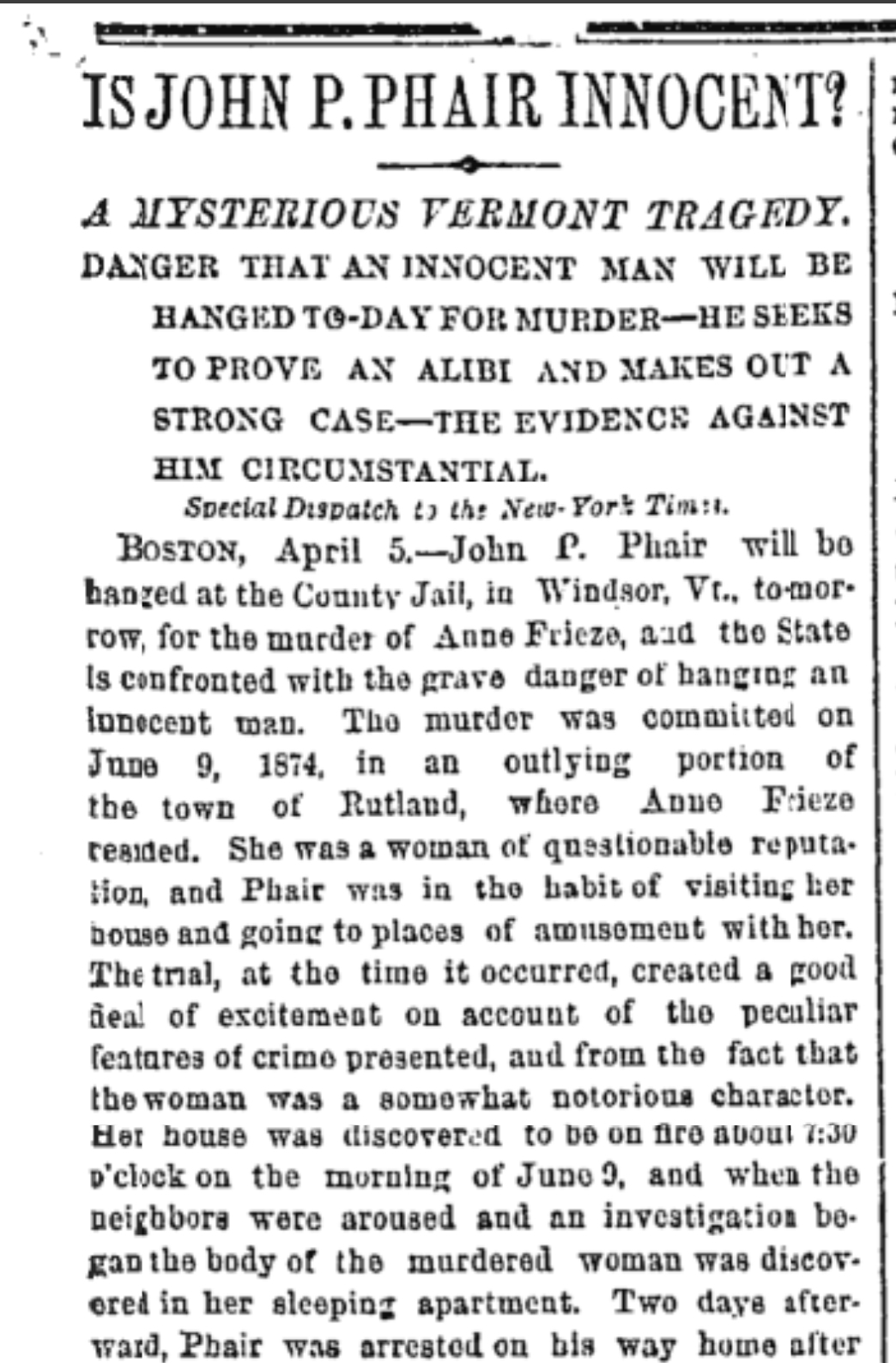
While awaiting execution, Phair maintained his innocence. His mother and the chaplain at the state prison appealed on his behalf to Gov. Horace Fairbanks for a reprieve. The governor refused, noting that the Vermont Supreme Court had rejected Phair’s appeal. The prisoner could still petition the state legislature to commute his sentence, the governor wrote, but he saw no reason lawmakers would do so, “unless the Legislature is ready to abrogate the death penalty entirely.”
An 11th hour reprieve
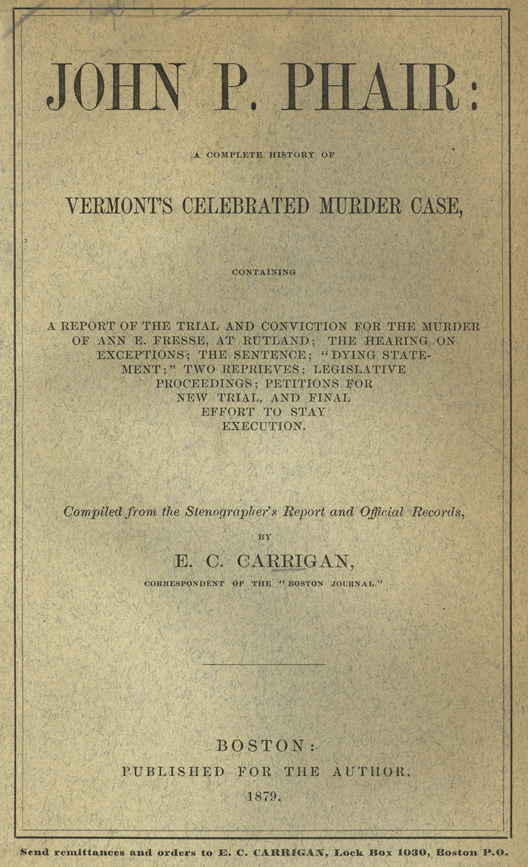
Less than two weeks before his execution date, Phair met with a Dartmouth student who was in Windsor performing with his college glee club. The student, E.C. Carrigan, was interested in becoming a journalist and asked Phair if he would provide a final statement that Carrigan could arrange to have published. Phair agreed, though he insisted for some reason that it not be published until the day after his execution.
In the resulting document, Phair relitigated the case, proclaiming his innocence and repeating the accusation that the pawnbrokers had perjured themselves. Carrigan offered the 8,000-word statement to the Associated Press, which turned it down; he then sold it to the Boston Globe. But Globe officials learned that the AP was planning to publish a summary of the document on the afternoon of the execution. In response, Carrigan persuaded Phair to allow the Globe to publish his statement on the morning of his execution.
A Boston businessman, Marshall Downing, who had grown up in Brookfield, Vermont, read the Globe’s story with particular interest. He remembered riding the train from Providence to Boston with a machinist from Vermont who mentioned that he had failed to land a job at a local screw factory. Downing even had proof — a notation he’d made in his journal — that he had been on the same train Phair claimed to have ridden that day. Downing read the Globe at 11 a.m. Phair’s execution was set for 2 p.m.
Downing immediately contacted the Globe’s managing editor, Charles Taylor, and each then wired Gov. Fairbanks, urging him to delay the execution so the new information could be reviewed. The telegraph operator in Montpelier couldn’t locate the governor, so he arranged for all the Western Union offices in the state to try to track Fairbanks down. At one o’clock, Taylor sent a telegram to the sheriff at the Windsor prison, beseeching him to delay the execution until he heard from the governor. The execution time was one hour away.
Phair was meeting with the prison chaplain when the hangman arrived. He brought with him a telegram from the governor. Fairbanks was granting a one-month reprieve. Phair heard the news and promptly fainted.
But the governor was in a quandary. State statute only allowed appeals for two years after a verdict had been rendered. That time had elapsed. Phair couldn’t legally appeal unless the state legislature changed the law. Since the legislature wasn’t scheduled to convene again until October 1878, Fairbanks extended Phair’s reprieve for another two years. Unless Phair’s appeals proved successful, he would be hanged on April 4, 1879.
Phair’s case became a cause célèbre. More than 20,000 people signed a petition calling on Vermont’s legislature to change the law. Lawmakers passed a law calling for two state supreme court justices to review any appeals. If the judges thought the appeal had merit, they could issue a stay of execution until the full court could consider the matter.
The Vermont Supreme Court met in Rutland on Feb. 4, 1879 to hear from Downing and others who had come forward since the original trial. Through this testimony, the defense hoped to cast doubt on the verdict. Downing recounted his recollected conversation with a Vermont machinist and said Phair might have been that man. Another witness said he had seen Ann Freese with a different man the night before she was murdered. The defense also claimed that police officers and prosecution witnesses had accepted bribes to lie under oath.
The prosecution countered that whoever killed Freese had clearly taken a train to Boston in time to sell her valuables, and everyone who encountered E.F. Smith in person testified that that person was really John P. Phair. Furthermore, the prosecution noted that Phair’s description of the part of Providence where he claimed he’d stayed overnight neglected to mention a recently erected Civil War memorial, the area’s most prominent feature. Phair, prosecutors said, was describing Providence based on a visit he’d made years earlier.
The following day, the justices announced that “no evidence furnishing a reasonable doubt of the guilt of the respondent (Phair) can be found,” and denied the request for a new trial.
Phair’s lawyers tried one more tack. They argued that under state law, once Gov. Fairbanks issued a reprieve, there was no legal mechanism for reviving the former death warrant against Phair. The supreme court rejected that argument too.
On April 3, the day before the scheduled execution, Gov. Redfield Proctor, who had succeeded Fairbanks, granted Phair yet another reprieve, this one for only six days, so the court could consider last-minute affidavits. In one, Marshall Downing stated he had finally met face-to-face with Phair and was convinced this was the man he’d encountered on the train from Providence five years earlier.
The defense also filed a claim that members of the Buffalo Bill Opera Troupe had been on the early-morning train from Rutland and Boston, suggesting that one of them might have killed Freese, and added an allegation that James Pierce, the Boston pawnbroker, had served time in prison, where he was known as Captain Kidd because he had supposedly once been a pirate.
The justices were skeptical of the new recollections and theories, trusting more in testimony given years earlier that identified Phair as the man who sold Freese’s goods in Boston. Phair and his lawyers had run out of options.
At 2 p.m. on April 10, 1879, before a gathering of 60 witnesses, Phair was hanged at Windsor prison, maintaining his innocence to the end. “I am sorry to die,” he said in his final statement, “but not so sorry as if I had committed the crime for which I am to die.”

