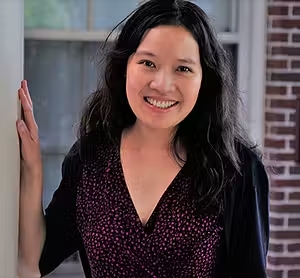
A Chinese history and human rights scholar will discuss the legacy of the 1989 Tiananmen Square protests and massacre and the censorship of historical memory during a public lecture at Saint Michael’s College on Wednesday.
In an interview on Tuesday, Rowena Xiaoqing He, whose talk will serve as the inaugural lecture for the college’s Global Issues Lecture Series, said that writing and teaching are ways she pushes back against political silencing and erasure.
“In this post-truth era, and with populism, that’s exactly why we need to collectively be responsible for what we say and not censor ourselves but verify the truth,” said He, an associate professor of history at the Chinese University of Hong Kong and a former assistant professor of history at Saint Michael’s.
“I see my mission as to enlighten and inform and engage the younger generation to make a difference in this world. Not just in the United States, but in this global village. You can’t just say, ‘oh, China’s human rights have nothing to do with us.’ A human rights violation anywhere is also a violation for human life everywhere.”
He, who was born and raised in the Guangdong Province in China, was 17 years old when the Chinese government deployed 200,000 soldiers equipped with tanks and AK-47s against unarmed students and workers protesting for democracy at Tiananmen Square in Beijing.
Protesters at Tiananmen were “following the Chinese intellectual heritage of Confucian dissent,” He said, “meaning they would hold the rulers (accountable) to improve but were not trying to overthrow the government. We understood that being patriotic means that we push (the government) to reform, not because of anger, but because of hope and trust in the government to reform itself.”
“But the moment you order your army to fire on unarmed civilians, you lose your legitimacy as a government,” He said. “We (protestors) were punished by that very system that instilled those values — to love the country, to love the people more than we loved ourselves.”
Haunted by that massacre, He participated in student-organized, pro-democracy movements. She devoted her academic work to studying “the nexus of history, memory, and power, and their implications for youth values, identity, and social change,” according to a description of the event provided by Saint Michael’s College.
In her first book, “Tiananmen Exiles: Voices of the Struggle for Democracy in China,” which was named one of the Top Five China Books of 2014 by the Asia Society’s China File, He interviewed and wrote about political exiles facing backlash for speaking out against censorship following the protests. Because of her work, He would also risk arrest if she were to return to Hong Kong, according to St. Michael’s.
“The Chinese Government used state power and machinery to silence people’s memory and people’s calling for justice and truth,” He said, describing the Patriotic Education Campaign, a state-led effort to reinstill public support for Chinese leadership following the massacre at Tiananmen Square.
He witnessed the impact of this education campaign, she said, in students who grew up under the influence of the patriotic education system and expressed reluctance or resistance to He’s critiques of the government’s censorship.
He said she hopes to honor her students’ capacity to learn and change, stressing the importance of communicating across political divides. In November 2022, when thousands of people across China took to the streets to denounce the Chinese Communist Party’s authoritarian rule and protest the government’s strict Covid-19 regulations, He said she cried as she “saw the younger generations waking up” and organizing to protest.
She said she looks forward to returning to the community of students and faculty she cultivated while teaching in Vermont.
He’s talk, titled “Lighting Candles in Darkness: From Tiananmen to Hong Kong,” is scheduled for 7 p.m. on Wednesday, April 26, in the Dion Student Center at Saint Michael’s College in Colchester.