


This post features photos by Mike Dougherty, Glenn Russell and Emma Cotton.
“The beginning of the end” is how officials described the arrival of the Covid-19 vaccine in December 2020. Now, some are wondering if the end is in sight.
Just five months after health workers received the first doses, more than 380,000 Vermonters, 70% of the eligible population, have been partially or totally immunized.
Officials are careful to note that risk remains. Herd immunity — the point at which enough people are vaccinated that the spread of the virus becomes negligible — requires closer to 80% uptake across the entire population, which includes children under age 12 who still aren’t authorized to receive the vaccine.
Plus, experts have warned that vaccinating the hardest-to-reach people will take more time and resources than accommodating the most eager.
Meanwhile, Covid-19 cases have plummeted. Many factors could figure into that drop, including warmer weather and the relative safety of outdoor activity. But officials have noted that cases declined first in the oldest age groups and gradually skewed younger, tracking with the state’s age-banding schedule for vaccine eligibility. That indicates the vaccine was a major driver.
The worldwide distribution effort is the largest vaccination campaign ever. It’s also the biggest in the history of Vermont, and the state has immunized its residents more quickly than any other in the U.S.
Vermont has done so by coordinating across state government, the Vermont National Guard, the private health system and beyond, to provide access and encouragement to as many people as possible.
“There has never, ever been anything so difficult, or complicated, or important as the effort that we’re undertaking now,” said Chris Finley, the immunization program director for the Vermont Department of Health, in an interview last week.
The program now approaches a turning point. While the supply of doses has not yet eclipsed demand, Finley said, the months of vaccine scarcity are largely over.
Most Vermonters who were vaccinated through April got their shots after following a strict eligibility schedule and booking appointments weeks ahead of time. Now, walk-in clinics, where anyone age 12 and over can show up and get a shot, are available every day.
“If there is a Vermonter who has not been vaccinated, but has been waiting for a convenient time, location, or more interesting experience, or a walk-in or drive-through opportunity, or just doesn’t want to be bothered with scheduling and planning — well, it’s your turn to shine,” Health Commissioner Mark Levine said on May 7. “Your moment has arrived.”


The first shots in December took place largely out of public view, in hospital basements and conference rooms. Nurses, doctors and hospital staff, who had been on the front lines of the pandemic response for months, sat for the first round of injections with tempered excitement.
The shift to public vaccinations in late January brought the effort into the open. Clinics have since been staged in high school gyms, hotel ballrooms, fire stations, fairgrounds — wherever there is floor space and ample parking.


In March, the Central Vermont Medical Center converted a recently shuttered JCPenney store into a hub where staff could vaccinate more than 450 people a day.
Remnants of the department store remained visible. An Arizona Jean Co. ad sat outside the area where staff members filled syringes, and the store’s expansive, mirrored jewelry case sat empty inside the entrance. Beds, for patients who might experience a reaction and need to lie down, happened to sit where the store’s bedding department had been.
Patients share memories of the store with vaccinators, said Barbara Qualey, who oversees the site for the hospital. “One came in and said, ‘I got my prom suit here.’”


By mid-April, nearly every local pharmacy in the state had joined the effort. Through both state and federal partnerships, pharmacists and pharmacy technicians have added full-time vaccinations to their schedules, seeing new patients roughly every 10 minutes, day in and day out. Some have hired staff to help with the workload.
Emily Barry pulled back from her job as a nurse in the psychiatric unit at the University of Vermont Medical Center to take a temporary role as a pharmacy vaccinator. She felt a calling to be a part of the effort, she said, and it brought some positivity after a challenging year.
“It’s been difficult in my profession. It’s been difficult on families, kids, everyone, older adults in nursing homes,” Barry said. “So I just felt like this would be the most helpful thing to do.”

Barry took a job with Integrated Resources Inc., a staffing service that contracts with pharmacies across the state to provide vaccinations. For each shift, she travels to a different pharmacy in a different town to deliver shots.
She regularly sees patients cry with relief. Some have brought her thank-you notes. Patients want to talk, Barry said — so much so that she has to politely end conversations to stay on schedule with appointments.
“I kind of just feel like Santa Claus every day,” she said.
Steven Simpson, the supervising pharmacist at Kinney Drugs in Berlin, said in March that the shift to full-time vaccinations had been surprisingly smooth. Simpson performs most of the shots himself, drawing syringes of the Pfizer vaccine and meeting patients in a corner of the pharmacy outside of public view.
His concern early on was logistics: Would patients have to be turned away if the store ran out of doses? What if a winter storm prevented a delivery?
It never happened, he said. “We’ve always had the vaccine when we need it.”
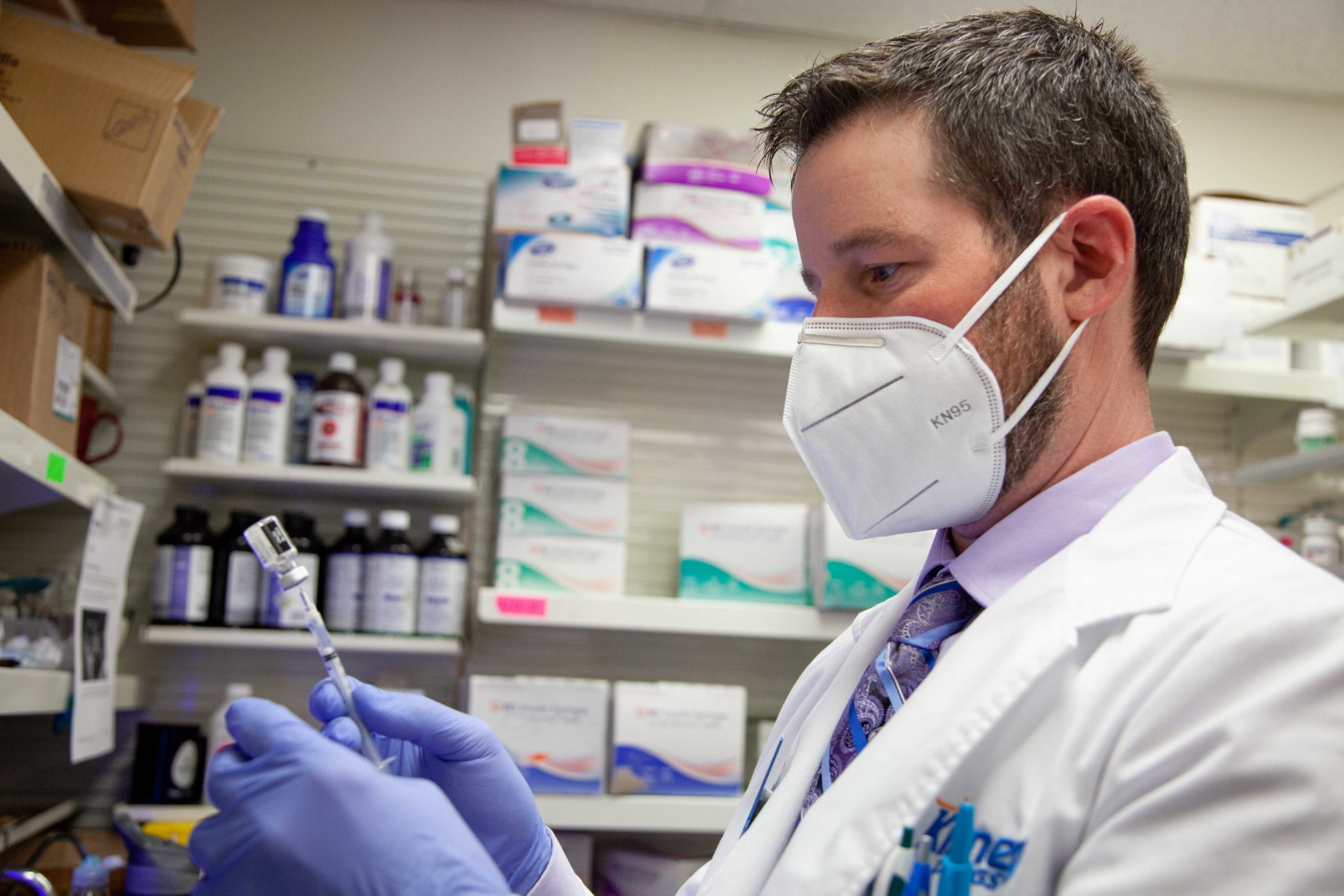
Finley said that’s thanks to a complex web of systems the state has put in place.
While some pharmacies receive shipments directly from the federal government, the state operates a storage depot to ensure that the temperature-sensitive vaccines are kept properly. (At the request of Operation Warp Speed, the location is kept secret and the site is closed to the press.)
When shipments arrive, state workers and Guard soldiers manage the tracking and storage of each unit, then transport the designated amounts to the sites where shots will be administered.
The vials are stored in specialized coolers. An electric probe ensures that each cooler maintains the proper temperature — at any time, a staffer can plug the thermometer into a computer and download the full readout. Every vial is tracked.


The National Guard staffs many of the state’s largest clinics, no matter where they’re held.
At the state’s first drive-through event, held in Barton on April 27, Maj. Daniel Dykman said his team had already crisscrossed the state, delivering shots in Brattleboro, White River Junction, Chittenden County and beyond.
“I don’t really know, to be honest with you, what the state has in store for us,” Dykman said. “We’re here to accommodate and support whatever the state’s actions are.”
The campaign has looked different every week, Finley said. Some shifts are more obvious, such as the pausing, then resuming, of the use of Johnson & Johnson doses, or the recent federal authorization of the Pfizer vaccine for children over 12. But even the routine distribution of doses can swing wildly, based on the state’s allocation from the federal government.
Every Tuesday afternoon, Finley logs onto Tiberius, a website run by the U.S. Department of Health and Human Services, to learn how many doses of Covid-19 vaccine Vermont will receive in the coming week.
Staffing vaccination events and publicizing available appointments requires some lead time, she said: “This just can’t be done overnight.” But she and her team must order the doses within two days of seeing the allocation number.


Early supply shortages brought friction. Critics argued throughout the spring that the Scott administration’s focus on age, while effective at keeping hospitalizations and deaths at bay, failed to provide equitable access to marginalized Vermonters and essential workers.
Watching those debates play out was challenging, Finley said, at a time when doses were scarce and the federal government had left crucial eligibility decisions to the states.
“I don’t know if there is a system that could have worked for everyone when the bottom line is: We didn’t have enough vaccine for everybody that needed it at a certain time,” Finley said.
The state has since worked to close key gaps. In February, local emergency medical service providers began driving doses to homebound Vermonters, racing against the clock to administer vaccines in people’s kitchens and living rooms before doses spoiled.
The effort to close a more than 10-point gap in vaccination rates for Vermonters of color began with targeted outreach, but eventually included prioritizing all Black, Indigenous and people of color midway through the age-based schedule. Clinics focused on BIPOC Vermonters still take place.


Drive-through clinics, deep-freeze temperature tracking, shipments of medication to hotels and malls — none of these systems existed before this year, Finley said. It’s likely not the immunization program the state would build from scratch, she said, but improvising has been a matter of course during the pandemic.
“Never in this response has any organization, whether it’s [the federal Centers for Disease Control and Prevention] or states, had the luxury to take a step back and think, how should this look?” she said. “It’s really, you’re building the boat while you’re sailing.”

