BENNINGTON — Around the state, slots for vaccines have filled up quickly at several clinics organized specifically for Vermonters who are Black, Indigenous and people of color (BIPOC) and those in their households.
The 100 allocated slots were completely filled within 24 hours of the Windham County’s NAACP announcement that it would open its first clinic in March, and organizers said those looking for vaccines were willing to drive from far corners of the state to receive them.
Watching vaccination rates for people of color fall behind that of the rest of Vermont’s population — and knowing that Covid-19 disproportionately endangers people of color — Wichie Artu, with the Windham County NAACP, decided to organize clinics locally.
Organizers of clinics in Brattleboro, Rutland and Bennington have pointed to barriers such as accessibility, transportation and distrust of a medical system that has historically mistreated people of color as reasons why clinics to serve such groups are important.
Artu said the health department has worked closely with local chapters of the NAACP and other groups, like the Vermont Racial Justice Alliance, to organize the events, with the health department running the clinics and the advocacy organizations acting as community liaisons.
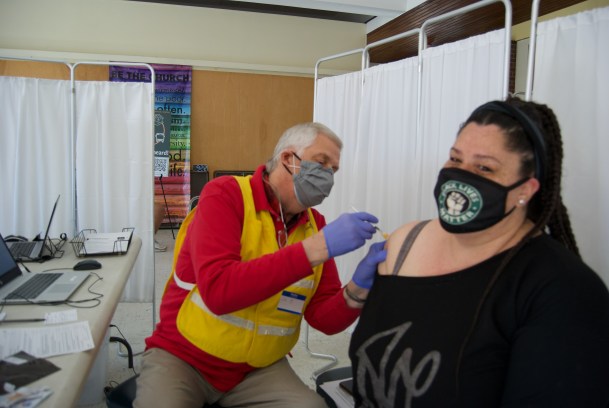
They’ve worked through those barriers while organizing the clinics, creating spaces where they hope attendees will feel welcome. Instead of holding them in Health Department offices or hospitals, they have sought out neutral spaces, such as schools and churches.
“Not only is the government famous for being slow and convoluted and confusing, it’s also been known to do experiments on people of color,” Artu said. “It’s also been known for giving information over to ICE (U.S. Immigration and Customs Enforcement). So the government has this reputation with our communities, and my role was to create a very big divisive line and create a security layer for our people.”
Artu said he made sure that those receiving the vaccine maintained control over the personal and identifying information they provided at the clinic.
Meanwhile, members of the Rutland County NAACP and the state’s Department of Health heard that residents of Rutland and Bennington were driving to Windham County’s clinic, so they decided to organize several of their own.
A total of 400 people registered to receive the vaccine on Saturday at two BIPOC-specific clinics in Rutland and Bennington. Next weekend’s two clinics are filling up quickly. Patricia Johnson, an emergency room nurse at Southwestern Vermont Medical Center who has been advocating for equity in health care, organized the clinic in Bennington.
Greetings at the doors of the Bennington clinic were marked with choruses of thanks, both from the clinic organizers and the attendees. Johnson took a number of measures to make attendees feel welcome, including ensuring that the demographic makeup of health care workers at the clinic represented those who came for vaccines.
“People trust those who look like them,” she said. “They feel comforted by another person of color treating them and creating a care plan or educating them.”
Held at the Second Congregational Church near downtown, Johnson said she hoped people of color might feel welcomed by the space, whose street-facing exterior hosts “Black Lives Matter” and “Immigrants and Refugees, Welcome” banners.
“Church is a place that people recognize as being safe and a place where you’re always welcomed,” Johnson said.
Some who came to be vaccinated said the clinic was easier to access than the registration through the health department website. Attendees heard about the clinic through word of mouth, the NAACP’s social media pages or one of the organization’s community partners.
“The word spread faster,” said Tina Cook, who recently ran for Bennington’s selectboard. “The information would have normally not traveled through this many layers.”
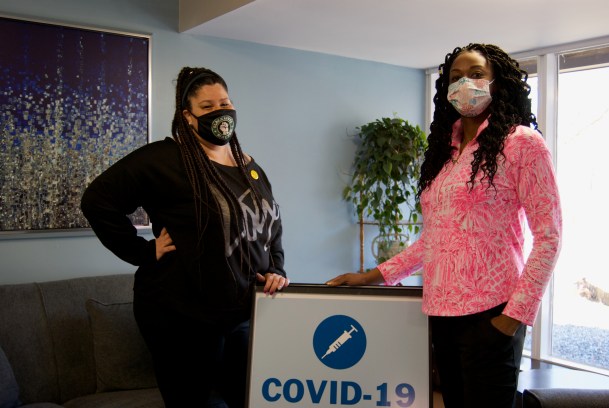
Mia Schultz, president of the Rutland Area NAACP, which extends to Bennington and Addison counties, was among the first people to receive the vaccine at Saturday’s clinic.
“There’s a lot of people who wouldn’t normally feel comfortable walking into a hospital to get their shots,” Schultz said. “People can come here and feel comfortable and feel welcome and feel safe and see people like them getting the vaccines. It’s needed, and it’s a beautiful sight to me.”
While hospitals and some clinics are staffed with police officers, Johnson invited Beau Alexander, a security guard from Southwestern Vermont Medical Center who came without a uniform, to make sure the entrance of the clinic remained peaceful.
“He believes in health equity and knows that some people might be put at risk by coming here,” she said. “We have gotten a few intake forms that were not so friendly and racist. So in order to protect people who want to come here and get the vaccine, he’s offered his time and full day to ensure the safety of everyone in this building.”
Organizers in Windham County avoided police presence, too.
“We were in contact with the Quaker community and the white ally community to make sure that we had people around, or at least there to call on, if there were de-escalation things that needed to happen,” said Steffen Gillom, president of the Windham County NAACP.
Megan Herrington, Bennington’s public health services director for the Bennington district, said around 3,000 Vermonters who qualified registered for the vaccine soon after Gov. Phil Scott opened eligibility for people of color.
“If we tried to do a one-size-fits-all, then we leave people out,” she said. “The strategy of having a BIPOC-specific clinic, it’s another tool in the toolbox.”
While 39.8% of white Vermonters have received their first dose of the vaccine, only 19.7% of people who are Black or African American, 23.6% of people who identify as Asian, 9.4% of Indigenous people and 4.4% of Vermont’s Pacific Islander population have received their first dose.
“People were willing to travel from Essex (County) to come here today because they were desperately wanting to get the vaccination,” Johnson said.
Gillom noted that, when those organizing the clinics are members of the communities the clinics are meant to serve, they can be more effective.
“I think the combination of those lessened barriers — and seeing people who you know and trust to do the best they can by you actually trying to administer these things — is super impactful and important,” he said. “People come out because they know that the NAACP is going to try their best to do right by them.”
To register for a vaccine appointment or get information on walk-in clinics, visit healthvermont.gov/MyVaccine or call 855-722-7878.
You will be asked to provide your name, date of birth, address, email (if available), phone number, and health insurance information (if available, but not required).