


Editor’s note: Mark Bushnell is a Vermont journalist and historian. He is the author of “Hidden History of Vermont” and “It Happened in Vermont.”
The young woman was wasting away. Something unseen was draining Hulda Burton’s vitality. The people of Manchester had seen it before. Now it seemed Capt. Isaac Burton was doomed to lose a second wife to the grave. His first wife, Rachel, had displayed the same symptoms before she died.
The captain, however, never fell under suspicion. Instead, people suspected the culprit was Rachel. Yes, the dead first wife. Actually, they believed that Rachel was somehow not quite dead, that she was, in fact, a vampire.
To stop Rachel’s presumed predations, they performed a grisly act: they dug up Rachel’s grave and removed from her corpse her lungs, heart and liver. Then they took the organs to the village blacksmith’s shop, where they burned them to ashes on his forge.
“Timothy Mead officiated at the altar in the sacrifice to the Demon Vampire who it was believed was still sucking the blood of the then living wife of Captain Burton,” wrote Judge John S. Pettibone in his “Early History of Manchester.” According to Pettibone, 500 to 1,000 people witnessed the burning in February 1793, which would have been quite the turnout, given that Manchester’s population at the time was 1,300. Pettibone said he was repeating the account he heard from one of the witnesses.
Perhaps the oddest thing about this report is that it is not unique in the annals of Vermont history. Three other stories of vampire burnings have also been handed down. Each supposed incident came in response to a mysterious illness that was claiming lives.
At the same time as Manchester’s incident was said to have occurred, a family in Dummerston was suffering a similar affliction. The incident is recorded in the “History of the Town of Dummerston” by David Mansfield, which was published in 1884.
One after another, the many children of Lt. Leonard Spaulding began contracting a sort of debilitating and eventually fatal illness. After this draining disease had killed six or seven of his children, their father sought feverishly to find some way to protect the remaining.
Here, the Spauldings’ story adds a twist. The victims were apparently buried in a row. People believed that an evil vine or root was growing from one coffin to the next; if it were allowed to reach the coffin of the latest victim, then another family member was in jeopardy. So they dug in the cemetery to destroy the root, then they unearthed the body of the last victim and burned his “vitals.”
Daniel Ransom claimed his family practiced the same ceremony in 1817, after his brother Frederick died of a consuming ailment. Writing in his memoirs as an old man, Daniel Ransom said his brother had been a student at Dartmouth when he died. His body was returned to his hometown of South Woodstock for burial. Soon afterwards, his father, to protect the rest of the family, had Frederick’s heart removed and burned in a blacksmith’s forge in town.
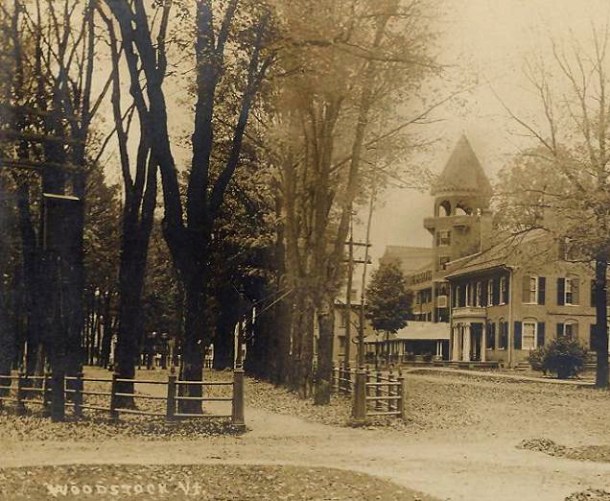
The final case of Vermonters combating vampirism is the most oft-repeated, and the most suspect. It supposedly occurred in Woodstock. When the town’s Vermont Standard newspaper reported the story in 1890, it was actually just repeating, and adding local details, to a story that had first appeared in the Boston Transcript. And that newspaper’s story was allegedly based on the memories of an unnamed “old lady,” who had lived in Woodstock decades earlier.
According to the papers’ accounts, in about 1830, when a local man named Corwin died of the dreaded wasting disease, people worried that his spirit would prey on his family members. As in the other cases, the man’s heart was disinterred. The Woodstock paper’s account added this chilling detail: the blood in the heart was said to still be liquid, even though the man had been dead for six months. The freshness of the blood was taken as proof of his vampirism, so the heart was taken to the Woodstock Green, burned and buried.
What exactly was going on in Vermont? Unless you are inclined to say, yeah, sure vampires, obviously, then you have to dig a little deeper.
Historians and folklorists believe the answer lies in the victims’ cause of death. They all died from an illness that sapped their strength. Its cause may have seemed mysterious, but it had a name even then: consumption. We know it today as tuberculosis.
Naming it was a lot easier than preventing it. Doctors at the time were stumped. They didn’t yet understand the bacterial transmission of the disease, so they couldn’t halt its deadly march through a family like the Spauldings.
Powerless against tuberculosis, people did what they could, according to Michael Bell in his book “Food for the Dead: On the Trail of New England’s Vampires.” Many people attributed epidemics to a phantom force, Bell writes, and then invented a way that it could be defeated.
The idea that spirits of the dead sometimes sought fresh blood to stay partially alive was nothing new, says Bell, a folklorist and anthropologist. The belief can be traced back thousands of years. Even with their comparatively crude understanding of how the body works, the ancients knew that blood was essential to life. Consequently, many cultures viewed blood as restorative: Roman gladiators sometimes drank the blood of their foes to assume their strength, and some bloody-minded rulers bathed in the blood for their victims in hopes of remaining young.
Since blood meant life, ancient peoples believed that ghosts and vampires were in search of it. Indeed, Bell writes, ancient Europeans sought to placate their spirits by pouring blood into holes drilled into graves in an effort to “feed the dead.” Or if people wanted to make sure the dead were fully dead, it was best to burn the heart.
Like vampires, these archaic traditions never really died. Bell writes that Vermonters were carrying forward beliefs from their ancestors. Even the Spauldings’ belief in an evil vine or root can be traced back to stories told long ago in Europe of plants growing up from the graves of heroes or between the bodies of lovers.
For all the bizarre ways Vermonters may have tried to combat consumption, none seemed to work. Daniel Ransom lived a long life, but he would hardly have counted the heart burning a success. Even after the rite was performed, his mother, sister and two brothers died from tuberculosis.
Likewise, the young bride Hulda Burton died shortly after the ritual that was supposed to save her. The same was true of the Spaulding family, which continued to lose members to tuberculosis.
As for the Corwins of Woodstock, local records from the period show no one by that name living, or dying, in the town. In that sense, perhaps of all these families, they are the most like vampires: You shine a light on them, and they disappear.
