


[D]USHETI, Georgia — “Blowin’ in the Wind” blared out of a set of speakers as two dozen teenagers followed along on handouts with a few words blanked out, like lyrical MadLibs.
Sporting a T-shirt that boasted “this teacher has awesome students,” Mako Zakariashvili energetically bounced between the groups of her students clustered around tables as they completed the first task of that day’s English lesson, focused on the theme of democracy.
The second task, for the students in this small town who two years ago had minimal English language skills: interpret Bob Dylan’s rhetorical questions.
“Maybe he or she goes to the street and some animals or people are discriminated against from others — by others,” one student said, correcting herself as she posited a theory about what Dylan meant when he asked, “how many times can a man turn his head and pretend that he just doesn’t see?”
This English class — part of the U.S. State Department’s long-running Access program, active in 80 countries — has Vermont roots. It’s one of scores of programs the Waitsfield-headquartered organization PH International has implemented in countries in the Caucasus, the Balkans, the Middle East and Eurasia over the last three decades.
PH International’s programs, often grant funded through the U.S. State Department, tend to focus on direct people-to-people connections. But the work fits into an overall U.S. foreign policy strategy of so-called “soft diplomacy” aimed at creating cultural ties and good will towards the United States in other places around the world.
Founded in 1985 to facilitate cultural connections between the U.S. and the then-Soviet Union, PH International, which changed its name from Project Harmony in 2008 to reflect the multinational nature of its work, has grown into an organization with offices in half a dozen countries.
Working with high school students, police officers, teachers, journalists and others, the nonprofit’s programs vary from widespread educational initiatives implemented on the ground in other countries, to months-long projects that involve travel to Vermont, other parts of the U.S., and other countries. Sometimes programs include cultural exchange with an American group, with participants traveling to the other groups’ countries. Other programs, like the language class, play out in communities.
The Access English language program, which PH International implements in four countries, including Georgia, gives students from economically disadvantaged backgrounds a chance to learn English.
“One of the strategic interests is to start bridging the divide — the cultural and sort of propaganda gaps — between our country and other countries,” PH International Executive Director Ann Martin said.
The classes are focused in regions where students likely wouldn’t have access to language classes otherwise, like the leafy small town of Dusheti, an hour drive outside of Georgia’s bustling capital — where students were nearing the end of their two-year program when they set about parsing the finer points of Dylan’s poetry.
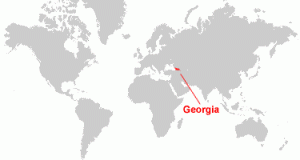
For young people in Georgia, learning English is a key to a prosperous future, according to Elene Chincharashvili, a student in the class. A former Soviet state, Georgia underwent a major political revolution in 2003 and a military conflict with Russia in 2008. In recent years, it has opened up and become a flourishing tourist destination. English, Chincharashvili said, not only opens educational doors, it also gives people a chance to tap into that blooming industry.
“In the past in Georgian schools, French and Russian languages were mostly taught but nowadays English is (the) main foreign language,” Chincharashvili said in an email later. “In the future you can’t get a job without knowing a foreign language and first of them is English.”
Later in the lesson, which members of PH International’s board were sitting in on, Zakariashvili led students through a debate over whether all citizens in a democracy are required to do certain things: pay taxes, report crimes to police, defend their country when it’s criticized, vote in elections — the last of which, students agreed all citizens should do.
“Why all of us should vote?” Zakariashvili asked her students to explain.
“It’s our right,” one student chimed in. Another called voting an “obligation.” So, Zakariashvili probed further, which one is it?
“Both of them,” another said.
Through the course, Zakariashvili, who last year traveled to Vermont with PH International for a teacher training program, has focused her lessons on environmental issues, multiculturalism, citizenship and more. “I always pick the topics that are connected to reality and they always draw parallels to their everyday life,” she said.
Media literacy has been another theme, and Zakariashvili said a goal of the Access program is to develop students’ critical thinking, so they can approach information thoughtfully, rather than emotionally.

“It is (the) 21st century, the century of technology and internet,” she said in an email. “My students are not (an) exception, they are active on social media websites and they know they need to be aware of fake news.”
Combatting disinformation is a part of PH International’s objections — PH also runs English programs in ethnic minority communities that speak their own languages, and Georgian is sometimes a second language for locals, according to PH staff. The aim is to help students approach information critically, whether they’re encountering it online or from other sources in their communities.
The program, according to PH International staff, is well-received in Georgia. Nana Ioseliani-Meissner, who direct PH International’s language programs in Georgia, says government officials have been welcoming and supportive of the organization’s efforts.
But the motivation behind such U.S.-supported cultural and educational programs goes beyond good will, according to foreign policy experts.
“It’s not just generous,” said Stan Sloan, a top expert in U.S.-European relations and a visiting professor at Middlebury College. “It’s self-interested.”
The U.S. prefers for other countries to be “western-oriented,” he said. And, as Russia undertakes efforts to expand its sphere of influence, programs with U.S. support could be seen “as offering alternative perspectives to the ones offered by Russia and Putin.” Tensions between Russia and Georgia have flared in recent months.
The U.S. pursues “soft power” initiatives in a variety of forms, ranging from public health initiatives to the Fulbright program.
Broadly, from a strategic perspective, Sloan said, those efforts can have the cumulative impact of improving the image of the U.S. in the international community’s view when tensions do arise.
“The soft power instruments and attractions the U.S. has does help give legitimacy to when the U.S. actually has to use hard power,” Sloan said.
Despite multiple proposals by the Trump administration to slash the State Department budget, including cutting funding for various “soft” diplomatic initiatives, Congress has not adopted most of those proposals in their appropriations bills. “Soft power” programs have enjoyed bipartisan support in Congress. They’ve also been championed by Sen. Patrick Leahy, D-Vt., the top-ranking Democrat on the Senate Appropriations Committee and a longtime vocal supporter for funding diplomatic initiatives.
Stephen Sestanovich, a Russian and Eurasian policy expert at the Council on Foreign Relations and the U.S. State Department’s former ambassador-at-large for the former Soviet Union, said “soft” power initiatives can be influential even in places like Georgia, which tends to be sympathetic to the U.S.
But, Sestanovich noted, how well different programs work is debatable. He emphasizes efforts “more closely linked to democratic breakthroughs,” such as those supporting journalists or free trade unions, over programs like English instruction.

For PH International, though, the objective is often in the face-to-face encounters and interactions. Martin, the organization’s director, recalled hearing from a colleague who worked in the former Soviet Union that a key factor that opened Soviet residents to being curious about the West was jazz music played on Radio Free Europe. It’s those “under the radar things” that can have major impacts that PH International provides, she said.
“It’s something that touches people,” Martin said. “I think that’s what many of the programs that we do attempt to do.”
Zakariashvili, who has been implementing the Access program in Dusheti over the last two years, has seen a massive transformation in her students.
“They would not talk, they did not want to share their ideas, they were thinking that they were wrong,” she said, as students milled about and chattered with each other after adjourning.
Improving their English, developing critical thinking skills and working as a group has empowered them, and opens the possibility for connecting with people and opportunities outside of Georgia, she said.
“They are not afraid (of) challenges that are coming ahead of them.”
Editor’s note: Elizabeth Hewitt participated in a PH International program as a high school student in 2006, and worked as a temporary employee on a month-long program in 2011.

