


Editor’s note: Making it in Vermont is an ongoing series by VTDigger’s business reporter Anne Wallace Allen looking at companies and industries driving innovation in the state. If you have ideas about inspiring entrepreneurs or companies, send them to Anne at awallaceallen@vtdigger.org.
[M]ore than 3,500 separate companies mounted exhibits at the Natural Products Expo in Anaheim the week of March 4. For Anna Keller, the marketing director for Twincraft Skincare of Winooski, one trend in skincare products stood out clearly: cannabidiol, or CBD.
“The buzziest ingredient anyone is talking about this year, after the Farm Bill passed, is CBD and hemp-derived products,” said Keller, who follows consumer trends in the skincare industry for the $45 million company. Keller traveled to Los Angeles to examine some of the CBD products that have been available in California at least since 2014, when California legalized the sale of medical marijuana. “We’re trying to learn as much as we can.”
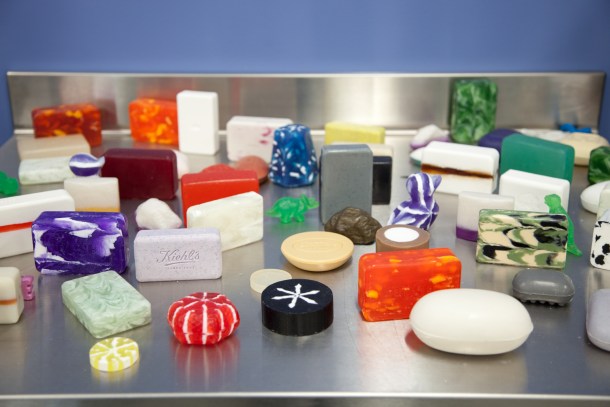
CBD’s just one of many ingredient trends followed by Twincraft, a company that blends old-fashioned machine manufacturing with the ever-changing demands of the soap and skincare industry. Although some ingredients, like coconut, lemon and lavender, are constant, others – like charcoal, which was big five years ago – come and go quickly. As a specialty skincare manufacturer that produces millions of bars of soap per year, Twincraft has a creative team dedicated to coming up with new shapes, sizes, colors and formulations for its products.
The company needs to be nimble to keep up with the requirements of its many custom orders. That means it can’t mechanize as much as some other soap manufacturers, and has to use a lot of staff on assembly lines. But it also means that when the 2018 Farm Bill passed late last year, apparently clearing the way for legal CBD sales, Twincraft was able to swing into action immediately to take advantage of the compound’s popularity.
Keller said she expects Twincraft to come up with a CBD product — probably a lotion — that’s ready to show customers in the next few months. The company would like to use Vermont-made CBD.
“It’s a good fit for us,” she said.
The Winooski-based Twincraft was started by identical twin brothers in Montreal who moved their company to Vermont in the 1970s. Now owned by the two men’s sons, Peter and Richard Asch, Twincraft employs about 200 people in Vermont and produces soap for about 200 wholesale customers in North America.
Michele Asch, Peter Asch’s wife, is Twincraft’s VP of leadership and organizational development. She said it’s more expensive to do business in Vermont, in part because of its out-of-the-way location, than it would be in elsewhere. But, she said, “we have no desire to leave.”
Instead, she said, the families want to pass ownership to the next generation. They have eight children between them, one of whom is working in sales.
Bar soap is still the core work of Twincraft, which also makes lotions, salves and other products at its factory in Essex. The company employs chemists who formulate products at the request of customers or on speculation. It also produces custom store brands for companies like Whole Foods, Estee Lauder, Tom Ford, Aveda, Mary Kay, and Young Life.
Like many Vermont manufacturers, especially in the food and personal care sector, Twincraft focuses on specialty products because the margins are higher and the company can benefit from Vermont’s reputation for quality, said Michele Asch.
The company buys its soap base, mostly palm oil, from Indonesia and Malaysia, and sometimes from England. It stocks it in huge sacks near its soap-making machinery at its Winooski plant. Most of its fragrances, essential oils, and other ingredients come from North America.

The company has a traditional factory floor, with 92,000 square feet of factory space for the bar soap factory in Winooski, 76,000 square feet for the liquids factory in Essex, and a 14,000-square-foot warehouse in Winooski. Dozens of people work with and around the machines. Workers hand-inspect bars of soap for flaws, work in cooperation with the machines to package them in individual boxes, and for some high-end products they package each bar by hand.
“We consider ourselves to be an artisanal manufacturer,” she said. “We’re dynamic, shifting our product lines all the time.”
Outside the factory floor is a quiet, carpeted laboratory space. Twincraft positions itself as an employer of choice with benefits such as a $500 grant that every employee can direct to a favorite nonprofit. It sends its excess soap to a nonprofit called Clean the World that turns it into bar soap for developing countries, Michele Asch said.
Apart from CBD, the biggest trend shaping Twincraft’s work is the natural products movement, said Keller. Customers are looking for sustainable packaging, such as reused plastic or plastic made from plant-based sources she said.
“It’s not just traditional natural brands or the people at Whole Foods,” Keller said. “Whether it’s a very prestigious brand like Chanel, or Whole Foods, everyone is trying to feed on the natural trend. People are looking for not just a minimal carbon footprint but a net zero one.”


