

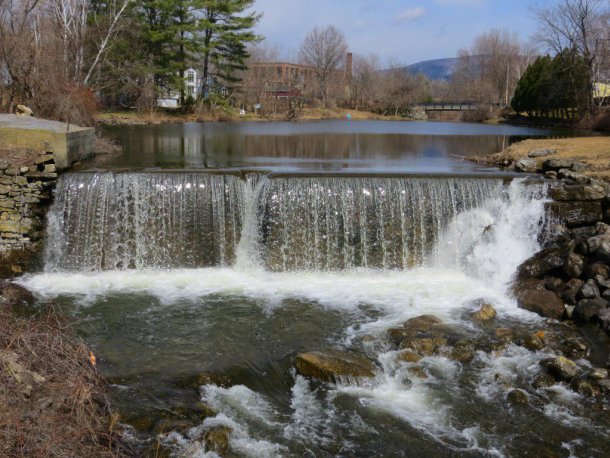
[N]ORTH BENNINGTON — Hydropower developer Bill Scully has halted preliminary work on a proposed 58-kilowatt generating facility planned for the Lake Paran Dam but will continue planning a smaller facility just downstream from the lake.
At Scully’s request, the North Bennington Village Board recently contacted the Federal Energy Regulatory Commission to request that a preliminary permit granted in 2017 to explore the Lake Paran project’s feasibility be discontinued.
The idea for the village hydro projects grew from a Bennington College course taught in 2016 by Susan Sgorbati, director of the Center for the Advancement of Public Action at the college, and Scully. The course was inspired in part by the discovery of PFOA (perfluorooctanoic acid) contamination in wells surrounding the former ChemFab Corp. factory in North Bennington.
Scully said this week that the failure to secure a letter of support from the Vermont Agency of Transportation was a factor in the decision to discontinue the Lake Paran permit. If circumstances change, he said, another preliminary permit could be sought from the federal agency to continue the planning process.
The lake is a village recreation area owned by the Lake Paran Association, but the state owns a railroad right-of-way across the front of the dam, hence the request to VTran’s Bureau of Rail and Aviation.
Scully said he was told that the agency determined the project could not be supported in part because it was “not in line with the mission” of VTrans.
In an December email to Scully, a VTrans official also said that no commitment to an agreement could be made without specific engineering plans in place for the hydro development, but that the agency would be open to future licensing discussions discussions involving the rail right-of-way.
The hydro proposals were both in the early stages of the lengthy Federal Energy Regulatory Commission licensing process — essentially having received permission to fully develop a project proposal before submitting a license application.
College course
The 2016 Bennington College course grew into the Paran Creek Watershed Project, developed by Sgorbati and Scully, in which several student task forces explored in an educational setting development of a feasibility study for village hydroelectric facilities at the two sites.
Each small project proposed construction of a powerhouse building for the turbine-generator unit, new structures at or near the dams to facilitate the waterpower process, and transmission lines to connect to the electricity grid.
Scully said the intention was to apply for group net-metering licenses for the facilities, which would supply power to the grid and produce income for the village. Beyond that, he said, the overall goal was to focus on the entire lake watershed area and on local environmental issues.
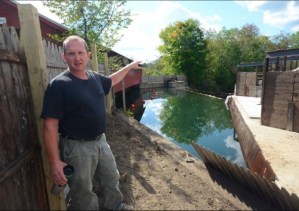
Plans still are underway for a 38-kilowatt hydropower facility at the village-owned Firehouse Dam near the firehouse on Paran Creek, located roughly 1,500 feet downstream from the southern edge of Lake Paran. Water flows out of the lake and past the Firehouse Dam toward the Walloomsac River.
Scully, a resident of the village, has major hydro credits in the Bennington area. He activated a restored 360-kilowatt power facility at the Vermont Tissue Mill dam on the Walloomsac River in North Bennington in 2015 and restored the former mill dam hydro facility on the Hoosic River in North Pownal, which went online in November 2017 with a generating capacity of 500 kilowatts.
That facility, which was restored with new and updated equipment, replaces a dilapidated facility that once generated power for the former Pownal Tanning Co. mill at North Pownal Village.
Historic mill area
A 38-kilowatt facility still is planned in North Bennington at the 40-foot long, 10-foot high concrete Firehouse Dam, which has an existing 1.27-acre water impoundment area behind the structure.
A 58-kilowatt hydro facility was proposed at the 120-foot wide, U-shaped Lake Paran Dam.
According to the student watershed project report, the Lake Paran Dam was built in 1840 by the local railroad company. The first dam burst on Feb. 11, 1852, according to the student report, and floodwaters destroyed all the existing factories and several residences along the creek.
Afterward, the dam was rebuilt.
Around 1960, Lake Paran was developed as a recreation area.
The smaller Firehouse Dam is estimated to have been built during the 1700s when the first mills were constructed along Paran Creek, the researchers found. In 1960, the brick firehouse was built nearby.

