


Editor’s note: Mark Bushnell is a Vermont journalist and historian. He is the author of “Hidden History of Vermont” and “It Happened in Vermont.”
[T]he devastation wrought by the Spanish Influenza is hard to imagine. It is just as hard to quantify. Estimates of those killed by the 1918-19 epidemic range anywhere from 20 million to 130 million.
The tragedy can perhaps best be understood by looking at individual lives cut short by this modern plague. One of those lives belonged to Rachael Robinson. You’ve probably never heard of her. If given more time, however, perhaps she might have gained fame. Even if she never became famous, her life is worth remembering.
To understand Rachael, you have to understand the context in which she grew up. Her family was well known back in the day. Robinsons had been in Vermont for as long as it had been a state. Rachael’s great-grandparents, Thomas and Jemima Robinson, grew up in affluent Quaker families in Rhode Island, but left when that state’s economy slumped. They move to Vermont in 1791 because of the greater opportunities the new state offered.
The Robinsons purchased land in Ferrisburgh and started farming. Unwittingly, they were also starting one of the more interesting families to call Vermont home. Through the generations, the Robinsons would include innovating farmers, ardent abolitionists, participants in the Underground Railroad, successful artists and writers.
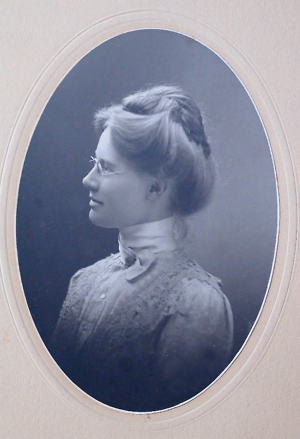
During the 1830s and ’40s, Rachael’s grandparents, Rowland and Rachel, spoke out against slavery and, as radical abolitionists, opened their farm to African-Americans fleeing slavery. The Robinsons didn’t have to hide these former slaves. Slave hunters were a rare sight in Vermont. At the farm, the Robinsons offered African-Americans food, shelter, paying jobs, and help finding a safe place to settle either somewhere in the North or in Canada.
Rachael’s parents were of an artistic bent. Her father, Rowland Evans Robinson, was the most famous member of the family. He left the farm as a young man and lived in New York City, where he worked as an illustrator and engraver. Returning to the farm, he turned to writing when his eyesight failed. Rowland wrote folksy tales of outdoor and small-town life, which drew a wide audience and made him the most popular Vermont writer of his generation, sort of the state’s answer to Mark Twain. Rowland would dictate the stories to his wife, Rachael’s mother, Ann, who was an artist as well, a portrait painter.
Rowland and Ann became parents relatively late in life. When Rachael arrived in 1878, Ann was 37 and Rowland 45. Still, two more children were to follow, a son, Rowland Thomas, and a daughter, Mary. Rachael was originally named Rachel, after both of her grandmothers, but changed the spelling as an adult.
Rachael’s parents doted on her. Rowland made handmade books for his young daughter and she reciprocated by hand making books for her father. The books are still at the old farmhouse, which is now the Rokeby Museum. The museum is something of a time capsule. The parlor and the upstairs bedrooms are laid out as if the family has just left the room and will be back momentarily. Rowland’s books are stored in his bedroom; his pipes hang at the ready on a decorative wall rack in another room.
One of Rachael’s delicate little books is stored in an archival box. Rachael made the book when she was only perhaps 6 or 8 years old, and you can see where someone carefully stitched it together. In it are Rachael’s skillfully rendered drawings of sheep, horses and cows, the animals she saw daily on the farm.
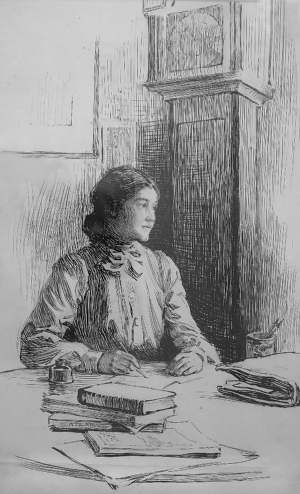
Deeper in the box are works from other periods of her life, from when art was her passion and later when it also became her profession — a pastel of her sister, Mary, wrapped in a blanket, another of her father, drawn in three-quarters profile with his imposing, long white beard, an etching of Lewis Creek for one of Rowland’s books, an impressionistic view of Central Park.
“She just has more raw talent than either of her parents,” says Jane Williamson, Rokeby’s director emerita.
Her family members seem to have recognized Rachael’s gifts. And they were certainly tolerant of her need for live subjects to draw. In one room in the house, a portrait of Mary hangs on the wall. In it, Mary sits in front of the same grandfather clock that still stands in the corner. On another wall in the room hangs Rachael’s drawing of Rowland playing his horn.
Ann was Rachael’s first teacher. When she ran out of things to teach her daughter, Ann took her to Burlington for weekly art lessons. Then, when Rachael was 12, she enrolled in a correspondence course with the Chautauqua Society of Fine Art. The program’s director was impressed with Rachael’s talent, saying she was one of the finest artists among the thousands who took the correspondence courses. He invited her to study with him and other established artists in New York the next summer.
“From that summer, her destiny was to go back to New York,” Williamson says.
At the age of 16, Rachael went to boarding school at the Goddard Seminary in Barre. Her absence hit Ann and Rowland hard, but they lessened the separation by corresponding with their daughter almost daily. Rowland reminded his daughter to keep at her artwork: “I do hope thee will not neglect thy drawing,” he wrote using traditional Quaker diction.

After graduating, Rachael taught art classes at the school, at home and in Burlington. She also continued her own art studies, traveling to New York for three winters to take classes at the Art Students League. There she studied under artists who would become known as leading American Impressionists, Childe Hassam and John Thwachtman, and famed illustrator Howard Pyle.
Women artists were still rare creatures in America. Most American women who aspired to be artists studied in Europe, particularly in Paris. Rachael had the misfortune of being born half a generation too early. Trailblazing artist Georgia O’Keefe was born nine years after Rachael and managed to gain acceptance in the art world at a time when women still couldn’t attend most of the nation’s leading colleges and universities. So Rachael’s professional work remained strictly commercial. Her ventures into fine art were mainly painting portraits of family members and friends.
Rachael finally left home for good at the age of 28 and moved to New York. There she found work at Decorative Designers, where she created book illustrations and covers. She also landed jobs illustrating magazines.
Five years later, Rachael found a husband who was ahead of his time. Robert Elmer, a successful businessman, encouraged his wife’s artistic career and took on household chores to allow her time to work.
“Today Rob got our dinner quite by himself—hamburg steak, sweet potatoes, tea, peaches and bread and butter,” Rachael confided once. “It was delicious and we had lots of fun eating it by our front window. Then Rob washed the dishes and after that hung some pictures.”
Rachael found new artistic outlets. She joined the Pen and Brush Club of New York in 1913 and won praise for paintings of Lake Champlain that hung at a club show.
She was also working on another project during this period. A friend who was visiting London sent her a providential postcard that showed the Thames River at twilight. The friend wrote that the card’s creator had captured the scene brilliantly and that someone ought to make similar postcards of New York.
“Our city is surely as lovely,” the friend wrote, “and thee could serve her well!”
Rachael took the hint and created a series of views of New York, including the Statue of Liberty, the Brooklyn Bridge and Grant’s Tomb. Then, she said, she “wore out three pairs of shoes” walking all over the city to find a publisher to print them.

The cards are luminous depictions of the city. They make New York look brighter and crisper than it probably has ever looked. Rokeby has at least one of the studies she created in preparation for the finished cards. It’s a fine impressionistic view of a pond in Central Park with the Plaza Hotel in the background. After the cards were published, a New York gallery exhibited her postcards, or perhaps the studies, recognizing them for the little gems they are.
Soon after the cards were published, the United States entered World War I and Rachael did what she could for the war effort. She sold paintings and donated the proceeds to help reforest the devastated woodlands of France. She also painted murals to decorate canteens on U.S. military bases. Rachael and Rob even invited sick and injured servicemen to visit them at their home on the Hudson River.
It was perhaps from one of those soldiers that Rachael contracted influenza — the U.S. military was particularly hard hit by the illness. She died soon afterwards at the age of 40. Like the millions of others killed by the pandemic, her truncated life leaves us to wonder what might have been.
(This season, Rokeby Museum will be open daily, 10 a.m. to 5 p.m., from May 20 through Oct. 28. The house is only open for guided tours, which are offered at 11 a.m. and 2 p.m., Friday through Monday, or by special request. Examples of Rachael’s artwork can be seen on the tour, including family portraits, pencil drawings and watercolors. The museum sells reproductions of her New York City postcards. For more information, check rokeby.org)

