

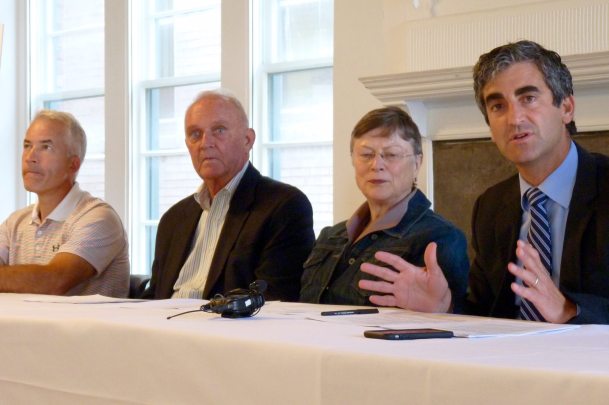
[B]URLINGTON — Reforms in the city employee retirement system over the last three years have saved taxpayers an estimated $2.2 million and are projected to save a total of $8 million by 2020, according to the city.
The savings stem from increased contributions from city employees, a new investment strategy and improved administration of the Burlington Employees Retirement System, city officials said at a Wednesday news conference.
Burlington’s payments into its employee pension fund rose from $1 million in fiscal year 2003 to nearly $9 million in fiscal 2015. During roughly the same period, however, the funding ratio — a measure of how much cash is available to address the future needs of the system — dropped from more than 100 percent to less than 70 percent.
That drop coincided with similar downturns for virtually every public pension system in the country, driven largely by the 2008 stock market crash and subsequent recession. But the drop in Burlington’s funding ratio was greater than the national average, increasing the urgency for reforms, said Mayor Miro Weinberger.
Some of the savings Weinberger reported Wednesday resulted from the Burlington Employee Retirement System choosing to withdraw its $155 million in assets from the management of the Vermont Pension Investment Committee, a state-run board, in favor of a private fund manager with lower fees.
“We’re one of a number of cities and states around the country that has sort of gotten out of the game of trying to beat the market,” Weinberger said. “We won’t beat the market, but we also won’t be well below the market as we had been for a number of years up until this change.”
Weinberger convened a city retirement committee in November 2013, which he said crafted reforms that held annual payments into the fund essentially flat from 2014 to 2016. The savings touted Wednesday are based on what the city says costs would have been without the reforms.
The stabilizing of payments has allowed modest reductions to municipal property tax rates in the last two years, Weinberger said. He thanked members of the committee, which include city councilors, unionized employees and members of the Burlington Employees Retirement System board.
“This has been accomplished without the kind of really sharp labor conflicts we’ve seen elsewhere in the country,” Weinberger said.
Jim Strouse, chair of the retirement system board, praised the mayor for “fostering a culture of trust” among the four city employee unions and other stakeholders that allowed the reforms to happen.
Burlington and the union representing city police reached a contract agreement Monday, making it the final bargaining unit to accept changes in employee contributions to the pension fund. That contract is retroactive to July 1, 2014. All four union contracts cover the same four-year period ending June 30, 2018.
In each of the four contracts, union members agreed to pay a greater percentage of their earnings into the retirement fund. In addition, if the city’s required payment into the fund exceeds $9 million during the four years covered by the contracts, employees have agreed to pay a portion of that excess.
That second provision, referred to by the city as risk sharing, is an innovative tool that will help avoid contentious negotiations in the future, officials said.
Previously, when annual payments into the fund exceeded projections, the difference would accumulate until the end of a labor contract, becoming a bone of contention as the city tried to avoid passing the overruns on to taxpayers.
Now, the risk sharing provision triggers increased contributions from city employees when payments exceed projections, instead of waiting for the next round of negotiations.
Employees who retire after the latest contracts were implemented may also receive lower cost of living adjustments, which were previously as high as 6 percent but are now capped at 2.75 percent, according to the city.
Jeffrey Wimette, a Burlington Electric Department employee and representative for the International Brotherhood of Electrical Workers Local 300, said he felt the union was fairly compensated for the concessions. He too praised the Weinberger administration for how it handled the contract negotiations.
“I give kudos to Mayor Weinberger for instituting this. It had to be done,” Wimette said.
Speaking after the news conference, Wimette said his union secured a wage increase and other smaller items that were nonetheless hugely important to front-line workers, such as a $200 boot allowance.
“That’s not in my paycheck, but it’s $200 I don’t have to spend,” he said.
Previous attempts at pension reform in the late 2000s led to concessions from city employees valued in the millions of dollars, officials said, but they weren’t showing up in the funding ratio calculations — leading to frustration.
“There was an unanswered question that hung over the retirement committee, which is, everyone was aware that in 2006 and 2009 the public employee unions had made substantial concessions valued in the multimillions of dollars,” Weinberger said.
Still, after those collective bargaining rounds, all the important trend lines continued to get worse, the mayor said. Taxpayer contributions went up, and the funding ratio went down.
The retirement committee eventually discovered one reason, he said: The retirement funds actuaries weren’t reflecting the concessions made by the union until an employee actually retired.
“So that was, in a kind of structural chronic way, undervaluing the impact of those prior reform efforts,” Weinberger said. Now the models estimating funding ratios reflect those concessions more accurately, he said. He attributed some of the savings announced Wednesday to that change.
Much work still needs to be done to make the pension system truly sustainable, the mayor said. Currently the funding ratio is 74 percent, still well below the widely recommended 80 percent, he said.
One area that may still need further adjustment is the lifespan estimates for people covered by the retirement fund. As people live longer, the pension will be underfunded if those estimates aren’t updated, Weinberger said.

