

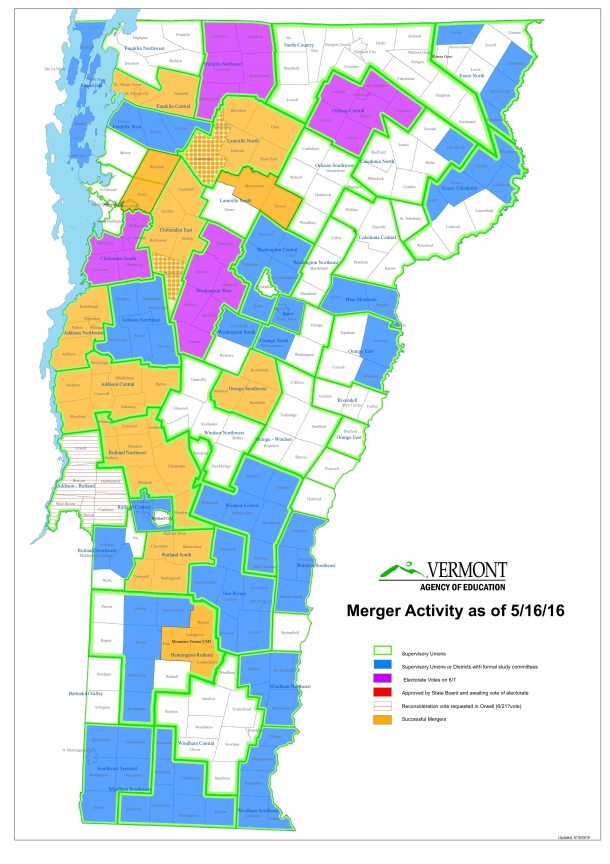
[O]n June 7, voters will say yea or nay to Act 46 mergers in four parts of Vermont. These are the last of 14 unification votes for parts of the state hoping to get in on the first phase — accelerated mergers — of the school district consolidation law and in so doing garner the largest tax breaks.
Washington West, Chittenden South, Orleans Central and Franklin Northeast supervisory unions are taking their individual cases to local voters on the first Tuesday in June. Also, a revote later that month in Orwell will ask residents whether they want to join the proposed Slate Valley Unified Union School District.
Since last fall when the first ballot was cast in favor of merging in Essex-Westford, voters in 39 towns, representing 45 school districts, have decided to streamline into 10 unified school districts, according to the Agency of Education.
Two merger proposals failed in the first round of voting. Elmore approved its merger with Morristown in a revote; Orwell will similarly reconsider its proposed merger in June.
“We were surprised by the number of districts that moved quickly to take advantage of opportunities available in Act 46,” said Education Secretary Rebecca Holcombe. “This is a remarkable and encouraging feat that proves that Vermonters are not afraid to roll up their sleeves and work together.”

Act 46 is a landmark school governance law that encourages Vermont’s 270-plus school districts to merge into larger units in response to a decline in the number of students attending Vermont’s schools. The law was passed at the end of the 2015 legislative session.
Nicole Mace, executive director of the Vermont School Boards Association, has said in the past that policymakers expected just a few mergers to go through in the first year. No one expected more than half a dozen merger proposals to be approved by the State Board of Education and voted on locally by this summer.
Some have said the communities that endorsed merger plans are those that had already been considering merging for some time and were “the easy ones” or the “low-hanging fruit.” Mace takes exception to that.
“These unification efforts were not easy,” she said. “These mergers are the product of school board leaders and administrators taking the time to understand the law, analyze the options for their communities, get questions answered, seek common understanding and common ground, work across communities to draft articles that reflect shared values, attended multiple public forums and have countless one-on-one conversations with friends and neighbors.”
Town Meeting Day 2016 has become seen as an endorsement of sorts by advocates for Act 46. On that day, five unification votes were held and saw sweeping majorities in favor of merger. Nearly 85 percent of voters supported the proposed mergers in Rutland South and Addison Central supervisory unions; nearly 80 percent said yes in Orange Southwest and Addison Northwest. The other vote was in Franklin Central, where unification garnered support from 70 percent of voters.
“The results are a reflection of the hard work of school boards and the trust that Vermonters place in their elected officials to develop a plan that preserves what matters most to their communities — not just for the next three years, but for the next generation,” Mace said.
Another element of the strong showing could be the fact that the vote was held on a day when many Vermonters planned to go to the polls, according to Jeff Francis, executive director of the Vermont Superintendents Association. Votes held on more random dates inspire voters that are closely following a given topic, he said, adding, “The March vote seems to support the idea that in general Vermonters agree with the concept of merging given the challenges facing schools and communities.”

But the road appeared rocky at the start on Nov. 3, when voters approved the first Act 46 merger of Essex Town, Essex Junction and Westford but residents in Elmore rejected 197 to 164 the notion of uniting with Morristown.
Although Elmore-Morristown was not actually an Act 46 merger initiative, Lamoille South Supervisory Union Superintendent Tracy Wrend told lawmakers on the House Education Committee that they should draw lessons from the result. She blamed “fear-based misinformation” for its rejection. Fliers circulated in the community said a yes vote would close the beloved one-room schoolhouse within four years.
After more public meetings to answer community concerns, a December revote delivered Elmore’s support, 251 to 180. In January, Morristown held another vote and garnered much more support and a clear mandate to move ahead.
On April 12, Orwell, one of the six towns — which collectively have eight school boards — in the proposed Slate Valley Unified District rejected unification in a vote of 211 to 121. Residents who opposed consolidating have said they fear Orwell Village School would close.
At the same time, choosing to go it alone would mean the town would lose $100,000 a year from the small schools grant, which phases out for towns that don’t merge. The tax consequences could be dire. Such a large loss to the budget would add about 5 cents to the property tax rate, according to Laura Jakubowski, finance director for Addison-Rutland.
Orwell plans to vote again June 21, but it won’t be a simple majority in favor that will be needed for a merger to happen. Instead, the yes votes will have to exceed two-thirds of those cast against the proposal in April.
Looking ahead, Holcombe expects more votes.
“Other communities will take longer, but many are doing their due diligence and considering options. We are hopeful that more communities will find ways to secure excellent education into the future, even in areas with declining enrollments,” she said.

