

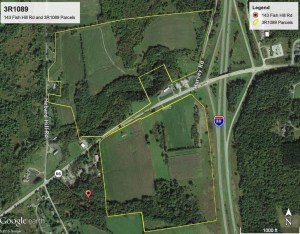
The partial Act 250 review for Jesse Sammis’ plan for a mixed-used development on 172 acres at Exit 4 has been on pause — publicly at least — since November. It seems likely, however, that high-powered talks are going on behind closed doors.
What the outcome of those talks might be and how they could affect the Act 250 review underway remain unknowns — and a matter of some frustration to those watching the process.
“This is supposed to be an open process,” commented Randolph attorney Brooke Dingledine this week.
Dingledine is advising Exit 4 Open Space (E4OS), a local group opposing the project. E4OS, which does not have party status in the Act 250 proceeding, was not invited to the ongoing talks.
Parties participating in the closed-door discussions are Sammis and two nonprofit opponents of the project — the Conservation Law Foundation (CLF) and the Vermont Natural Resources Council (VNRC). A recent filing by CLF Attorney Sandra Levine suggests that another nonprofit — the Vermont Preservation Trust — may be joining the talks.
Public Hearings
First, the background: Five months of Act 250 hearings on the Sammis plan — limited at this time to a “partial review” of two components of the broad land-use law — formally closed in October. At that time, the chair of the District 3 Environmental Commission reviewing the application pledged a decision before the year was out.
A few weeks later, however, commissioners granted a request, filed by Sammis, CLF, and VNRC, to put the Act 250 process on hold for three months, until February 18. The three parties said they wanted the time to attempt to resolve their differences.
In the “partial Act 250 review” underway, Sammis’ project is being evaluated for its impact on primary agricultural soils and for conformance with regional and
local plans. Before anything could be built, the project would still need to obtain approval under all of the law’s many criteria.
Sammis has proposed developing portions of the two parcels he owns on either side of Route 66. Project components include a rest-stop, visitor’s center, office buildings, a hotel, light industrial facilities, and residential housing. The current plan calls for development of 47 acres of prime farmland on the 172 acres he owns, compared to 70 acres in his initial proposal.
In this application, Sammis is seeking permission to do both on-site and off-site mitigation of prime ag soils. On-site mitigation generally involves clustering and
other “innovative” design techniques to minimize development of ag soils on the
applicant’s parcel.
Off-site mitigation, granted when only certain criteria are met, allows the developer to build on some of the ag acreage, in exchange for paying for the preservation of roughly twice as many acres of agricultural land elsewhere.
Given the emphasis on the soils issue at last year’s hearings and the kinds of evidence submitted by project opponents, it seems likely that the preservation of agricultural land is also the essential topic on the table in the private talks underway.
New Request
Last Tuesday, CLF Attorney Sandra Levine submitted new paperwork seeking the Act 250 commissioners’ approval of a “memorandum of understanding” (MOU) that had
already been signed by four people — Levine, Sammis, the executive director of the VNRC, Brian Shupe, and Paul Bruhn.
Bruhn is the executive director of the Preservation Trust of Vermont, though he was not identified as such on the MOU. The non-profit is engaged in a variety of preservation projects, including land conservation.
Levine told The Herald that Bruhn is “helping us out,” and clarified that the “us” included “the applicant,” Sammis.
The MOU submitted by Levine attempted to set up a situation in which certain parties — Sammis, CLF, VNRC, and up to three members of E4OS — could hold negotiations with a mediator, with all parties to be bound to an agreement not to disclose “what is said in mediation.”
The MOU went on to suggest that the Act 250 commission should “consider whether to enter sanctions” against any party who might violate the confidentiality vow.
This week, the commission flatly denied the parties’ request that commissioners formally “adopt the MOU.”
The response, signed by commission Chair Tim Taylor, suggested that the parties were asking the commission to do things “beyond the scope of the powers delegated to the Commission.”
Taylor’s response goes on to encourage the parties to continue to work to find “common ground with respect to the disputed issues,” and to file for an extension
in a timely manner, if they find that more time is needed. Taylor also noted that, whatever the outcome of the talks, the commission remains responsible to weigh the evidence presented during the hearings and to decide whether the project meets the Act 250 standards under review.
This week, Attorney Dingledine said that E4OS rejected the invitation to join the talks under the conditions stated in the MOU. She noted that the group operates by consensus, making it inappropriate to empower just three designees to agree to terms of a mediated negotiation.
Levine said those involved in the talks have not yet decided whether to seek another time extension.
