

[O]pponents of Vermont Gas Systems natural gas pipeline said Tuesday that the expensive project is no longer necessary because technological advances have obviated the need for the product.
Witnesses who testified against Vermont Gas said cold climate heat pumps are an efficient alternative heating source, home heating oil prices are low, and NG Advantage can send natural gas on tractor-trailer trucks to industrial customers who still want the gas.
Vermont Gas put its top executives on the witness stand during the first day of hearings. On Tuesday public advocates brought in witnesses who criticized both the pipeline extension project and the calculations that the company has used to justify the efficacy of the pipeline.
The price when the Public Service Board approved the project on Dec. 23, 2013, was $86.6 million. The new cost estimate stands at $153.6 million to build the transmission pipeline — not including distribution costs that the company said Monday would be $5.8 million plus $1,600 per new customer.
Vermont Gas started construction between Colchester and Middlebury last summer, just months before the first price increase was announced. About six miles have been completed in Chittenden County, according to the company’s April cost update report, and $61.5 million of the budget has been spent.
From here, the quasi-judicial Public Service Board can issue an order to keep the project going, or make the company re-argue for its state permit, called a certificate of public good. In October, the board went through an identical series of hearings but ultimately decided the project was still a benefit to the public. This week, they appeared to be more skeptical.
“I’m pleased that we had the chance to present our case,” said Don Rendall, the president and chief executive officer of Vermont Gas. “We’ll proceed in accordance with the board’s order when the order comes out. We’re presenting the facts as they are and doing it in as open, direct, and transparent way as we can.
“I’m confident that our estimate is reliable,” Rendall said. “I’m confident that it was estimated as effectively as it could be.”
Jim Dumont, who represents AARP and Kristin Lyons, pressed the Public Service Department on several points. The department’s job is to represent the public interest in utility cases, and the department disagreed with Dumont’s arguments that alternative energy sources are more cost-effective than natural gas service.
Natural gas distribution, Dumont argued, has only about a 25 percent cost advantage over a cold-climate heat pump.“>only has about a 25 percent cost advantage over home heating oil. Dumont argued that cold-climate heat pumps are cost-effective for homeowners as compared to natural gas. Further, he said that industrial customers don’t need natural gas through a pipe because they can trucked in by NG Advantage. “>have it trucked in by NG Advantage.
James Volz, chair of the Public Service Board, also focused on compressed natural gas — the type of gas service that is being trucked to a so-called gas island in Middlebury for customers including Cabot AgriMark.
Volz said the board should consider the gas island and natural gas infrastructure as a “sunk cost” that companies won’t get their money back from whether the pipeline is built or not.
Asa Hopkins, the director of energy and policy planning for the Public Service Department, said the efficiency of cold-climate heat pumps depends a lot on how people use them and various weather conditions, among other things.
Hopkins said he did not change his methods to account for compressed natural gas because it was an unjustified, much more sweeping change to the economic modeling than changing fuel prices or costs.
Hopkins was the sole witness representing the Public Service Department, and he reiterated the department’s position that the project is still in the public good. “There is no call for a re-opened proceeding,” he said.
Reached by phone, Chris Recchia, commissioner of the Public Service Department, said that the department used numbers from the U.S. Energy Information Administration that are “the most credible numbers allowable.”
“All modeling is a matter of what assumptions you use, and we think we’ve used some very credible assumptions,” Recchia said. “[Hopkins] didn’t have a particular objective to come to a particular conclusion.”
AARP brings in heavy-hitting economist
David Dismukes, an economist from Louisiana State University, was Tuesday’s major witness. AARP flew him to Vermont to defended his economic modeling, which projects up to $200 million in lost economic activity and 3,650 lost jobs across Vermont over a 70-year period.
Dismukes’ low-ball numbers were about $100 million in lost economic activity and 1,500 lost jobs across Vermont in a 20-year period. He also told the board during his testimony that regulators need to address risk that utility companies put on ratepayers during capital projects like pipelines.
“Their shareholders are going to be the ones who make that money,” Dismukes said of Vermont Gas’ profits. “The ratepayers are going to be the ones who pay for it. … The key to this is who bears the risk in all this.”
Hopkins, a physicist who serves as an energy planner for the Public Service Department, analyzed parts of Dismukes’ analysis during his own testimony. Hopkins said Dismukes had valuable insight but overestimated employment losses.
“His analysis assumes some continuing job loss through time, as does ours, and I think it is actually appropriate to recognize that ongoing effect,” Hopkins said. “The main difference as I see it … is in the question of the overall scale and whether the results meet with a common-sense test in terms of the size of the impact.”
Dismukes said the economy would lose job opportunities to a pipeline that delivers fuel instead of delivery truck drivers.
“I like to characterize them more as ‘employment opportunities’ as opposed to ‘jobs,’” Dismukes said. “If my business goes down for five years, there are fewer employment opportunities for five years.”
Lawyers for Vermont Gas, whose experts used different modeling that projects a net benefit from the $153.6 million project, also questioned Dismukes. They said Dismukes didn’t account for delivery drivers finding new jobs.
Palmers bring in neighbors as witnesses
A couple that owns an organic farm in Monkton analyzed the cost increases and the environmental impacts of the project.
Jane and Nathan Palmer brought in local experts to testify. Barbara Wilson, a former math major, analyzed how the pipeline could affect rates; George Gross explained how methane emissions impact the environment; and Melanie Peyser, a legal specialist who volunteers with the organizing group Just Power, also spoke.
The board pressed Wilson on whether she understood the complicated process that regulators use to set prices. Gross told the Public Service Board to adopt what he considers an improved scientific method to measure the climate warming impacts of methane leakage from
the natural gas extraction process
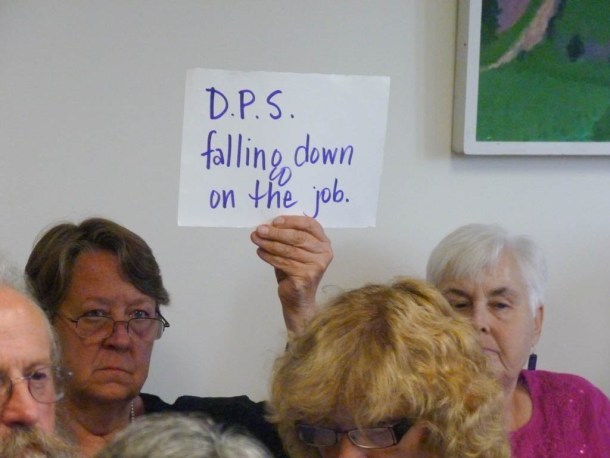
Beth Thompson, a protester from Danby, attended both days of hearings and Monday’s rally. She held up a sign that said the Public Service Department “fell down on the job” and another during Dismukes’ testimony that simply said “truth.”
“Our private citizens, for no pay, did the kind of deep thinking, deep analysis, and vetting that should’ve been done in the first place,” Thompson said in an interview. “And it didn’t hurt that AARP’s expert took us all to school this afternoon.”
CORRECTIONS: The details of George Gross’ and Jim Dumont’s arguments were corrected on June 25. Gross argued that methane has greater global warming effects than carbon dioxide, not that the gas stays in the atmosphere longer. The original article attributed inaccurate information about cold-climate heat pumps to Dumont.

