


[W]itnesses for Vermont Gas Systems faced detailed questions on Monday from a state board that will determine whether the company’s permit for a 41-mile pipeline project should be reopened.
It was the first day in a two-day process that is scheduled to end Tuesday afternoon. The Public Service Board, which regulates utilities, is re-evaluating a December 2013 decision to grant Vermont Gas a permit for Phase 1 of the Addison Rutland Natural Gas Project, which would run from Colchester to Middlebury and serve about 3,000 customers.
The board has the power to halt the pipeline construction. At issue is the escalating cost of the pipeline, which has increased from $86.6 million to $153.6 million.
That increase prompted the Public Service Board to take another look at the company’s certificate of public good. The Public Service Department, which represents ratepayers in utility matters, reiterated Monday that it would pull Vermont Gas through a rate case if the company completes the project and tries to recover any of the price increases from ratepayers.
“The fact that the price of the project has gone up does not automatically mean that rates will go up,” said Chris Recchia, commissioner of the Public Service Department. Witnesses from the department are scheduled to testify Tuesday.
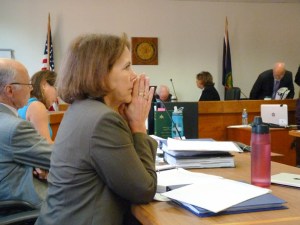
On Monday, lawyers for private nonprofit organizations and individual landowners led a tense grilling of representatives of the natural gas company during an eight-hour process, pecking away at the company’s arguments that building the pipeline would improve Vermont’s economy.
The daylong debate, marked by intense questions from AARP’s attorney Jim Dumont, touched on the oil market, methane emissions, mathematical processes for construction planning and the company’s credibility after announcing two price increases in six months.
Eileen Simollardes, a vice president for Vermont Gas, testified that distribution to customers in Middlebury and Vergennes is assumed to be a flat $5.8 million plus $1,600 per customer hookup. But as the activist group Just Power wrote on its Twitter account, based on those estimates, the total cost would be $159.4 million, not including customer connections, or $164.2 million assuming 3,000 of hookups.
Vermont Gas officials objected to that assertion.
“It would be misleading to take from [Dumont’s] comments that the cost has increased again,” said Don Rendall, chief executive officer for Vermont Gas. “The costs we’re talking about here [are the] costs to build the transmission backbone of the pipeline to Middlebury.”
Rendall commended the Public Service Board members for asking hard questions on behalf of the public. Tuesday is scheduled to be Vermont Gas’ opportunity to examine witnesses brought by the Public Service Department, the Conservation Law Foundation, the AARP and others.
The economic arguments
The company announced its $153.6 million estimate in a December news conference, after Rendall and other new leadership took over and vowed greater transparency. But the company faces accusations that it uses economic models that paint too rosy of a picture for the company.
Dumont is the lawyer who appealed the original certificate of public good to the Vermont Supreme Court on behalf of landowner Kristin Lyons. He said economic benefit is not the right reason to approve a natural gas pipeline, but he looked into the numbers from Vermont Gas and the Public Service Department — and said he disagrees that there would be an economic benefit.
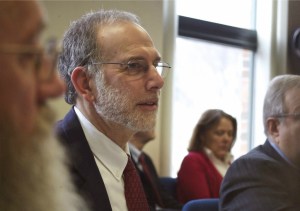
“The [Public Service Department] has justified this project on the basis that it creates a net economic benefit to the state,” Dumont said. “That’s not what rates are for. That’s not what the Public Service Board is for.”
Dumont hired outside expert David Dismukes to question Vermont Gas’ economic reasoning on behalf of AARP to attempt to dissolve the company’s arguments.
Dismukes argues in his prefiled testimony that fuel dealers would be put out of business, taking jobs for oil and propane delivery truck drivers with it.
“Assuming you want to use this logic, once you put a pipeline in the ground, you don’t have any more jobs,” Dumont said. “There are construction jobs, and then the jobs go away. All of the fuel dealers and the construction companies, they don’t have jobs anymore.”
Richard Heaps, the economist for Vermont Gas, disagreed. Heaps said Dismukes’ analysis was based on a faulty premise that people will be unemployed for a long period of time.
“There will be some disruption, and people will have to move from the jobs that they had with the fuel dealers to jobs in a new industry,” Heaps said. “The economy’s doing quite well, so people will be able to move and find new jobs.
“We’re growing faster than the rest of the state [in Chittenden County],” Heaps said. “No Chittenden County resident has been harmed by the expansion of the pipeline, by the expansion of these other types of businesses.”
Plummeting oil prices
Dumont presented oil market information from the International Monetary Fund, the World Bank and Goldman Sachs to Heaps, who responded that he doesn’t read that information regularly. Heaps said the price for a barrel of oil was about $60 on Monday, and he expects the price to shoot up in the next three years.
Matt Cota, executive director for the Vermont Fuel Dealers Association, disagreed. He said there is a large supply of oil in the market today, and the conversion cost of moving from oil to natural gas is not worth it based on what he knows about oil futures.
“There is data out there that shows we’re not going to see a rebound in prices; we’re going to see a depression in prices because there’s so much oil on the markets today,” Cota said. “There are many predictions that are on the opposite sides of Mr. Heaps’ prediction that say oil prices are going to go to $30 a barrel or $40 a barrel.”
Rendall said, “We’re not in the business of predicting oil prices, and that’s because the predictions have been so consistently wrong. The important thing here is that we have something that gives customers another choice. The important thing is that we give them a reliable choice for something that has regulated pricing.”
Environmentalists look on
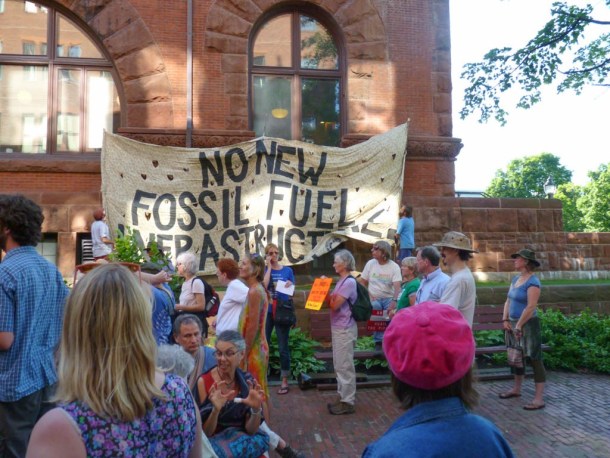
While lawyers engaged highly technical conversations, environmentalists looked on in silence with signs that warned about methane emissions from fracked natural gas and rate impacts on senior citizens.
Just after the official hearings ended, Rising Tide, Just Power and other activist groups were beginning a planned all-night protest outside the Public Service Board’s headquarters at 112 State St.
Starting around 4:30 p.m., about 100 protesters marched around the building. They planned a “truth-in” vigil to start after dark in observance of people around the world who have lost their homes as a result of fracking.
Vermont banned fracking several years ago, but there is no state law that prohibits building infrastructure for natural gas, some of which comes from fracking.
“You can’t unring the bell,” said Mary Martin, a landowner in Cornwall who had opposed Phase II of the Addison Rutland Natural Gas Project. “Once you’re made aware of what’s going on with global climate change, you can’t go back on it.”
Anna Rose, 21, of Burlington, was one of the many organizers of the event. “I’m a Vermont Gas customer, and I’m particularly concerned about the ratepayer impacts. Gas prices are already too high.”
Alex Prolman of Burlington said about three dozen protesters would camp out between 110 and 112 State St. The group did not have a formal permit to be there but did not plan to resist arrest.
“The reason [the Public Service Board is] at this remand process is because of many years of fierce public opposition,” Prolman said. “It makes it much harder for them to grant a certificate of public good when the public is saying very loudly this is not good.”

