

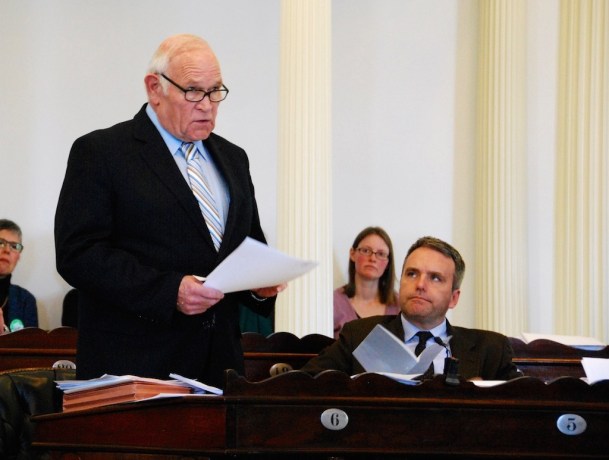
The legislation, S.141, passed 20-8 on second reading. Senators are expected to take a final vote on the legislation this week.
“Quite frankly this is a bill that has to do with who should have a firearm. It’s that simple,” said Sen. Dick Sears, D-Bennington, who as Senate Judiciary chair was one of its primary authors.
The legislation makes it a crime for people with certain violent or drug dealing convictions to possess firearms. It’s already a federal crime for people with a broader range of convictions be in possession of a gun, leading many critics to say the provision is redundant.
However, Vermont is the only state without a law that mirrors, to varying degrees, the federal one, according to Sears. Local police and prosecutors want the ability to go after cases the feds aren’t prosecuting, he said. The penalty under Vermont law would be a misdemeanor, unlike the federal law which carries a felony charge.
S.141 also requires people with mental illness found by a court be a danger to themselves or others be reported to the FBI database of people prohibited from owning guns. The provision includes a legal process for people to have their right to own guns reinstated.
Sen. Joe Benning, R-Caledonia, sought to strike an 18 month waiting period before such a petition can be filed, calling it “arbitrary” but his amendment failed. Sen. Peg Flory, R-Rutland, voiced concerns that people found to be a danger to themselves for reasons of self neglect, such as a person with severe anorexia, could lose their right to have guns were this provision to become law.
Sen. John Rogers, D-Essex/Orleans, one of four Democrats to vote against the measure, sought to have it referred to the Appropriations Committee, citing concerns about what it might cost the court and corrections system. That proposal failed as well.
Rogers said that “where this bill started is an attack on our heritage and traditions” mounted by monied interests from out-of-state. After the vote, Rogers said in an interview he was referring to Everytown for Gun Safety, a gun safety group an organization formed by a merger of Michael Bloomberg’s Mayors Against Illegal Guns and Moms Demand Action for Gun Sense in America.
Rogers said it was possible he could have supported the bill if it hadn’t evolved from an earlier gun proposal that would have required background checks for private gun sales, often referred to as universal background checks.
That bill, introduced by several top Democrats, generated significant backlash from gun rights groups, who turned out in droves for a public hearing in February. Sears, who opposes background checks, chose not to take it up, and instead drafted a committee bill that became S.141.
Ann Braden, with the group Gunsense Vermont, said after the vote that it represents a “meaningful step” toward ensuring public safety.
Keeping guns out of the wrong hands is a “puzzle” she said, and S.141 is a piece of that puzzle. Her group supported the universal background checks, but Braden said they won’t push to resurrect it in the House.
“Universal background checks is something where we’ve always understood that it will take a long time, and we just want to make sure that this bill…gets all the way through the House,” Braden said.
Darin Goens, state liaison for the National Rifle Association, said the legislation has come a long way, but his organization still has concerns about it.
“We started with universal background checks and this is what we’re left with. Is it perfect? No. Does it have problems? Absolutely, but that’s part of the process and we’re only part of the way through it,” he said, adding that “this bill is far from over.”
His primary concern is the restoration process for people with mental illness reported to the FBI database. The NRA wants to make sure it’s “appropriate” and “effective,” which he said remains to be seen.
Goens, who lives in New Jersey, made reference to the bill’s proponents having outside support from Everytown for Gun Safety. Asked if the NRA’s involvement could be viewed the same way, he said he did not.
“I represent members and residents of Vermont who pay dues,” he said, adding, “They don’t represent people. I represent people who vote in this state and pay taxes.”

