

Editor’s note: This article by Greg Guma is derived from material from his book Spirits of Desire, a romantic mystery of the paranormal set in Vermont during the spiritualist craze of the 1870s.
Belief in ghosts and the survival of some immaterial essence beyond the span of human life dates back thousands of years. Ancient Egyptians visited the family plots of departed relations to provide food and clothing for the journey beyond, and Enlightenment-era scientists conducted ghoulish experiments to determine the precise location of the soul.
Most religions tell us that the soul goes somewhere after death — traveling to heaven, hell or a pleasant afterlife resort; reincarnating into a new body; or remaining in the ground until the Second Coming. At the start of the 20th century, Duncan Macdougall, a respected surgeon, thought he had determined the precise weight of the soul by using an ornate Fairbanks scale to track weight loss as people died. People will try anything.
My own quest began in the 1970s, sparked by synchronicity and an unexplainable “journey.” Living in Bennington, I had received as a present a book by Helena Blavatsky, the famous Russian occultist and founder of the theosophical movement. It was published in 1888 — the same year as a “lucky” silver dollar I used to carry in my pocket. That was also the publication date of an unusual antique book that had mysteriously “appeared” in my apartment. As a result of all that I became curious about what it all might mean.
And that led to the discovery of a key turning point: Blavatsky’s first encounter with Henry Olcott, the psychic investigator who would become her life partner, in nearby Chittenden, Vermont.
In October 1874, Blavatsky followed Olcott to that small town near Rutland, to see the “manifestations” of an alleged medium named William Eddy. Their resulting alliance led directly to the founding of Theosophy, an impressive synthesis of Buddhism, occultism, and Western philosophy that became enormously influential in subsequent decades.
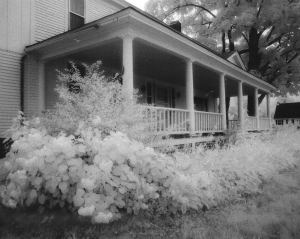
It was a strange time, an explosive era of spiritualism as well as a period of rapid industrialization, economic depression and political corruption. Interest in “spirit” phenomena had been building since 1848, when reports circulated that two teenage sisters in upstate New York could stimulate “spirit rappings.” By the early 1870s, little Chittenden had become a popular pilgrimage site for those interested in contacting deceased relatives and friends in the Eddy family’s “circle room,” a second floor séance hall in their farmhouse.
The local press wasn’t impressed. A June 29, 1874, article in the Rutland Herald pronounced the Eddy manifestations “the vilest deception upon whoever they can get to pay 50 cents for being duped.” But Olcott, a retired colonel who had looked into naval yard corruption during the Civil War, had an open mind, and spent more than two months in Vermont, looking into the case and publishing his findings in New York city newspapers. One of his stories attracted Blavatsky’s attention.
According to his accounts, later published in book form as People from the Other World, the nightly materialization of “spirit forms” included Native Americans, children, and deceased businessmen, along with disembodied hands playing musical instruments, and, once Blavatsky turned up, exotic visitors from the other side of the world.
Although Olcott felt that some of the alleged phenomena might be fake, he couldn’t disprove everything he witnessed. Like Dr. Macdougall, at one point he used a Fairbanks scale in an attempt to weigh a spirit. With special access to the tiny closet in which William Eddy sat during his trances, he concluded that there were no secret compartments; in short, no way to explain how so many “spirits” could appear and disappear.
The notoriety of the Eddy séances also attracted the attention of a celebrity doctor from New York City, George Miller Beard, one of the first to experiment with electricity as a stimulant to deal with nervous disorders. Convinced that spiritualism was hokum and materializations had to be a case of mass delusion, he came to Chittenden to observe, debunk, and apply a strong electric current to one of the “spirits.”
To his own shock, nothing happened. But that didn’t stop Beard from giving a newspaper interview afterward in which he claimed that it was all a hoax, accomplished through disguises and convincing only because the witnesses were “weak-brained.” As he put it in The New York Sun, “In this land of marble and mountains the natives are drunk with excess of beauty and live in a moral state somewhat analogous to chronic alcoholism.”
Even the Rutland Herald, no friend of the Eddy family, was incensed. “We characterize him [Beard] as a humbug and a conceited ignoramus,” the editor wrote on Nov. 18. Olcott took to calling him the “electric eel.”
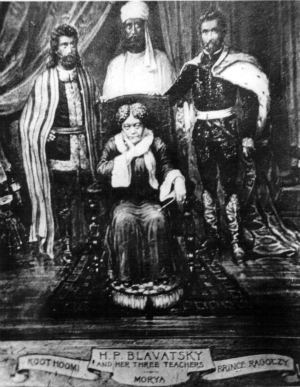
If George Beard was the archetypal rationalist quack, Helena Blavatsky was surely another archetype — the occult pioneer. By her own account, before reaching the US in 1873 she had already delved into various mystical traditions, become a student of Tibetan adepts who sent her telepathic messages, and had a special destiny — to bring what she alternately called a wisdom religion, divine magic, and the “secret doctrine” to a materialistic yet psychically fertile Western world.
Once she started attending séances in Vermont, the cast of materialized spirits expanded dramatically — a Russian boy, a Kurdish warrior who had once been her bodyguard, an old Russian woman, and her dead uncle, among others.
But her explanation was a far cry from Beard’s denunciation and also different from Henry Olcott’s surmise. Although she declined to comment at the time, preferring to defend spiritualism against the attacks of people like Beard, she later argued that spirits of the dead rarely return, and that materializations are “usually the astral body or double of the medium or someone present.” The medium is often a passive participant, whose mind is attracted by the “astral light” while the physical body is in a trance, she offered.
She also issued a warning. Attempting to contact the dead “only opens the door to a swarm of ‘spooks,’ good, bad, and indifferent, to which the medium becomes a slave for life.” In The Key to Theosophy, a kind of “occultism for dummies” primer written shortly before her death in 1891, Blavatsky added that while some so-called spirits are just “poll-parrots” that repeat whatever they find in the medium’s or other people’s brains, “others are most dangerous, and can only lead one to evil.”
A century later, I weighed the evidence and wrote a series of newspaper and magazine accounts. During visits to Chittenden, I interviewed two women who knew William Eddy and his brother Horatio in later years.
Agnes Gould, at 96 the oldest local resident at the time, told stories suggesting that what might have begun as a sincere pursuit descended into fakery. “If they’d kept honor among themselves, they would have been the richest people in the world,” she said. But, “then they got jealous of each other and began telling lies about each other.” After the séances of William Eddy ended, one of his sisters, Mary Eddy Huntoon, capitalized on the family’s fame with performances that were far less convincing.
Another local resident, 80-year-old Mabel Potter, was undecided. There might have been some tricks, she said, “but I don’t know. I think a lot of it was genuine, because they’d been all over that house to find out about cupboards or closets that they could use to be doing something tricky.” Although Potter moved into Horatio Eddy’s house in the 1920s, she didn’t see any ghosts. But, she knew others who did. One account involved a sewing machine in the house that started up unassisted in the middle of the night.
Potter also described William Eddy in his 90s, working alone in his garden, a tall, solidly-built man who still sported a full black beard. He spent most of his life alone, living an interior existence, never marrying, and declining to indulge in the theatrical spiritualism evidently practiced by his brother and sister.
Will he be back? I asked Agnes. Although she did believe some people can see into the future, she replied, “I don’t think anybody can bring a person back to this earth. Nobody but God.” When I pressed, she added, “And who’d want to come back?”
A good question, along with several others that have yet to be definitively resolved. Are spirits of the dead real? Is material existence a one shot deal? Are all such unexplained phenomena merely the result of suggestion, wish fulfillment, and clever manipulation? Or could Blavatsky have been on the right track? To explore the possibilities, I eventually wrote Spirits of Desire, a novel about the spiritualist craze of that bygone era and a trail that led Blavatsky, Olcott and many others to Vermont and a world of séances, elemental forces, astral projection, and past lives.
Even today my personal quest isn’t over, in part because I still haven’t been able to explain the “journey” I mentioned at the start. It happened in October 1974, precisely a century after Blavatsky and Olcott met, and not far away.
One evening, while I was napping with my partner in our Central Vermont home, she felt my body grow uncommonly cold and couldn’t wake me up. As far as I knew, however, I wasn’t lying there. I was at the other end of the house, reading one of Blavatsky’s books.
It wasn’t just the usual dream state. I felt completely present, as if it was just a normal experience in daily life — that is, until something pulled at me, and I felt myself zooming up and backward. Suddenly, I was back on the bed, being violently shaken by my panicked partner. Afterward, she told me that she feared I was dead.
Was it just a vivid fantasy? Or was I taking a brief astral stroll, somehow drawn to Blavatsky or her ideas? Was it a message or merely a dream? I still can’t say for sure. But I keep asking. And, in the meantime, I choose to believe that not everything in life — or afterward — can be neatly explained.

