

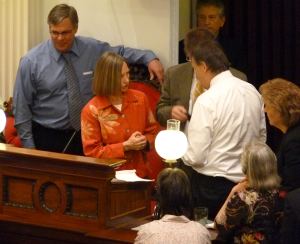
Gov. Jim Douglas and Democratic leaders of the Legislature reached consensus on a veto-proof budget Wednesday evening, just hours before the Legislature adjourned.
Neither side had the stomach to go through another acrimonious veto session after the governor’s historic budget veto and ensuing special legislative override session last year.
“We all wanted to get this resolved,” Douglas said. “My sense is Vermonters were not thrilled with how last year played out.”
Senate President Pro Tem Peter Shumlin thanked the administration and lawmakers for their commitment for “putting Vermont on a fiscally responsible spending path and doing so without raising broad-based taxes and doing so while growing the economy. That’s what this deal is about.”
Each side gave a little and got a little on Wednesday, and the deal paved the way for adjournment.
Douglas claimed partial victory on a repeal of millions of dollars in capital gains taxes, an increase in the estate tax exemption and an agreement that the state will not tie $10 million of the state’s “rainy day funds” (savings in a cash flow account) to the Challenges for Change government restructuring bill.
“We all had different opinions – and we’ve expressed them – but I think we’ve achieved a compromise that is a reasonable middle ground that can pave the way to adjournment,” Douglas said.
Smith and Shumlin had rejected the $3.2 million capital gains tax break for business owners Tuesday night, but then had a change of heart the next day after they worked through the details with the administration. Douglas had originally proposed a complete repeal of the capital gains tax increases the Legislature passed last year. Smith and Shumlin also rejected the governor’s proposal to enact mandatory cost savings in education, such as thresholds for student-to-teacher ratios.
“In the context of the very difficult times we find ourselves in, as a state and a country, where we faced very difficult unemployment, which has caused pressures to our unemployment budgets, making sure people who are out of work have health care and can care for their families,” Smith said. “We have protected Vermonters in need during these difficult times and through this budget we will put Vermont on solid footing for the future.”
Forty percent of profits generated by businesses registered in Vermont would no longer be subject to the capital gains tax after Jan. 1. Last year, the Legislature removed the 40 percent exclusion.
The rollback of the capital gains tax increase for businesses will cost the state $3.2 million in the second half of fiscal year 2011 and $11 million in fiscal year 2012. The provision does not include profits from investments or the sale of land.
The estate tax adjustment raises the threshold for taxable inheritance income from $2 million to $2.75 million. The administration and lawmakers do not anticipate a loss to the state’s coffers as a result of the change, according to Secretary of the Administration Neale Lunderville.
Last Friday, Shumlin and Smith also announced they would not seek a cap on a federal pass-through tax exemption for corporations known as the domestic production deduction, which would have generated $1.7 million in revenue. (Douglas had pressed lawmakers to dump the tax increase because it would hurt businesses in the down economy.) At the same time, much to the governor’s chagrin, the Democrats supported tapping as much as $10 million from the state’s stabilization fund. Douglas wasn’t ready to say whether he would sign two other bills that he has previously hinted he might veto: the health care reform bill and new legislation that would increase penalties for landowners who take land out of the current use program for development. The governor has said he doesn’t like a provision in the health care bill that require pharmaceutical companies to disclose gifts to physicians who receive free drug samples. The higher current use penalty, in his view, would hurt farmers and loggers.
Sen. Susan Bartlett, chair of the Senate Appropriations Committee, said the budget did not include revenues from a cap on the production deduction tax break. The $3.2 million capital gains tax breaks will come from savings in three areas: $1.6 million in fees for space (the amount the state pays for rent), a reduction of $850,000 in total information technology expenditures and $400,000 to $500,000 in funds generated from the resale of abandoned property.
In fiscal year 2012, however, the capital gains exemption will cost the state $11 million and will become part of the state’s $122 million deficit.
“I think it’s a reasonable compromise and targeting it to businesses makes sense,” Bartlett said.
