

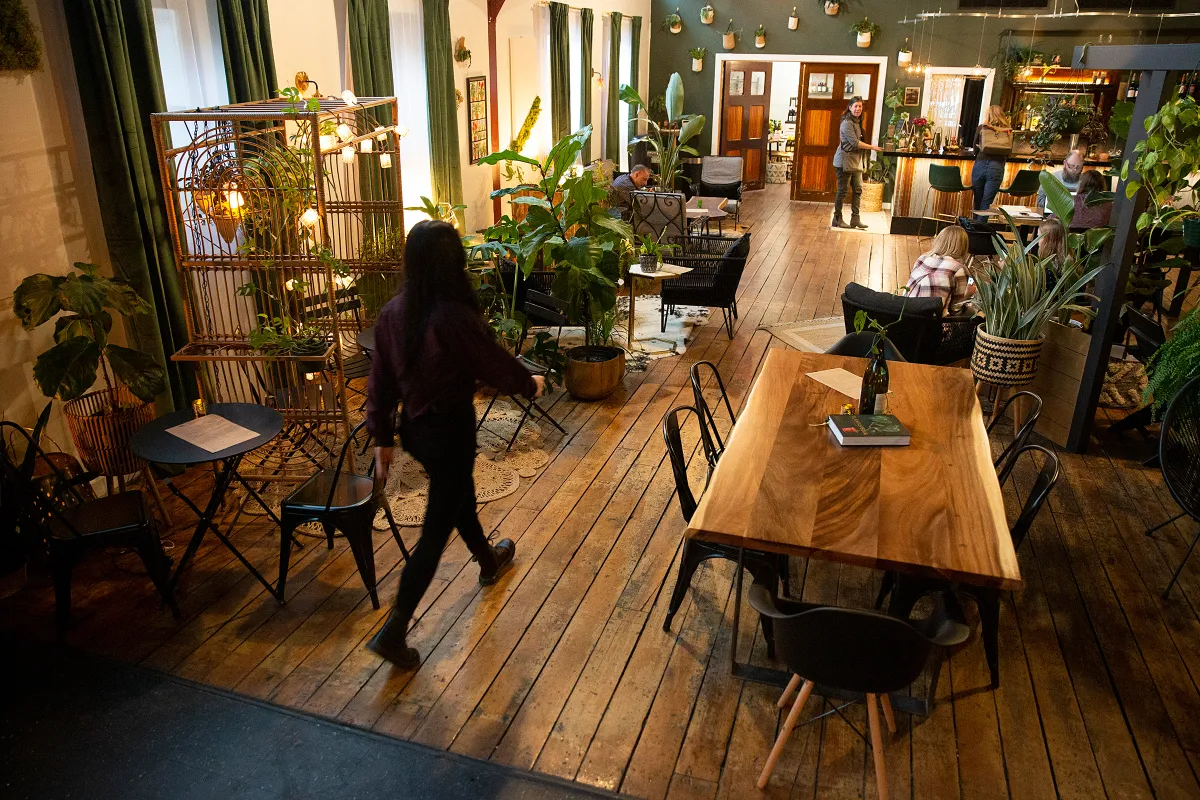
This story by Marion Umpleby was first published in the Valley News on Aug. 21, 2026.
WHITE RIVER JUNCTION — In the early hours of Aug. 5, Kelsey Rush awoke to an alert from a security camera on the exterior of Putnam’s Vine/yard, her cafe and bar on South Main Street.
The footage showed two people engaging in sexual behavior behind a wooden bench in the bar’s patio area.
About four hours later, Rush posted clips of the footage to Putnam’s Instagram using snake or eggplant emojis to cover the people’s genitals, along with captions such as “When someone replies five stars, and you have to remind them that lasting for two min does not make for five stars.”
She also posted footage captured two nights before that showed two people using drugs on the bar’s property.
Similar incidents, ranging from drug use to theft, have become daily occurrences, Rush said in an interview, and she was fed up.
“I was definitely triggered by the idea that this gentleman and his partner were … trespassing, being lewd, leaving behind fluids on places customers sit,” Rush said.
She soon deleted the videos after receiving criticism from viewers about her decision to post footage of people having sex without their consent.
The Vermont state law regarding the disclosure of sexually explicit images without consent does not apply to public places or commercial areas “where a person does not have a reasonable expectation of privacy.”
While it’s unclear whether the people having sex in the video were unhoused or using drugs, the incident — and Rush’s decision to post footage of it — sparked ongoing discussion about the prevalence of drug use and homelessness in White River Junction and how the village can support people grappling with these challenges as well as the businesses affected by them.
“The way people view unhoused people, people dealing with substance issues, it’s awful,” Jordyn Lich, a production manager and producer at the White River Junction community media center JAM (Junction Arts and Media), said in a recent interview.
Lich, who provided screenshots of Rush’s posts to the Valley News, recently drafted a letter urging Rush to apologize for her actions, agree to never again distribute security camera footage on social media, and to engage with a local organization to “repair the harm they have caused in the community.”
“Putnam’s chose to publicly humiliate these community members and tag the Hartford Police Department on social media, the least appropriate avenues to deal with the situation,” the letter read.
As of Monday, the letter had received 65 signatures.
Rush received the letter after she issued an Aug. 12 apology on Facebook stating, “We are sorry that the way we shared these stories contributed to fear, hurt, or stigma in our community.”
The post went on to say that Putnam’s had joined a “community watch set up by a neighborhood business” and made donations to the Upper Valley Haven and H2RC, a group that organizes needle clean-ups.
“I’m sorry. I took them down,” Rush, a resident of Hanover, New Hampshire, said in a Thursday interview. But, she added, “when you trespass … you’re giving up your right to privacy.”
In addition to her apology, Rush said the posts did not reflect her business’s values.
“Putnam’s prides itself on an extensive track record of supporting the community, giving back, and creating a safe and inclusive third-place where all are welcome,” Rush said in a statement to the Valley News. “We are looking forward to continuing to listen, learn and help contribute to addressing the critical challenges related to crime and drug use in the WRJ community.”
Rush, a Dartmouth graduate who opened Putnam’s in 2022, has noticed an increase in theft and drug-related incidents on the bar’s property in the past three months.
She estimates she’s spent several thousand dollars replacing stolen patio furniture and extension cords. She’s also invested in protective gear to clean up human feces and needles, and her employees frequently have to wash drug residue from the bar’s outdoor tables, she said.
Stephanie Waterman, who owns Growpro, the dispensary and plant store located in the same parking lot as Putnam’s, has noticed similar incidents.
“The last year we have seen this incredible degradation downtown with a significant increase of drug activity,” Waterman said in a Thursday interview.
She often sees people passed out in the parking lot, and her staff have found “dozens of needles on the ground.”
Waterman didn’t see Rush’s posts, but she considers them “a hysterical and interesting PR move,” she said.
“There’s no right to privacy in a public space, so if you’re having sex in a public space, you have no right to privacy,” Waterman said, echoing Rush’s sentiment.
At the same time, “I’m glad she took it down,” Waterman added. “Obviously it’s a little crass.”
Instances of drug use and theft at Putnam’s coincide with steep housing costs in White River Junction and a growing need for food and shelter among the village’s unhoused population.
“White River Junction to me is like the most textbook example of gentrification I have ever witnessed,” said Lich, adding that Putnam’s, where a 5-ounce glass of wine can cost $35, is “part of the problem.”
Larry Blake Harvey, executive director of the Hartford Community Restorative Justice Center, which offers community housing and employment opportunities to people seeking a fresh start, said he’s noticed an increase in people visiting the nonprofit for snacks, water and a hot shower who aren’t part of its programs.
“We don’t have the funding to support all these people,” said Harvey, who recently had to put away many of the center’s free snacks because the demand was growing too high.
Supporting White River Junction’s unhoused population also came up at the Aug. 18 Hartford Selectboard meeting, where Lich criticized Rush’s Instagram posts.
“In these posts, Putnam’s mocked, demeaned and posted nude, explicit content of these individuals without their consent,” Lich said in the public comment section of the meeting.
Selectboard member Miranda Dupre acknowledged that issues of homelessness and addiction go beyond the scope of White River Junction.
“I don’t think the town is going to solve this problem. I think all we can do is harm reduction and kind of like putting band-aid fixes wherever we can …,” she said at the Aug. 18 meeting.
But that’s not enough, and it’s not sustainable for the town as a whole, she added.
She urged the selectboard to demand the state and federal government fund healthcare and other services.
Lich had their own ideas, too.
“Perhaps plan free community workshops around harm reduction” and “what it means to live in a surveillance state,” they said.
The Hartford Community Restorative Justice Center, for its part, has been working on ways to include unhoused people and those struggling with addiction in discussions about how the village can better support them.
One avenue could be a public “circle of support,” where unhoused people can voice their needs and experiences.
“This is a challenge that every major city is facing without a lot of answers, so as a rural community the cards are kind of stacked against you,” Harvey said.
