
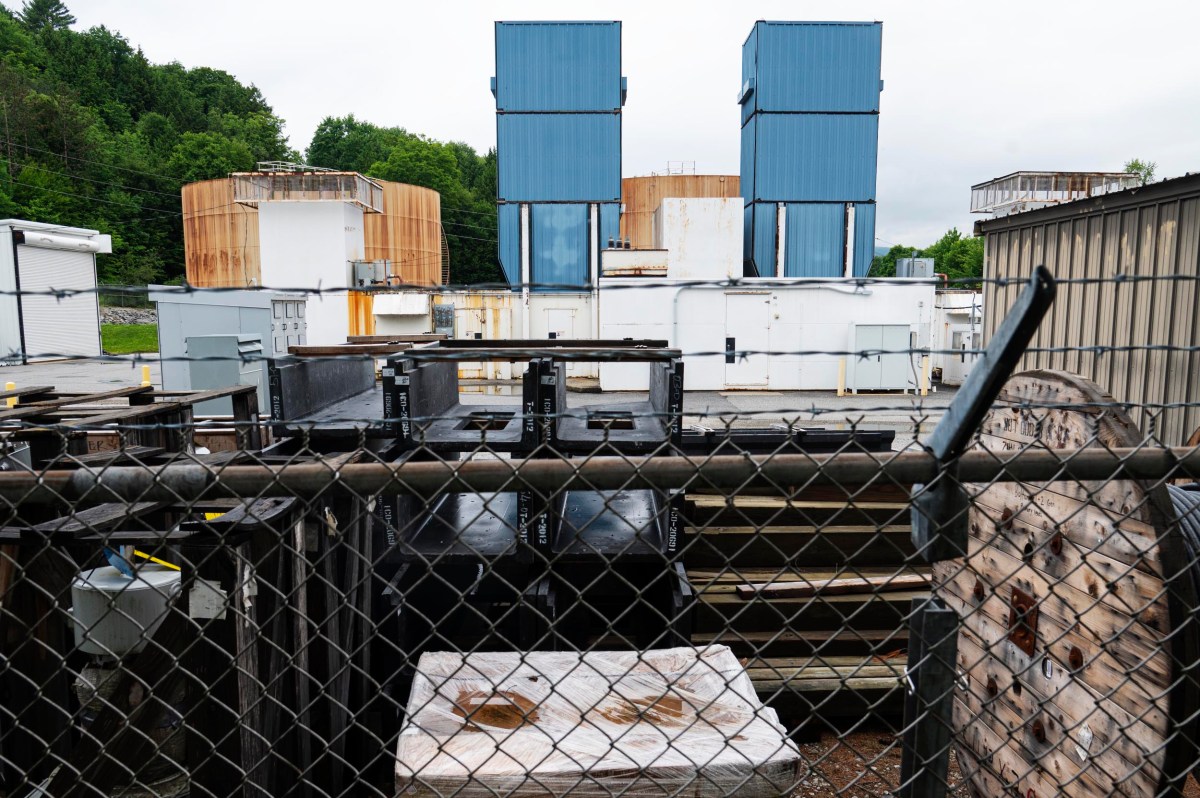
Vermonters spend nearly $4 million a year to keep seven petroleum plants on standby, facilities that, on average, fire up for about 10 hours a year when summer heat and winter cold push the grid to their limit.
These generators run at times “when the system is stressed, usually when demand is very high,” TJ Poor, director of planning at the Vermont Department of Public Service, told VTDigger.
And those generators are also the only ones in Vermont burning fossil fuels.
Vermont generates about 27% of its own electricity, relying predominantly on hydropower imported from Quebec, according to the U.S. Energy Information Administration. But during peak power usage — the hottest summer evenings and coldest winter nights — the state utilizes its only seven petroleum plants to meet the high demand. For the rest of the year, those fuel-burning plants sit dormant — though Vermonters spend millions to keep them ready.
The plants ultimately act as “a last resort” that are only necessary as a backup plan when other resources are not available, said Shana Louiselle, the communications manager at Vermont Electric Power Company, also known as VELCO.
New England’s Independent System Operator, a nonprofit that operates the region’s power grids, is responsible for moving the power from the generators to where people need it.
Every year, different electricity resources compete in the operator’s auction, called the forward capacity market, to see which generators can provide electricity to sufficiently meet the peak demand. The auction takes place three years in advance of when the electricity is actually distributed.
In Vermont, the fossil fuel plants are turned on for an average of 10 hours a year. And yet, results from ISO NE’s 2023 forward capacity auction show the plants are being funded by about $3.8 million during the 2026-27 period to keep the plants on standby.
The annual costs show up through fixed “forward capacity payments” on residents’ electric bills to act as insurance, in case the generators are used. When the plants are turned on, they are then also paid the market price for any electricity they generate.
VELCO is a transmission system that was designed around those peak conditions and “worst-case scenarios,” she said, causing them to continuously study the conditions and plan for them in advance.
While the peaker plants do not significantly impact Vermont’s carbon footprint, petroleum itself has become a massive source of greenhouse gas emissions in the state.
According to the U.S. Energy Information Administration, Vermont has the lowest energy-related carbon dioxide emissions of any state in the U.S.
However, Vermont also consumes nearly six times more energy than it produces and about 62% of that energy is petroleum-based, the second highest in the nation.
Mary Cate Colapietro, ISO NE’s communications specialist, said that the designated generators operating during the period of high demand do not always have to use fossil fuels.
“It’s not based on fuel, it’s based on their competitive bids into the wholesale market and the outcomes of the market,” Colapietro said.
However, the generators that have been successful within the market in the past have consistently been petroleum-based for Vermont. In 2024, all of the state’s peaker plants also used fossil fuels.
Vermont finds ways to curb the peak
As climate advocacy groups call for Vermont’s electric grid to transition to clean energy, Vermonters may be able to also cut down on the seasonal costs, too.
Many Vermont utilities have implemented or are in the process of implementing flexible load programs to address those peaks. These programs call for a load of power to be shifted to outside of the usual peak hours of 5 to 8 p.m.
“Oftentimes offsetting the peak can be done for economical reasons, right, because peak periods are often the same time as, you know, more expensive electricity, so it can serve a dual purpose for helping Vermonters reduce their bills,” Louiselle, the VELCO spokesperson, said.
In 2017, Burlington residents were urged to shift their energy usage away from peak regional hours through the Burlington Electric Department’s “Defeat the Peak.” The program allowed customers the opportunity to lower utility wholesale costs, keep overall utility rates stable and curb the emissions from peaker plants.
When the utility’s savings target was reached, donations to local nonprofits were given from a portion of customers’ savings. Through the program’s success, Burlington Electric Department has been approved by Vermont’s Public Utility Commission each year since 2024 to use a budget of about $2.6 million for their energy efficiency efforts.
More recently, Green Mountain Power also created its own flexible load program, in which customers pay discounted rates to charge their electric vehicles during off-peak hours.
Similarly, climate advocacy groups have started their own initiatives in an attempt to pressure the power grid to shut down its oil plants and transition to a more renewable energy source through a kind of activism they call “peakbusting.”
Climate justice groups 350VT and 350NH are using a demand-response approach, in which consumers are encouraged to collectively cut corners on their electricity to curb the peaks so the peaker plants do not have to turn on at all.
Joining 350NH and the Climate Disobedience Center in its No Coal, No Gas campaign, 350VT is calling for Vermonters to spend time with friends, go outside or schedule high-electricity activities, like using laundry machines and dishwashers, for a different time of day.
“Ultimately we want to see these peaker plants shut down. We want to see tangible, meaningful action to really transform our world ultimately into a less extractive, more regenerative economy,” said Rebecca Dalgin, 350VT’s organizing co-director.
A transition to renewable energy is just as important for Vermont utility companies, Louiselle said, but relying on peaker plants is necessary “to maintain reliability 100% of the time, 24 hours a day, seven days a week.”
Correction: An earlier version of this story incorrectly stated how the costs of the plants was distributed among Vermonters.