

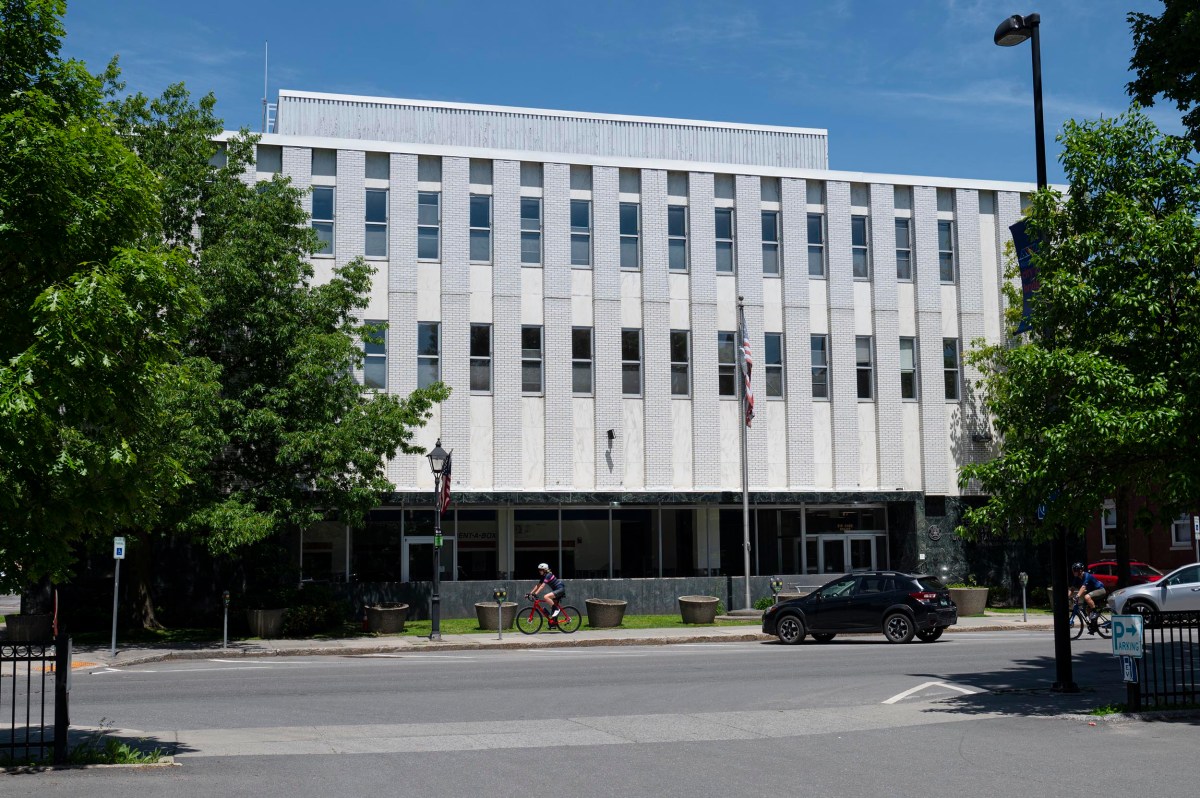
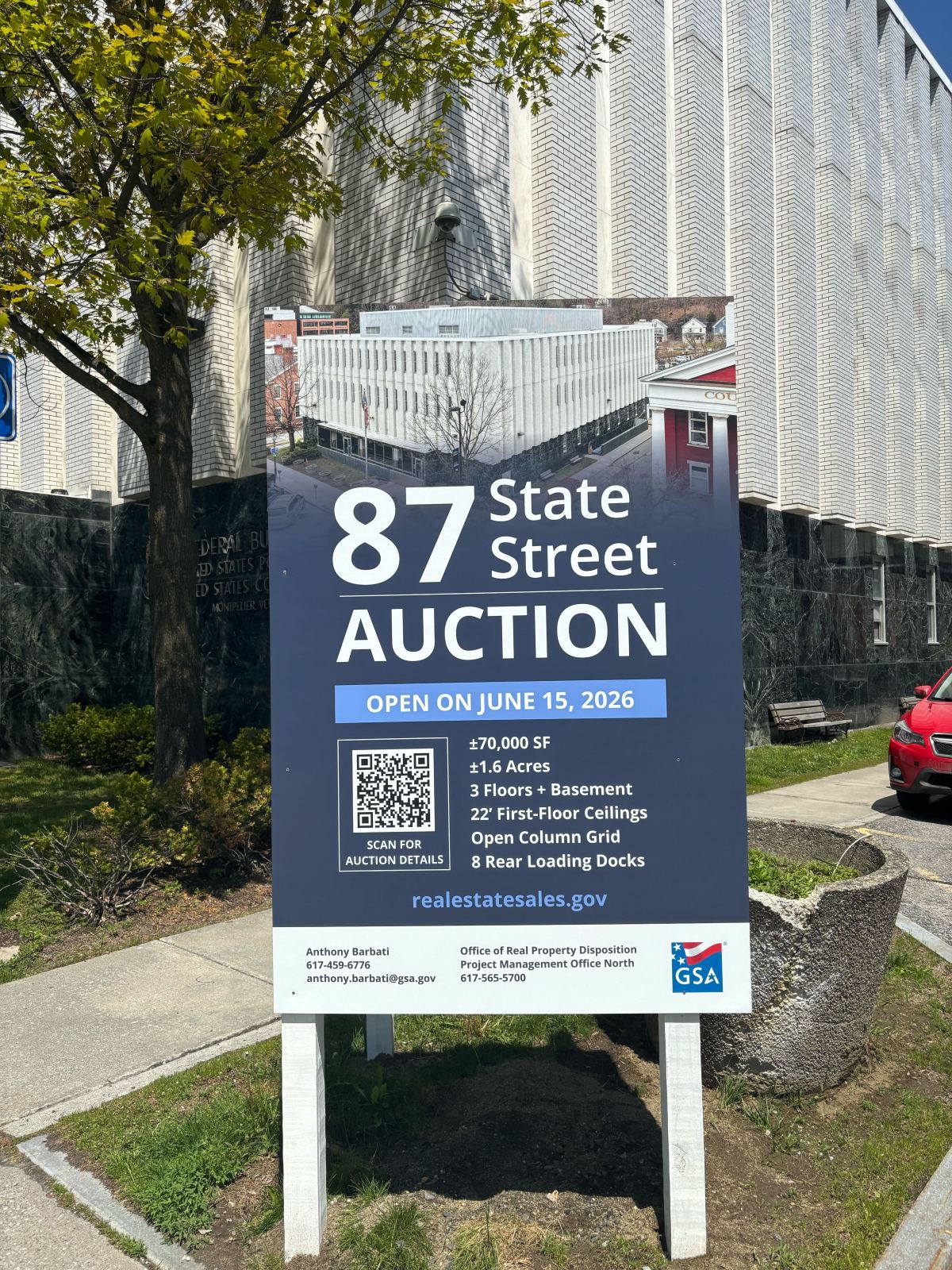
The former Montpelier post office, vacant since the July 2023 flood, will go up for federal auction starting June 15, finally putting within reach the fate of one of downtown’s most prominent buildings.
The most interested buyer, however, still has major questions about what could be hidden inside.
“We’re talking about a stone’s throw from our state capital, and yet we face these significant challenges when it comes to figuring out what comes next for the property,” said Jon Copans, head of the Foundation for a Resilient Montpelier.
The hulking concrete-and-marble structure at 87 State Street has sat virtually vacant amid the shops and offices of downtown since floodwaters caused significant damage and forced the U.S. Postal Service to relocate to a new spot on Main Street.
Foundation for a Resilient Montpelier is a nonprofit coalition dedicated to helping Montpelier rebuild from the 2023 flood. Last year, the foundation attempted to coordinate the purchase of the building on behalf of the state of Vermont through a “negotiated sale” process, which allows state and local entities to get priority access to a property, Copans said.
The foundation’s vision for the property centers around the possibility of using the large parking behind the building for multifamily housing, Copans said. Their analysis shows that the parcel could fit up to 70 or 80 housing units.
Meanwhile, the building itself would most likely remain an office space.
“We want to put that building back to work for Montpelier,” he said. “It was developed as a commercial building, and it’s probably best suited to be a commercial building.”
But in the process, the foundation uncovered a report that revealed previously undisclosed, widespread contamination from PCBs, a class of industrial chemicals linked to negative health effects, Copans said.
“It doesn’t do a full job of characterizing the PCB contamination, but frankly, that report is just enough information to be significantly concerning in terms of the level of contamination,” he said.
According to the 2023 report, Clay Point Associates, Inc., found widespread PCB contamination in the walls, floors and paint. Some of the exterior materials tested positive for PCBs as well.
“PCBs in building materials are pervasive — in some cases in significant quantities,” the report states. “Considering the age of these materials, it is possible that they are deteriorating. Therefore, we recommend that air quality monitoring be performed to determine if the presence of PCBs is compromising indoor air quality.”
The report stated that this was only an “initial screening” that should be followed by an in-depth analysis. But the federal government refused to allow the prospective buyers to access the building for a full environmental assessment, Copans said.
“We have no ability to do what’s called characterizing the contamination in order to really fully understand the scope of remediation costs, and so that really makes it challenging to arrive at what a fair price for that property would be,” Copans said.
A Tetra Tech environmental site assessment posted on the auction website also listed seven “recognized environment conditions,” including a “strong odor and oily staining” around the elevator area that it could not investigate further because the elevator itself was sealed.
Paul Hughes, a spokesperson for the General Services Administration, the agency that manages buildings for the federal government, said via email that the agency has met all applicable federal regulations necessary to sell the property.
The agency is “committed to effective management of taxpayer funds and getting fair market value,” he wrote, adding that “our findings suggest a public sale will achieve a much higher price point than the amount offered by the State.”
Ultimately, the foundation walked away from the negotiated sale process in March. Copans said even calling it a negotiated sale is a “misnomer” in his opinion, since the federal government refused to back down from its initial asking price of $2.4 million.
But Copans hasn’t given up just yet. The foundation is pursuing a potential way to participate in the auction. It wants to create a local development corporation composed of interested property developers pooling funds and expertise to a nonprofit to manage the sale.
The foundation gathered some of those developers last week to discuss the creation of that development corporation, Copans said. A bill, S.237, which passed in the state House and Senate this session, would also provide up to $1 million in grant funding from the Agency of Commerce and Community Development for a local development corporation to purchase “federally impacted properties,” including this one.
Will the price be right this time? Copans said the coalition is making “shrewd” calculations based on the potential cost of PCB remediation. The federal government has announced a starting bid of $500,000.
The bidding is scheduled to run online until August 5. Copans said another “point of uncertainty” is who else might be bidding on the property besides the coalition.
“If there’s prospective buyers, if they want to engage with us to talk about where we might have some shared interest, we would be very much interested in those conversations,” he said.
