

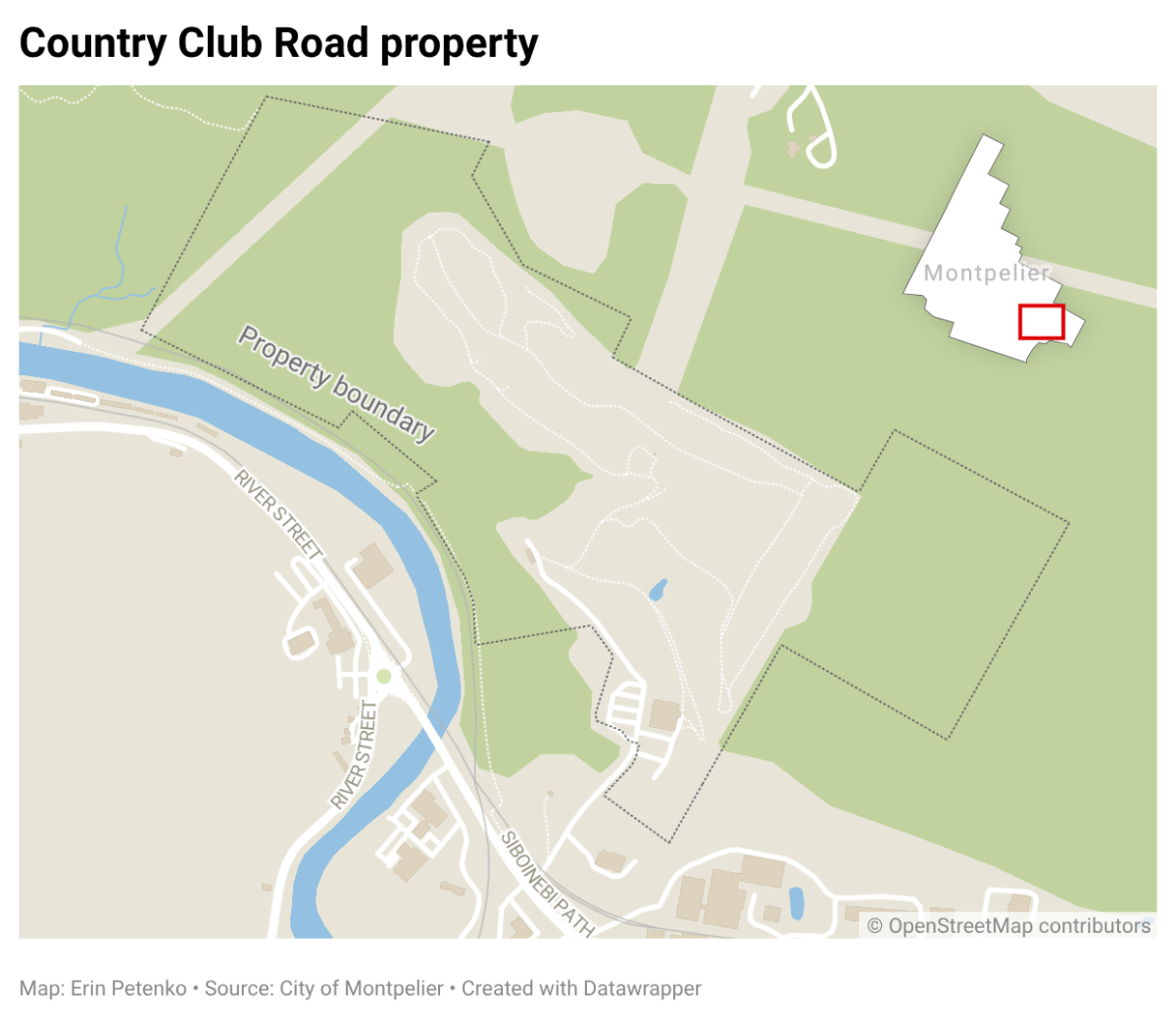
At the traffic circle where Route 2 and Route 302 meet outside downtown Montpelier, one might notice a sign for the former Elks Country Club. If you drive up the road next to it, you will come to a small building surrounded by a vast field of grass, dotted with trees. Depending on the season, you might catch some cross-country skiers or kids playing frisbee golf.
That nearly vacant expanse could become a neighborhood with hundreds of homes under proposals from four developers — part of a yearslong effort to ease Montpelier’s housing crunch, grow its tax base and shift residents away from flood-prone downtown.
It has been no small feat.
Developers have now provided in-depth reviews of their visions for the site, along with their own credentials, and sat down for Q&A’s with the city council subcommittee in charge of the project.
Still, some questions remain.
With new home prices soaring across the state, how can the developers ensure the final product remains affordable for locals? Will Montpelier be able to hold up its end of the bargain by building infrastructure and addressing the brownfield contamination? And what kind of neighborhood do Montpelierians want this to be?
At a city council subcommittee meeting Thursday, the three councilor members were able to knock one proposal out of the running. Pennrose, a national property developer, had designed its proposal with apartments only.
But the councilors acknowledged that it would be hard to narrow down the three remaining developers. They agreed they could not meet the original April 22 deadline to make their final pick.
The postponement was a slowdown in the five-year-long saga that has been Country Club Road.
“I think it’s really worth taking a pause and making sure we get this right in terms of process,” said Ben Doyle, a District 1 city councilor.
A long journey
The possibilities for Country Club Road’s development go back to 2021, when Citi Properties, a local property agency, purchased the land and shut down golfing on the property, according to reporting from The Bridge.
A group of local tennis devotees approached the city about the possibility of collaborating on recreational opportunities at the site. Instead, the city decided to buy the entire property in 2022 and turn it into a center of both housing and recreation.
Since then, the city, with the help of a consulting contract with White + Burke, has been going through the gradual process of gathering feedback, testing the site’s soil and garnering interest from developers.
Montpelier has had its fair share of critics throughout the process. When the $2 million bond to buy the property came up in 2022, some residents said the city could not afford the higher property taxes that the purchase, and the later development, would bring. But the bond vote passed, 1,205-1,021.
Perhaps the project’s most vocal critic has been Steve Whitaker, a local resident known for frequent attendance at city council meetings. He’s also acted to slow down the process. In 2024, the Vermont Community Investment Board revoked Montpelier’s growth center status after Whitaker pointed out an error in the city’s application.
He still has objections. In repeated letters to the mayor and city councils he shared with VTDigger, he said the city should wait and do more testing of the site’s environmental hazards before it commits to going any further.
Sal Alfano, a District 2 city councilor who leads the Country Club Road subcommittee, confirmed the site had chemical contamination from years of golf greens maintenance.
However, he pointed out that all the developers were aware of the potential contamination. Chinburg, Dew and now-nixed Pennrose even have previous experience developing on brownfield sites, which are properties where development may be complicated because of the potential release of hazardous materials.
“None of them is even blinking at the prospect of it,” Alfano said. “They’re just unsure how it will affect cost. And if the city is able to get funding for it, then we’ll be able to take care of it.”
Another key concern Whitaker raised is the affordability of the future homes for sale and apartments for rent.
The proposals vary, but all of them include some units below “Area Median Income,” a federal benchmark for affordable housing programs. But the Vermont threshold for AMI allows landlords to charge nearly $2,000 for a studio apartment, according to Vermont Housing Finance Agency data.
Alfano said the committee was looking for a mix of both market-rate and subsidized housing. He said they had to balance two needs for the project: “We want to put as many people as we can” into housing, but on the other hand, “we need to increase the grand list,” or the value of all properties in the city, which generates tax revenue for Montpelier.
Along with basic amenities like water and sewer, the city might need to install a new traffic light at the intersection with Routes 2 and 302, depending on the amount of increased traffic, according to project documents.
The city is applying for a Community and Housing Infrastructure Program tax incentive, which essentially allows the city to cover the cost of the project’s infrastructure through increased future tax revenue.
But if too many units are subsidized, the city won’t be able to earn enough to pay it back.
“Those are calculations that are underway,” Alfano said. There’s also the possibility of Montpelier partnering with a developer to bond the infrastructure, so the developer itself assumes part of the risk.
Kelly Kury, Montpelier’s recently hired city manager, said via phone the city has also received $3 million from Northern Borders Regional Commission, is awaiting a decision on a $5 million Community Development Block Grant, and has applied for federal Better Utilizing Infrastructure to Leverage Development dollars to help hit the $11 million estimated cost of the project.
There’s one thing both parties agree on. In an email to councilors after Thursday’s subcommittee meeting, Whitaker praised the decision not to try and meet the April 22 deadline.
“Slowing down is the correct call,” he wrote.
Three visions of the future
There’s no strict process for members of the public to vote on their favorite proposal. But in an informal survey gathering feedback, one developer came forward as an unofficial front runner: Execusuite.
“I like the emphasis on home ownership, the dense pedestrian village feel, and the quirky Montpelier vibes,” one anonymous survey member said.
All the proposals include a balance of housing and recreation. Although the Hub’s offer to partner on recreation facilities has stalled, Kury said that Montpelier still intended to offer some sort of recreation area at the site.
But Execusuite’s offer includes the possibility of more amenities than the others, including a farm with an attached classroom, a sugar shack and a cafe.
“They’re thinking out of the box,” Alfano said.
Execusuite’s proposal also leans heavily toward home ownership over rentals. Instead of subsidized rentals, the developer’s more affordable options include condos, duplexes and tiny homes, all the way down to zero-bedroom homes.
Execusuite also has regional ties. The Upper Valley-based developer is best known in the area for purchasing the former Goddard College campus in Plainfield, which it has slowly transformed into the “Creative Campus at Goddard” with events and a restaurant.
Some of the other developers have local projects on their resume as well. DEW Properties built the housing above the Transit Center in Montpelier and worked on the Barre City Place.
Pennrose’s proposal, in contrast to Execusuite, solely offered apartments for rent. Alfano said the subcommittee had decided against the firm because members were hoping for a blend of apartments and homes for sale.
But of the remaining options, he said, “all three companies have something strong to offer.”
“They all have question marks, too,” he said. “So we’re trying to get the answers that we don’t have to try and make the best decision.”
Correction: An earlier version of this story gave an incorrect dollar amount for the contract with White + Burke and misstated the definition of the grand list.
