



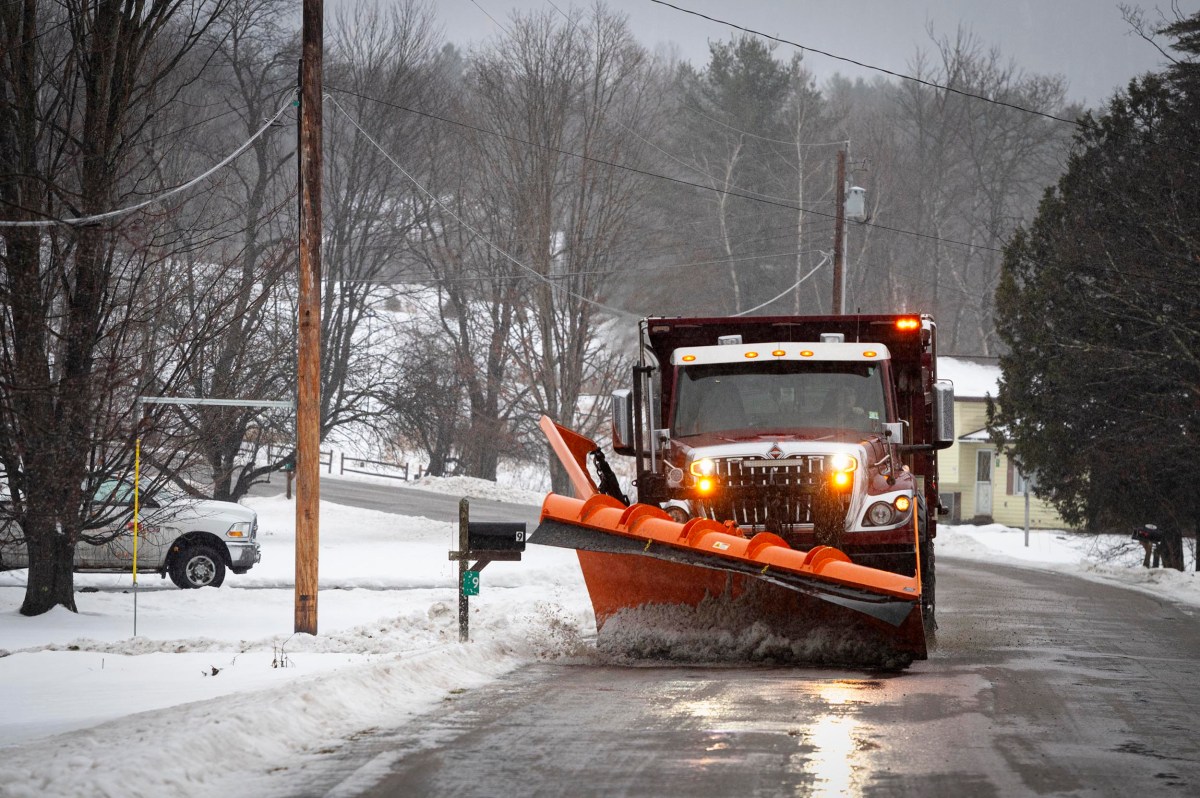
Though we may have endured the year’s last snowfall (knock on wood), House lawmakers Friday turned their attention to a very wintery issue: road salt.
The ice removal tool has exploded in use in recent decades, with more than 60 million tons used annually across the globe.
But lawmakers were more concerned with road salt’s adverse impacts than its safety features. In 2020, the Environmental Protection Agency estimated that road salt caused $5 billion in damage to cars and infrastructure. Chloride runoff into lakes and streams impairs water quality and harms wildlife — including in Vermont, where a number of streams are considered chloride impaired, particularly in Chittenden County.
That’s where S.218 comes in. The bill would establish best management practices for road salt application in an effort to decrease salt use and runoff. The bill would also create certifications for commercial and municipal salt applicators. If someone received the certification, they would then have limited liability protection against snow and ice slip-and-fall lawsuits.
It’s an idea lawmakers in both chambers have kicked around before, as some environmentally conscious legislators have grappled with both the pros and cons of salt use.
“We’re benefitting but also paying dearly,” Rep. Ela Chapin, D-East Montpelier, who reported the bill on the House floor, told her colleagues.
Although the House ultimately advanced the bill Friday, Republican skeptics questioned whether the legislation would truly protect businesses from liability. Plus, the proposal currently lacks an appropriation to put it fully into practice, and GOP members balked at both the price tag (about $700,000 to stand up the program plus recurring annual costs) and the logic of passing a bill without its needed funds.
Rep. Richard Nelson, R-Derby, said he knows a business owner in Newport who settled a slip-and-fall lawsuit because it was cheaper than litigation. He said he feared the bill wouldn’t stop such incidents from happening.
And Rep. Matt Walker, R-Swanton, said he was aware of 16 towns that have nixed immediate plans for new salt sheds because they’re unaffordable. Such sheds reduce runoff by protecting salt from the elements. He argued it would be more effective environmental protection to pass legislation that makes it easier for municipalities to store their salt.
But supporters, including the House Environment Committee chair Rep. Amy Sheldon, D-Middlebury, said the bill’s prevention-first approach to reducing salt contamination was fiscally prudent. Plus, even without an appropriation, the bill would direct the state to study municipal salt storage, helping inform future decisions.
“This bill is truly a conservative, nonregulatory approach, applying the old adage of ‘an ounce of prevention is worth a pound of cure,’” Sheldon said on the House floor. “We ask for your support.”
In the know
“The impacts would be all encompassing and potentially extreme.”
That was the conclusion of a Joint Fiscal Office memo presented to the House Appropriations Committee on Thursday, in response to the question of what would happen if legislators and Gov. Phil Scott can’t agree on a new state budget by the start of the new fiscal year.
The committee was considering that possibility — for now, just a hypothetical — amid growing consternation between legislators and the administration over the education bill that’s currently moving through the House. Scott again this week threatened to veto this year’s state budget if that education proposal, H.955, doesn’t ultimately arrive at his desk in a form he likes.
In short, explained Emily Byrne, the Legislature’s deputy fiscal officer, on Thursday: If there’s no budget by July 1, the state government would shut down, likely with some impacts similar to what happens when the federal government shuts down.
But the details are clear as mud. The fiscal office doesn’t know which state employees would continue to work during a shutdown, or how or when they would get paid. State contractors could be left in the lurch. And access to key human services, such as Medicaid payments and nutritional benefits, could also be up in the air, Byrne explained.
Moreover, a state shutdown could negatively impact Vermont’s bond rating, she said, leading to a higher cost of borrowing down the line. “A budget impasse may not immediately impact ratings, but there is long-term reputational risk,” the fiscal office wrote in its memo.
The state government has never shut down before, Byrne said, so there’s no historical precedent to study. And, existing state law provides few, if any, contingency plans in case of a dire budget impasse. One potential solution: In other states, courts have stepped in to direct the government on how to operate during such an impasse, she said.
Committee members seemed to be in agreement Friday that they wanted to avoid anything close to that hypothetical.
“You can see what a conundrum it would be to not have a budget — and how devastating it could be,” said Rep. Robin Scheu, D-Middlebury, the committee’s chair.
— Shaun Robinson
Nearly two years ago, the federal government set a new rule that requires state and local government bodies to make their website and mobile app content accessible to people with disabilities. And the government set a deadline — April 24 of this year, said Rik Segal, legislative counsel, in the House Energy and Digital Infrastructure Committee on Friday.
“There’s very technical things that websites will have to use in order to meet these rules,” Segal said. And if website content doesn’t abide by compliance guidelines, the federal government can impose fines, he said.
Don’t fret!
Kevin Moore, director of information technology for the Vermont Legislature, said he doesn’t expect the legislative branch to run into trouble under the new federal rules. “This is more of an evolution of something we’re already doing,” Moore said to the committee.
To make the website accessible, its designers follow disability guidelines on things like the size of headers or line spacing, Moore said. Anyone who uses the legislative website can submit complaints if they believe the site is out of compliance, Moore said, though the state gets few complaints.
— Charlotte Oliver
On the move
The House Ways and Means Committee on Friday voted out H.955, the House’s education reform bill. The legislation will now head to House Appropriations.
The bill would create study committees in seven areas of the state to facilitate voluntary mergers of the state’s 119 school districts.
Lawmakers in the Ways and Means Committee preserved the general structure of the legislation but tacked on language around school construction aid, prekindergarten student funding and school transportation.
The legislation directs the state to provide $50 million in annual state aid for school construction but leaves many of the program’s details for lawmakers in future years to fine tune.
Likewise, lawmakers in 2027 will be tasked with establishing a funding structure for universal prekindergarten.
“Doing multi-year work in a biannual Legislature that is five months a year is very, very hard, and I think it takes a lot of faith and a lot of work in between to know that we are moving pieces of things forward and that more will have to be done in the future,” said Rep. Emilie Kornheiser, D-Brattleboro, the committee chair.
The committee voted 6-5 in favor of the bill.
Several lawmakers said they felt troubled voting out the bill with such an uncertain future for critical pieces of the state’s education system.
“I look forward, I hope, to being here to participate and being part of the next steps, because clearly we’re not done, not by a long shot,” Rep. Jim Masland, D-Thetford, said before voting yes.
“My primary constituents certainly want me to vote no,” he added. “I’m going to vote yes on the prospect that we can continue to move forward and get stuff done. I might not be here next year for just that reason.”
The legislation will need to to be approved by the Appropriations Committee and, eventually, by the full House before heading to the Senate.
— Corey McDonald
Clarification
Wednesday’s newsletter implied that the Legislature is subject to Vermont’s Open Meeting Law. While the Legislature is not subject to Vermont’s Open Meeting Law, the legislative branch is subject to its own public access rules and the Vermont Constitution’s transparency requirements.
