


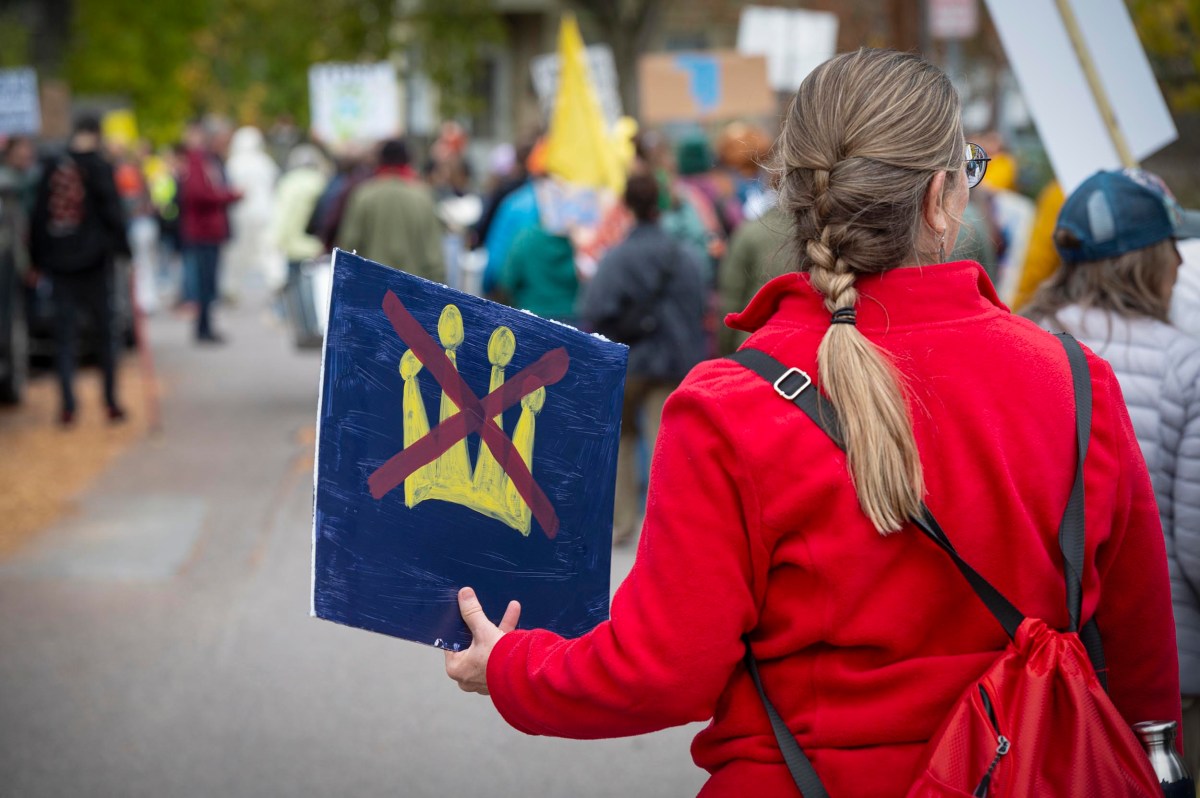
Over a year into the second Trump administration, thousands are expected to gather at over 50 protests in Vermont on Saturday for the third No Kings Day.
The protests, which largely center on opposition to the Trump administration, are part of a national day of action that organizers say could be the largest single-day protest in the country’s history. The Trump administration has faced persistent scrutiny for actions that critics and scholars have said undermine democracy.
“Every day more and more people are being affected by this corruption and mass destruction of our social fabric in this country,” said Marilyn Lagrow, who is helping organize a No Kings event for the Champlain Islands.
“If we don’t save ourselves, nobody else is coming to save us,” she added.
Saturday’s protests in Vermont will include rallies in towns across the state, along with four “rolling rallies,” which will see groups of people in cars — some decked out with American flags, streamers and Uncle Sam cutouts — driving to multiple nearby events in succession.
While organizers are expecting thousands of people to turn out in Vermont, some fear that the frigid weather forecast and a sense of discouragement might keep people home. Nationally, organizers anticipate a turnout even higher than the estimated 7 million who attended No Kings rallies in October, with over 3,000 events planned across all 50 states.
Multiple organizers said they hope the protests will remind people that they’re not alone in their frustration and will bring more people into their movement.
The first two No Kings events drew thousands in Vermont in June and October of 2025.
Many of Saturday’s No Kings protests around the state are organized by local groups that are part of the nationwide Indivisible movement, a progressive advocacy effort that has organized wide-scale opposition to the Trump administration. That movement was started in 2016 and has grown to include dozens of separate Indivisible groups in Vermont and thousands across the country.
Lagrow, who helped found the movement’s Champlain Islands chapter, said she got involved after Trump was reelected for a second term.
“I was basically in shock, comatose, despair. It eventually turned to rage, and I said, ‘You know, I can’t do rage for the rest of the four years. I have to do something.’”
She said the group has grown to over 450 members and that the sense of community has been key to moving from despair to action.
The group’s rally on Saturday will include a remembrance of people who have died during Trump’s second term, including Renee Good and Alex Pretti, who were both killed by immigration agents in Minneapolis this year, Lagrow said. She said the remembrance will also honor people who have died in immigration detention, people who have died as a result of cuts to USAID and those who have died due to other policy decisions.
“[Resistance] needs to be loud, and it needs to be everywhere, and it needs to be all the time,” she said. “This is a five-alarm fire, and we need to get together as the citizens of this country and put it out.”
The dozens of local Indivisible chapters in Vermont are not a monolith. While some members, like Lagrow, said their groups try to focus on the excesses of the Trump administration — “that’s the only thing that everybody in our group agrees on,” she said — others are more willing to embrace other issues.
Queen City Indivisible, in Burlington, has advocated for bills in the Statehouse that would prohibit law enforcement officers, including those with Immigration and Customs Enforcement, from covering their faces and would prohibit ICE from making civil immigration arrests at sensitive locations like schools and hospitals, according to organizer Maryann Bock.
Like Lagrow, Bock sees building community as a core goal of Saturday’s No Kings events.
“It builds a sense of camaraderie and a sense of encouragement and spirit. And that helps people stay activated,” Bock said.
Building community is so important to the Burlington group that it held a series of potlucks last weekend in the lead-up to this Saturday’s No Kings event. Bock said she co-hosted a brunch potluck with her neighbors, where they discussed everything from whether knocking on people’s doors is a good strategy to local zoning rules in the city.
Community is also key to Catherine Kidder, who is helping to organize Saturday’s rally in Newbury. Kidder is part of Third Act, a group co-founded by author and environmentalist Bill McKibben that focuses on organizing older adults around climate, racial justice and democracy issues.
Kidder said she hopes people walk away from Saturday’s events with a deeper sense of community. “It’s our smallest and our deepest place of resistance,” she said.
Kidder wants the events to mobilize community members who might not already be part of these groups, she said. She and other organizers in more rural corners of Vermont emphasized wanting to be strategic in their messaging and actions, trying to discern where they might find common ground with more politically disengaged or conservative neighbors.
“We’ve been really careful here to be respectful,” Kidder said. “To recognize boundaries and to reach across them when we feel we could, or should, or might.”
That’s also been important for Sherry Marrier, who lives in Barton and organizes with an Indivisible group in the Northeast Kingdom. She said group members have attended trainings on deescalating any encounters with counterprotesters and communicating with those who don’t agree with their message. They’ve received threatening messages over Facebook, she said, and think seriously about safety.
She thinks often about how activists like her can find common ground with people who disagree with their message and with people in the community who might not see themselves as being interested in politics.
“We’re still neighbors. We have so much in common, and we will always have so much in common,” she said.
“Democracy is the most important thing that our country has going for it, and we cannot lose it.”
Information about this weekend’s No Kings events can be found here.
