

Back in January, virtually no one imagined that lawmakers responsible for consolidating school districts would go anywhere near last fall’s disparaged recommendations from the school redistricting task force.
Recall that lawmakers last year had punted the responsibility of drawing consolidated school district maps to the task force. But in November, when that body endorsed a proposal that incentivized voluntary rather than mandatory mergers of the state’s 119 school districts, it bucked one of Act 73’s key directives.
At that point, Gov. Phil Scott described the task force’s work as a failure, and lawmakers looked hesitant to consider much of the panel’s proposals.
Now? Well, things have shifted. We’re in the “spitballing” phase of the process, as Rep. Peter Conlon, D-Cornwall, the House Education Committee chair, put it Tuesday.
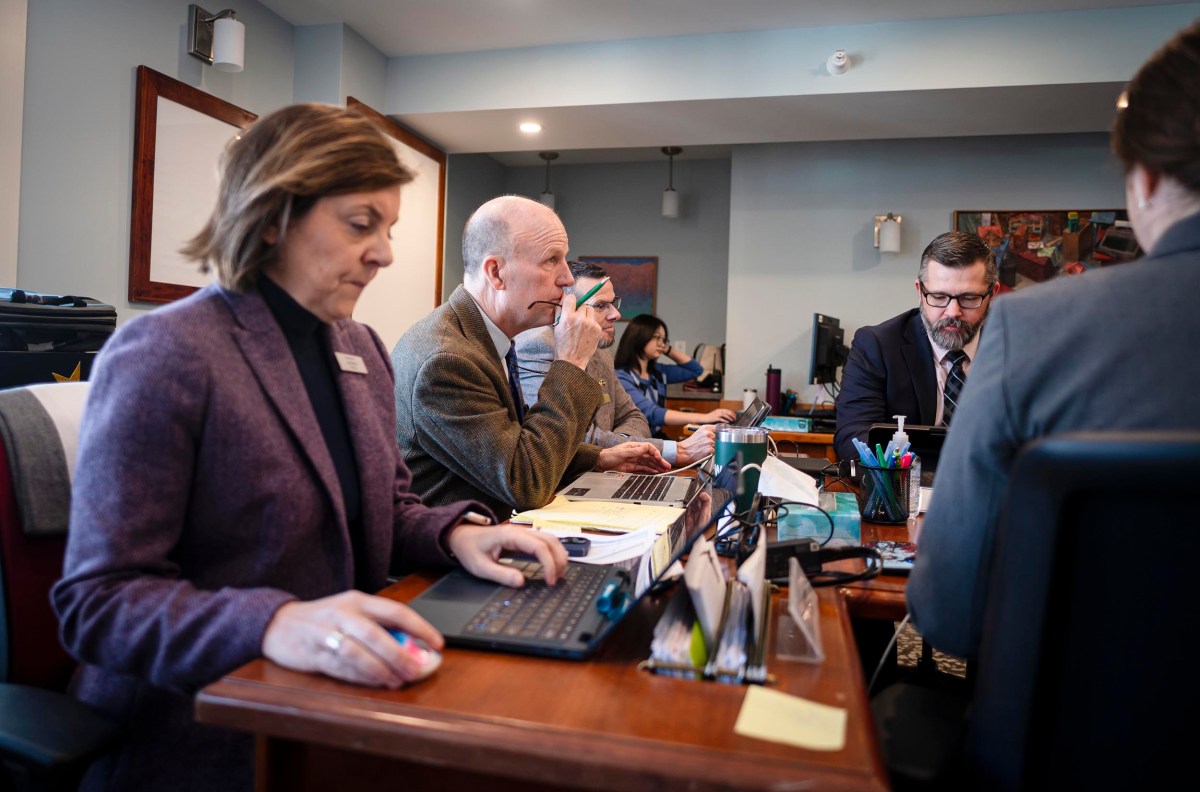
House lawmakers have put on the back burner Conlon’s more ambitious proposal to merge the state’s 119 districts into 27, and are instead working on a proposal that uses cooperative education service agencies, or CESAs, as the key organizing principle for a consolidation proposal.
Those regional entities, already in use in Southeast Vermont, facilitate the sharing of services in special education, professional development, human resources and more — a key recommendation of the task force.
A map presented by Rep. Leanne Harple, D-Glover, on Wednesday would overlay five CESAs atop the state’s existing governance units.
The idea would be to save some money in the short term by allowing districts to regionalize, while giving each CESA the power to facilitate mergers of school districts under their umbrella before the proposed new education funding formula kicks in.
Both chambers of the Legislature are considering proposals that would allow for a period of voluntary mergers (another recommendation of the redistricting task force). A proposal in the Senate Education Committee would create a two-year on-ramp period for school districts to voluntarily merge.
“Maybe it’s not the path that folks sort of envisioned when we started this process, but it’s also not nothing,” House Education Committee member Rep. Jana Brown, D-Richmond, said Wednesday. “I think it’s a significant opportunity. It maybe isn’t what we envisioned when we started with Act 73, but I think it is substantive.”
Lawmakers in the House Education Committee have set a rough goal of trying to get the proposal out by next week’s end.
Many details are still being worked out. But it’s a significant pivot for lawmakers in the House Education Committee.
“I’m trying to find something that can generate enough votes to move out of this committee,” Conlon said Thursday morning. “Up until now, I haven’t been able to do that. That’s why we’re on the track that we’re on.”
For some lawmakers, the pivot back to the task force’s recommendations was a frustrating endeavor.
“We called for there to be a redistricting task force. The task force did their job. They came back with recommendations. We basically ignored those recommendations for the first half of the session. And now we’re back to looking at their recommendations,” Rep. Kate McCann, D-Montpelier, said on Wednesday. “I mean, it just floors me. I just want to drop it all and be like, ‘I can’t stand this.'”
— Corey McDonald
In the know
The U.S. Department of Health and Human Services has launched an investigation into a Vermont law that requires health insurance companies in the state to cover abortions.
Representatives from the Department of Financial Regulation have confirmed that they received a letter from the federal government Wednesday evening informing them that the department has 20 days to respond.
Vermont is one of 13 states President Trump’s administration is investigating.
The Vermont law that Health and Human Services cites in its letter to the state requires that health insurers provide coverage for abortions and abortion-related care. The letter does not single out or address Vermont’s suite of related abortion shield laws or the state’s constitutionally enshrined right to personal reproductive autonomy, known as the “Reproductive Liberty Amendment.”
Read the full story here.
— Olivia Gieger
On the move
This year’s omnibus transportation bill, H.944, is making its way through the House after the chamber’s Transportation Committee approved an initial version of the policy and spending legislation Wednesday afternoon. The bill sets up a framework for the state to start charging electric vehicle owners a fee based on how many miles they drive, designed to supplant the gasoline taxes that those drivers, of course, don’t pay.
The average EV driver would pay $154 per year under the plan as it’s currently drafted, according to estimates from the Legislature’s Joint Fiscal Office. Under existing law, EV drivers pay a higher registration fee than gas guzzlers. That construct would be eliminated once the mileage-based fee takes effect.
On Thursday, the House Ways and Means Committee made a number of changes to how drivers could pay the proposed fee and where specifically the revenue would go. The committee approved its version of H.944 that afternoon, and it will now head to House Appropriations, after which it would be up for debate on the floor.
— Shaun Robinson
Ground rules
There’s been a colorful addition to the walls of the Statehouse cafeteria, and it’s not another piece of children’s artwork.
The sergeant-at-arms’ office put up a poster above the trash cans this week urging lobbyists, advocates and other Statehouse rats to “regulate” their behavior in the dining and social hub. Using bright colors and cartoon graphics, it offers some suggestions “to keep the cafeteria available for everyone.” That includes not using one’s laptop there during the 11:30 a.m. to 1 p.m. lunch rush and, perhaps, leaving the space entirely during that time if one isn’t eating.
The poster has drawn some consternation this week from lobbyists who frequent a group of tables along the hallway that runs between the entrance to the cafeteria at one end and the speaker’s office at the other — whom the poster appears to specifically call out. Those tables offer some of the few public seats in the building with easy access to power outlets.
That area — apparently called the “South Dining Room” — “is increasingly used as a work space by regular visitors, displacing diners and creating concern about Cafeteria access,” the poster reads. “As demand for seating outweighs availability, diners & day visitors are displaced.”
“WHAT CAN YOU DO TO HELP? … SELF-REGULATE,” the poster says.
Agatha Kessler, the sergeant-at-arms, wouldn’t talk on the record about the poster on Thursday.
— Shaun Robinson
Quote of the day
“There are a lot of fees and taxes over there in New Hampshire — despite their best advertising efforts,” Rep. Emilie Kornheiser, D-Brattleboro, said during Thursday morning’s Ways and Means Committee hearing on the transportation bill.
— Shaun Robinson
